Pune’s Mula-Mutha Rivers Choking Under Untreated Wastewater
Reported by Shoaib Tadvi
Pune, 13th August 2025: Pune is facing an alarming sewage and water pollution crisis, with experts warning that without urgent, science-backed, and future-oriented planning, the city’s rivers and groundwater may suffer irreversible damage. Despite repeated projects and promises, most of the city’s sewage still flows untreated into the Mula and Mutha rivers, endangering public health, aquatic life, and the environment.
70% of Sewage Untreated
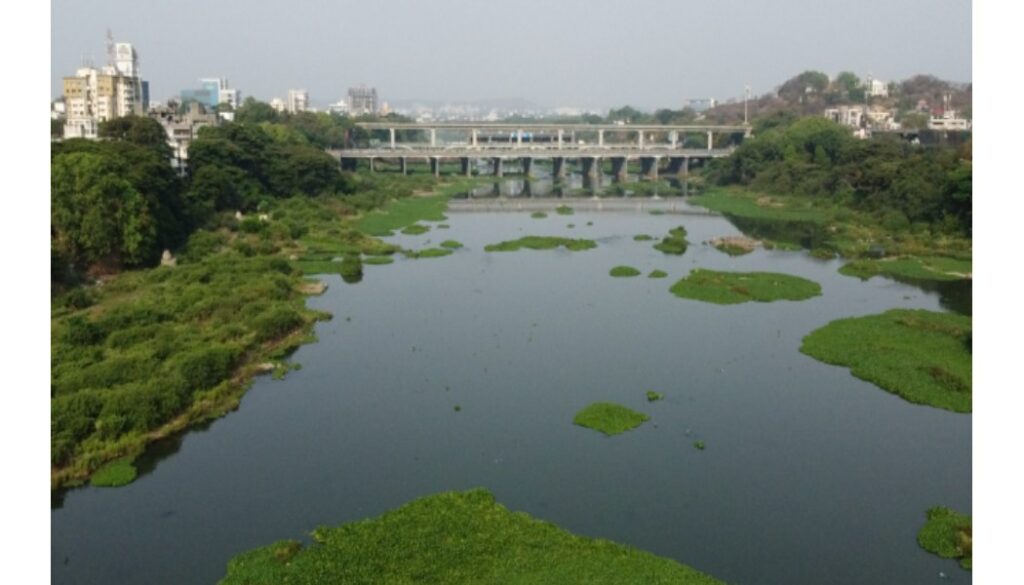
“Pune generates around 1,500 million litres of wastewater every day, but treatment plants handle only 477 MLD. Nearly 70% of sewage flows untreated into the Mula and Mutha rivers. This toxic mix of domestic waste and industrial effluents, visible even in satellite images, is poisoning our water, harming fishing communities, causing diseases, and contaminating groundwater. Unless we urgently reduce wastewater generation and expand treatment capacity, population growth will keep us chasing a problem we can never catch,” said environmental activist Sarang Yadwadkar.
Planning Gaps and Climate Impact
Environmentalists and researchers emphasise that the crisis stems not just from present failures but from the absence of long-term planning. Climate change expert Dr Priyadarshini Karve pointed out that pollution is being aggravated by changing weather patterns and short-sighted governance.
“Only 30% of our sewage is treated, and dams have disrupted the natural flow of water. Planning in cities like PMC is reactive, not future-focused—STPs take a decade to build, and by the time they are ready, the city has already outgrown them. Even with 11 new STPs, only about half the polluted water will be treated. Cutting trees for profit and short-term politics worsens pollution and destabilises our climate. Development plans must be rooted in science, guided by expert opinion, and supported by citizens—factoring in climate patterns, because unusual changes, like rains in May, are already here,” Dr Karve said.
Concrete Over Ecology
Activist Ameet Singh criticised the city’s infrastructure priorities.
“Concrete roads, endless bridges, and poorly managed sewage treatment are choking our city. On paper, we have 477 MLD treatment capacity, but no one tells us how many plants actually function. Plastic and chemical waste cannot be treated like organic waste. Trees are essential for natural filtration, yet we keep cutting them. The Mula-Mutha river no longer truly flows with water—it flows with waste,” Singh said.
PMC’s Response
When contacted, a senior Pune Municipal Corporation (PMC) official said, “Work is in progress—we are constructing more STPs as part of our plan to clean the Mula-Mutha river.”
However, critics note that similar assurances have been made for years without significant improvement in water quality. Untreated sewage, industrial effluents, and unregulated construction along riverbanks continue to degrade the waterways.
Rivers on the Brink
Once vital sources of drinking water and livelihood, the Mula and Mutha rivers have now become carriers of waste and disease. Fish populations are declining, groundwater is contaminated, and riverbanks face encroachment. Plastic waste, particularly single-use items, and chemical residues further complicate treatment.
Environmentalists stress that trees play a crucial role in preventing water pollution by filtering runoff, absorbing pollutants, and maintaining groundwater recharge. Yet, tree cutting for road widening and commercial projects remains unchecked.
Experts Recommend Long-Term Measures:
Expand sewage treatment capacity well beyond current needs to match projected population growth over the next 40–50 years.
Ensure all STPs are functional, regularly monitored, and transparent about performance.
Strictly regulate industrial discharges into rivers.
Protect and increase urban green cover as a natural filtration system.
Integrate climate science into all urban planning decisions.
The challenge, as Singh, Karve, and Yadwadkar emphasise, is not just technical—it is political, social, and ecological. Without strong citizen engagement, transparent governance, and commitment to long-term planning, Pune’s water crisis will deepen, affecting generations to come.
The rivers, once central to Pune’s identity and survival, risk becoming lifeless drains. The choice before the city is clear: continue reacting to disasters or commit to a science-led vision that safeguards water resources for the next half-century.