Pune Startup Astrophel Aerospace Tests Indigenous Cryogenic Pump at ISRO, Aims for Turbopump Integration by 2026
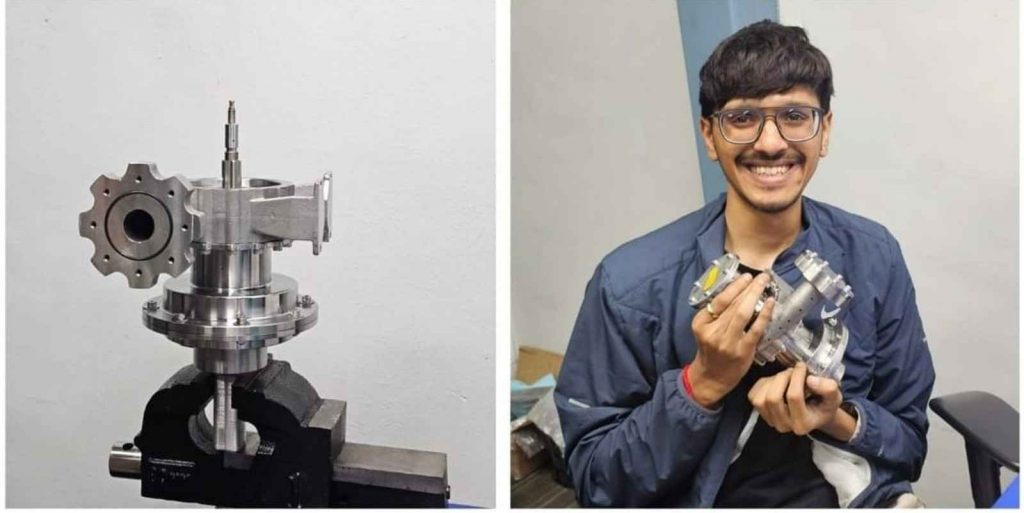
Pune, 11th September 2025: Pune-based spacetech startup Astrophel Aerospace has begun testing its homegrown cryogenic pump at facilities of the Indian Space Research Organisation (ISRO). The company plans to transition the prototype into a turbopump by late 2026, paving the way for integration with its Astra C1 rocket engine.
With this achievement, Astrophel joins the select group of private Indian companies attempting to indigenously develop high-performance cryogenic propulsion systems—a critical requirement for reusable and cost-efficient space launch vehicles.
“The cryo-pump is the foundation of our upcoming turbopump system,” explained Suyash Bafna, Co-Founder of Astrophel Aerospace. “If validated successfully, it will demonstrate not just our capability, but also India’s strength in designing advanced propulsion hardware that can compete globally. The certification from ISRO will mark a defining moment for Indian spacetech startups.”
Building the Heart of a Rocket
The pump, roughly the size of a one-litre bottle, houses over 50 precisely engineered components. It currently spins at 25,000 revolutions per minute to deliver cryogenic fuel at controlled pressure. Despite its compact size, it generates 100–150 horsepower—comparable to a family car engine. Once scaled up to a turbopump, it is expected to deliver 500–600 horsepower, powering both first and second-stage rocket engines.
A single small-lift launch vehicle (SSLV) typically requires eight or more turbopumps during liftoff, underlining the importance of Astrophel’s innovation. Unlike electric-pump models used by some startups, the turbopump draws its power directly from the engine, eliminating dependency on batteries and improving reusability.
Beyond Space: Eyeing Global Collaborations
Astrophel Aerospace is also finalising a memorandum of understanding (MoU) with a US-based partner and exploring collaborations for global exports of cryogenic subsystems. These technologies, beyond space launch vehicles, also have applications in industries such as oil and gas, which deal with cryogenic fuels.
“This is the result of years of frugal engineering,” said Immanuel Louis, Co-Founder of Astrophel Aerospace. “Our lean manufacturing approach—borrowed from the automotive sector—allows rapid assembly, scalability, and cost efficiency. This milestone brings us closer to building India’s first privately developed gas generator cycle.”
India’s Space Economy Push
Astrophel’s progress comes as India works to expand its space economy from $8.4 billion in 2022 to $44 billion by 2033, aiming to secure 8% of the global market share. With more than 250 startups now active in the sector, propulsion breakthroughs like Astrophel’s cryo-pump are seen as vital to realising this ambition.
“India has always proven it can achieve world-class technology at a fraction of the global cost,” Bafna added. “Our cryo-pump shows that private players can now contribute meaningfully to that mission.”