School Fees, Rent, EMIs: Why India’s Middle Class Feels Poorer Than Ever in 2026
By Samiccha Malik
New Delhi, 9th June 2026: The Indian Middle Class Cannot Afford 2026. The Numbers Make It Impossible to Ignore.
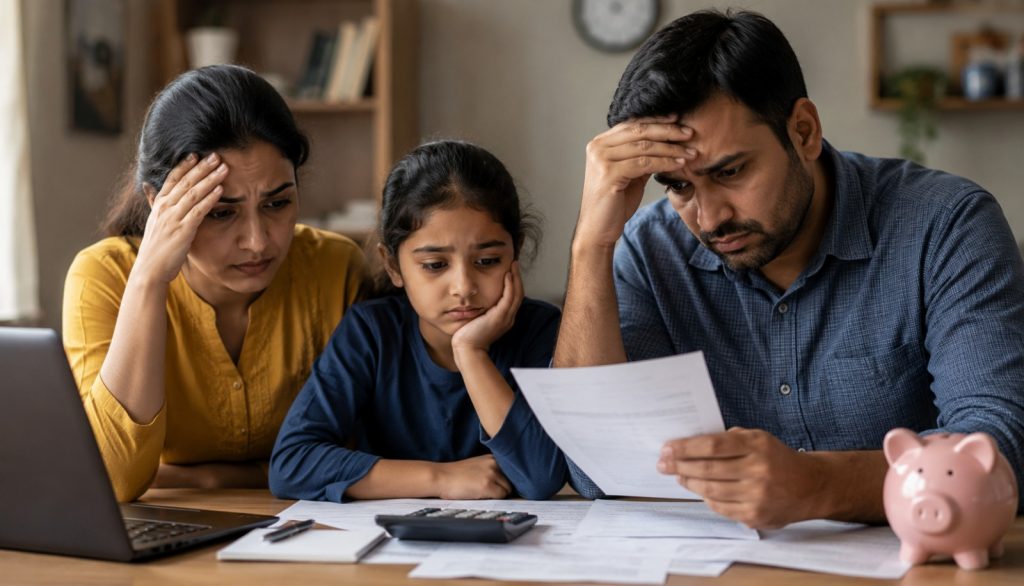
There is a particular kind of exhaustion that comes not from poverty, but from almost being okay. The Indian middle class knows it well. The salary arrives, the EMIs leave, the rent is paid, the school fee is due, and somewhere in between, the month ends before the money does. This is not a feeling. It is arithmetic.
The numbers are unambiguous. India’s education cost index nearly doubled over the past decade, rising close to 89 per cent between 2013 and 2025 not in sudden surges, but month after month, year after year, without relief. When all costs are counted tuition, transport, uniforms, coaching classes, digital tools, and exam fees parents spend anywhere between 20 to 30 per cent of their annual household income on education alone. For many middle-class families, schooling has quietly become the single largest line item in the household budget, surpassing even rent or healthcare.
Meanwhile, the roof over their heads is getting more expensive too. Residential rents in major Indian cities surged between 12 and 24 per cent annually between 2021 and 2024, before settling to a still-steep 7 to 9 per cent in 2025.People move to cities chasing better incomes, only to find that housing costs consume whatever wage gains they made on the way there.
The savings cushion that once protected this class has all but dissolved. India’s household savings rate fell from 23.6 per cent of GDP in 2021 to 18.4 per cent in 2023, according to the RBI Annual Report 2024. The middle class is not saving less because it is spending recklessly. It is saving less because the fixed, unavoidable costs of a middle-class life – school fees, rent, EMIs, healthcare now consume what used to be the savings margin.
Outstanding education loans in India surged by nearly 96 per cent between March 2019 and March 2025. Many households are now prioritising education spending over home purchases, retirement savings, and long-term wealth creation not out of choice, but out of necessity.
What makes this particularly sharp is the arithmetic of wages versus costs. Median salary growth runs at roughly 9 per cent annually. Education inflation runs at 6 to 12 per cent. Food inflation crossed 10 per cent in late 2024. Urban rents have climbed 35 per cent since 2022. The numbers do not reconcile. No raise is keeping pace with the combined rise of these fixed obligations.
And yet, this cohort sits in a peculiar no man’s land. It earns too much to qualify for government welfare programmes. It earns too little to absorb a medical emergency, a job loss, or a fee hike without taking on debt. Even households that begin financial planning early are finding it increasingly difficult to manage rapidly compounding education and housing expenses over time. The safety net does not exist for them.
By 2030, India is projected to have up to 700 million people in its middle class. That is a remarkable number. But the question it raises is not one of size it is one of sustainability. A middle class that cannot save, cannot absorb shocks, and cannot plan beyond the next school fee cycle is not a thriving one. It is a stretched one.
The aspiration that defined the Indian growth story for three decades get educated, find stable work, own a home, send your children to a good school has not disappeared. It has simply been repriced beyond the reach of the people it was originally promised to.
Nobody in power seems ready to say that out loud. The numbers, however, already have.
(Samiccha Malik is an intern news reporter with Punekar News)