Pune Water Crisis Deepens: Tanker Prices Touch Rs 3,000, Housing Societies Feel the Heat
Reported by Shoaib Tadvi
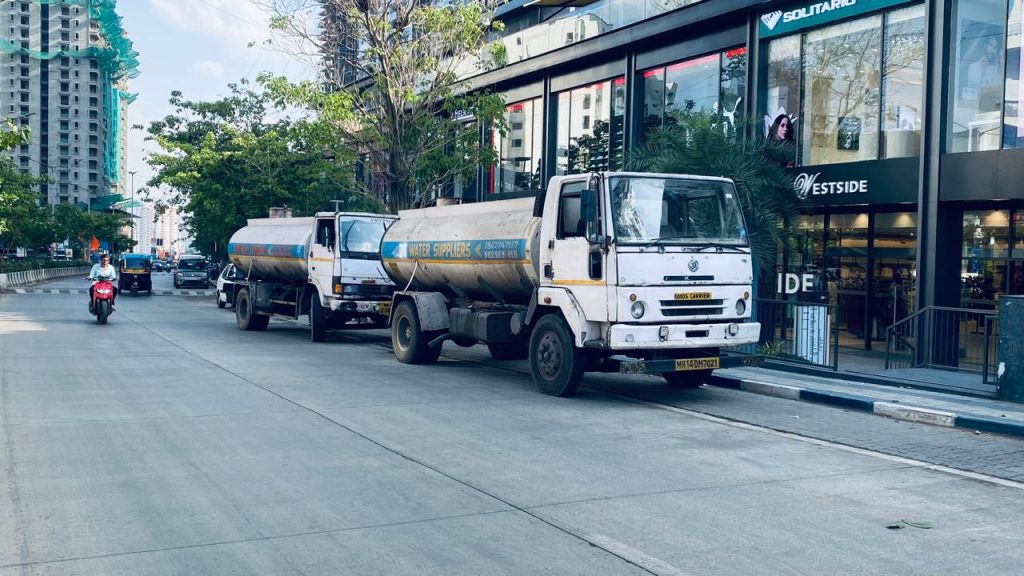
Pune/Pimpri Chinchwad, 23rd June 2026: Pune’s worsening water crisis has placed thousands of residents under increasing financial strain, with housing societies across the city reporting a sharp rise in private water tanker prices amid shrinking groundwater reserves and alternate-day water supply by the Pune Municipal Corporation (PMC). As borewells and wells continue to dry up due to the delayed monsoon, societies are being forced to rely heavily on private water tankers, significantly increasing their monthly maintenance expenses.
Residents from Undri, Mohammedwadi, Handewadi, NIBM Annexe, Keshav Nagar, Baner, Balewadi, Bavdhan, Bibwewadi, Wakad, Dhayari, Vadgaon Khurd, Lohegaon and several parts of Pimpri-Chinchwad say the crisis has become a daily challenge, with tanker rates increasing by nearly 30 to 60 per cent in recent weeks. A standard 10,000-litre water tanker that earlier cost between ₹800 and ₹1,000 is now priced anywhere between ₹1,200 and ₹2,500, depending on the locality and the type of water required. Drinking water tankers have witnessed the steepest increase, with prices touching ₹3,000 in some areas.
The increase in private water tanker prices has varied across different parts of the city. In Handewadi, regular water tankers now cost around ₹850, while drinking water tankers are priced between ₹1,400 and ₹1,800. In Keshav Nagar, regular tanker charges have increased from around ₹650 to ₹900, while drinking water tankers cost between ₹2,000 and ₹2,500. In Mohammedwadi, a regular tanker costs around ₹900 and drinking water tankers are approximately ₹1,700. Baner and Balewadi have witnessed significant increases, with regular tanker rates now ranging from ₹1,200 to ₹2,000 or more depending on availability, while drinking water tankers are being supplied for ₹1,700 to ₹3,000. In Wakad, regular tanker charges have climbed to ₹1,300–1,500, while drinking water tankers cost up to ₹3,000. Across Pimpri-Chinchwad, regular water tanker rates currently range between ₹1,000 and ₹1,500, while drinking water tankers are priced between ₹2,500 and ₹3,000.
While PMC supplies a 10,000-litre municipal water tanker at an official rate of around ₹666, residents say the limited availability of civic tankers has forced them to depend almost entirely on private suppliers.
Pranay Vilas Patil, Chairman of Fortune Siddhipriya Society in Handewadi, said the rising cost of water has become one of the society’s biggest expenses.
“Earlier, usable water tankers cost around ₹600 to ₹850, while drinking water tankers were available between ₹1,400 and ₹1,800. Today, a major portion of our society’s maintenance is spent only on purchasing water. Despite repeatedly following up with PMC and receiving assurances, we have not received a single free water tanker.”
In Keshav Nagar, Ranjeet Lonkar, Chairman of Venkatesh Graffiti Society, said almost every housing society in the locality is facing similar challenges.
“A usable water tanker that earlier cost around ₹650 now costs nearly ₹900, while drinking water tankers have reached ₹2,000 to ₹2,500. This is not just our society’s problem. Almost every nearby society is facing the same issue. We keep changing tanker suppliers to maintain some control over prices, but many societies have no option except paying the increased rates.”
Jaymala Dhankikar, a resident of Ganga Kingston in Mohammedwadi, said the increase in tanker prices has directly affected housing society finances.
“A normal water tanker that earlier cost around ₹900 and a drinking water tanker around ₹1,700 have become a major financial burden. Housing societies are struggling to manage their maintenance budgets while ensuring adequate water supply for residents.”
The impact of the crisis is equally severe in Baner and Balewadi, where several societies have become completely dependent on private tankers after borewells dried up.
Meghna Bhandari, a resident of Regulus Society, Balewadi, said tanker prices have increased sharply over the past few weeks.
“Earlier, a regular water tanker cost around ₹800. Now the rates have increased to nearly ₹1,200, while in several cases residents are paying between ₹1,800 and ₹2,000 depending on availability. The increasing cost of water is putting additional financial pressure on housing societies.”
Ameya Jagtap of Baner-Balewadi Nagrik Manch and a resident of Perfect 10 Society, Balewadi, said several societies are now forced to enter long-term agreements with tanker suppliers.
“Our society is currently paying between ₹1,200 and ₹1,500 per tanker, depending on the requirement. However, many societies across Baner and Balewadi are paying anywhere between ₹1,800 and ₹2,500. Tanker operators are asking societies to sign contracts for six months to one year before assuring regular supply. Since many borewells have gone dry, societies have no alternative but to depend on private tankers.”
Adv. S. O. Mashalkar, Chairman of Bliss Avenue Society, Balewadi, said there is little uniformity in pricing.
“Drinking water tankers are now costing up to ₹3,000, while many societies are paying nearly ₹2,000 even for regular-use water. The contractor engaged by a society generally offers a comparatively reasonable rate, but if another tanker operator is contacted, they often quote any price they choose. There is an urgent need for regulation of private tanker charges.”
In Lohgaon, Sachin Jadhav, a housing society member, said residents are also facing delays in water delivery.
“The problem is not just the price but also the availability of tankers. There are days when bookings get delayed because suppliers themselves are struggling to source water.”
Priya Kulkarni, a resident of Bibwewadi, said the increased expenditure has affected every resident.
“The society committee has no option but to purchase expensive tankers to maintain regular supply. Eventually, the additional cost is reflected in residents’ monthly maintenance.”
In Wakad, Sameer Gurumukhi, Chairman of Wisteriaa Society, said tanker prices have more than doubled within a few months.
“Until May, we were paying around ₹600 per tanker. The rate later increased to ₹950, and now in many parts of Wakad, tanker prices have reached ₹1,300 to ₹1,500. Even societies receiving PMC water are forced to purchase separate drinking water tankers, with prices going up to ₹3,000.”
The crisis has also intensified across Pimpri-Chinchwad.
Sachin Londhe, Chairman of the Pimpri-Chinchwad Co-operative Housing Societies’ Federation Ltd., said:
“Regular water tanker rates across many parts of Pimpri-Chinchwad have increased to between ₹1,000 and ₹1,500, while drinking water tankers are now costing housing societies anywhere between ₹2,500 and ₹3,000. This has become a major financial burden for residents. I have already raised this issue with the PCMC Commissioner through a message, but I have not received any response so far. In the meantime, housing societies are taking their own measures to manage the shortage by supplying water only during fixed hours, shutting down swimming pools and implementing other water conservation measures. It appears that the administration is waiting for the monsoon to bring relief, but residents need immediate intervention. There is an urgent need to regulate private tanker rates, ensure adequate municipal water supply and provide timely assistance to housing societies facing severe water shortages,” said Sachin Londhe, Chairman of the Pimpri-Chinchwad Co-operative Housing Societies’ Federation Ltd.
According to tanker operators, falling groundwater levels and drying borewells have forced them to travel much longer distances to source water. They also cite increased diesel prices, higher operational costs, mandatory CCTV installation, deployment of additional manpower and long waiting hours at water-filling points as major reasons behind the sharp increase in tanker charges.
In Dhayari and Vadgaon Khurd, the situation has become particularly severe. Private wells that previously supplied enough water for 10 to 12 tanker trips a day are now able to fill only around five tankers, resulting in long queues and delays in water delivery. Residents waiting for PMC’s free tanker service have also reported waiting periods of two to three days due to overwhelming demand.
PMC has already implemented alternate-day water supply across several parts of the city to conserve available water and is increasing the number of tanker-filling points in localities such as Undri and Bavdhan. The civic administration is also preparing a Standard Operating Procedure (SOP) to regulate private tanker operations and prevent arbitrary pricing during the ongoing crisis.
With reservoir levels continuing to remain low and widespread monsoon rainfall yet to arrive, residents fear dependence on private water tankers will continue to increase. Housing societies have urged PMC to ensure timely municipal tanker supply, strengthen groundwater recharge measures and introduce effective regulation of private tanker rates until the city’s water situation improves.