IISER Pune Colloquium: V. Ramgopal Rao Calls for Stronger Industry-Academia Collaboration
Pune, 20th August 2026: The Maharashtra Academy of Sciences and IISER Pune jointly hosted a colloquium by Prof. V. Ramgopal Rao, Group Vice-Chancellor of BITS Pilani, on August 20, 2026, at the C.V. Raman Auditorium on the IISER Pune campus. The title of his talk was “Unleashing India’s Scientific Potential: Breaking Barriers and Igniting Innovation.”
Prof. Pinaki Talukdar, a faculty member in the Department of Chemistry at IISER Pune, welcomed the audience and said the lecture was being held as part of IISER Pune’s 20th anniversary celebrations. The Maharashtra Academy of Sciences is also celebrating its golden jubilee this year.
Dr. Dinesh P. Amalnerkar, President of the Maharashtra Academy of Sciences, said the academy’s motto is “Science for the Benefit of the People.” He added that the academy is organising student-centric events as part of its golden jubilee celebrations.
IISER Pune Director Prof. Sunil Bhagwat introduced Prof. Rao, who is a former faculty member of IIT Bombay, former Director of IIT Delhi and a renowned researcher in nanoelectronics.
During his talk, Prof. Rao examined India’s position in the global research and innovation ecosystem and identified industry-academia collaboration as a critical element for the country’s future progress.
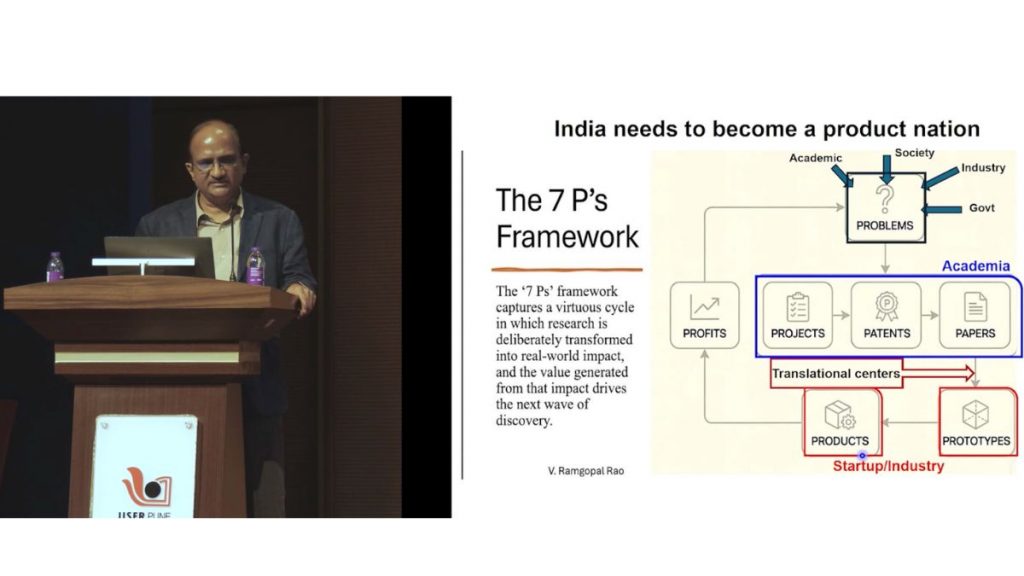
He said India has talent, capital and markets, but needs to develop effective models to translate scientific research into wealth. He spoke about the 7P framework, under which a problem leads to papers, patents and projects. Taking the cycle further to the next set of Ps—prototypes, products and profits—can help strengthen the research ecosystem and generate solutions to new problems, he said.
Prof. Rao also spoke about his early research career at IIT Bombay and later at IIT Delhi, where he collaborated extensively with scientists in chemistry. His teams worked with molecules developed by chemists to create applications involving sensors.
Along with his team and collaborators, Prof. Rao worked on applications including the diagnosis of cardiac conditions, explosive detection and soil nutrient sensing. He said his research continues to focus on applications in areas such as healthcare.
Identifying domestic demand and connecting researchers with various stakeholders are key to developing impactful products and taking them to market, Prof. Rao said. He suggested that translational centres could facilitate this process by helping scientists develop prototypes, obtain certifications and establish manufacturing.
While some laboratories in India are already working along these lines, establishing more such centres could help catalyse similar efforts across laboratories and institutions and accelerate the journey from research to real-world applications, he said.
Earlier in the day, Prof. Rao visited laboratories at IISER Pune and interacted with members of the institute. The IISER Pune community thanked Prof. Rao for his visit and for sharing insights from his research and innovation career.