MPSC Protest: Pune Police Change Traffic Routes Near SM Joshi Bridge, Appeal for Cooperation to Protect Emergency Access
Reported by Mubarak Ansari
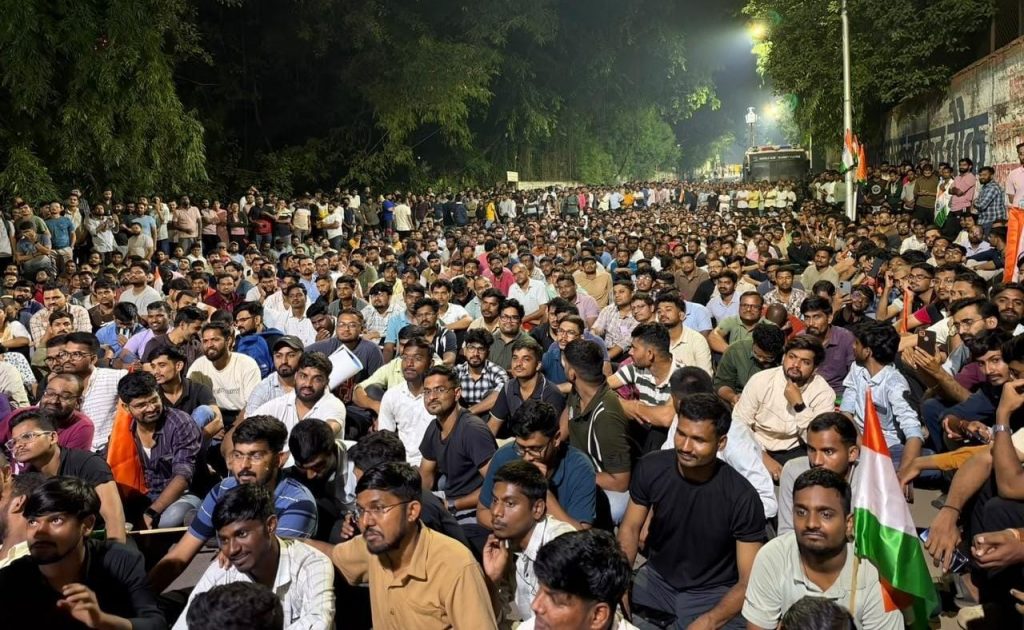
Sadashiv Peth, 6th October 2026: Pune police have changed traffic routes around SM Joshi Bridge and Patrakar Bhavan amid the ongoing MPSC student agitation and appealed to protesters, motorists and residents to cooperate in keeping roads accessible, particularly for ambulances, fire engines and other essential services.
In a statement, police said congestion around the protest site was also affecting adjoining roads. Motorists have been advised to avoid the SM Joshi Bridge–Patrakar Bhavan area wherever possible, use available alternative routes, follow traffic police instructions and refrain from stopping vehicles unnecessarily on the road.
Police said the administration was taking necessary action regarding the students’ demands, while measures were being implemented to maintain law and order and regulate traffic during the agitation. The statement did not specify the action being taken on individual demands.
“While respecting the students’ right to protest, protesters, motorists and citizens are urged to cooperate with the administration to minimise inconvenience to the public and ensure that essential services operate smoothly,” the police statement said.
Emergency Services Given Priority
Police warned that the effects of congestion could extend beyond inconvenience to ordinary commuters and potentially delay ambulances, patients travelling to hospitals, fire engines and other essential services.
Keeping traffic moving at the protest site and on adjoining main roads, without obstructing emergency services, was therefore being given special priority, the statement said.
The warning concerns the potential impact of congestion. The statement does not identify a specific incident in which an ambulance, fire engine or patient was delayed.
A separate four-day traffic assessment provided by Pune police indicates that the disruption has been concentrated on the bridge approach and nearby junctions. The wider Poona Hospital neighbourhood and Karve Road generally recorded conditions at or better than their usual baseline.
These findings do not rule out difficulties on individual roads or the risk of emergency vehicles encountering queues near the protest site.
Police Cite Six-Month Traffic Comparison
According to the police statement, available data from Google’s traffic monitoring system is used to observe traffic daily and hourly across approximately 1,000 km of roads in Pune.
Police said a comparative review of available data from the previous six months showed an increase in congestion and congestion alerts around SM Joshi Bridge after the agitation began. The statement does not quantify that increase.
The accompanying control-room brief provides a more detailed assessment of conditions between October 3 and October 6 across 954 monitored road segments, comparing readings with each road’s usual conditions for the same hour and weekday.
It identifies the approach between Garware College and Khandoji Baba junction, the adjoining stretch towards Hotel Rupali, and roads around Alka Talkies and Ganjve Chowk as the main congestion hotspots.
Bridge Approach Records Speed of 5.3 km/h
The lowest recorded speed on the monitored bridge approach during the four-day assessment occurred at 10 am on Tuesday, October 6, when traffic moved at 5.3 km/h, against a usual 11.4 km/h. The brief reports its delay measure as 123% above normal.
Conditions remained difficult at 11 am, when the recorded speed was 6.3 km/h and the reported delay measure was 80% above normal.
The assessment identifies two recurring periods of disruption: late morning, approximately 10 am to 1 pm, and evening, approximately 5 pm to 9 pm. It associates the morning slowdown with crowd gatherings and the evening deterioration with the overlap between protest activity and regular rush-hour traffic.
Saturday, October 3, produced the most severe evening conditions on the approach. At 7 pm, vehicles moved at 7.8 km/h against a usual 13.4 km/h. On the adjoining Khandoji Baba–Hotel Rupali stretch, the speed fell to 6.2 km/h.
The brief cautions that the approach is routinely congested even under normal conditions. A return to its usual baseline therefore does not necessarily mean free-flowing traffic.
Saturday Congestion Lasted Nearly Six Hours
One of the longest recorded congestion episodes occurred on the Khandoji Baba Chowk–Hotel Rupali stretch on Saturday. It began at 5.30 pm and was reported clear at 11.29 pm, lasting 359 minutes.
On Tuesday morning, a congestion episode on the bridge approach lasted from 10.02 am to 12.20 pm. By approximately 2 pm, monitored conditions on the approach had returned to their usual level.
The assessment recommends allowing for prolonged queue-clearance periods after crowds disperse rather than assuming that traffic will immediately return to normal.
Navi Peth Experiences Repeated Slowdowns
Navi Peth’s worst hour during the monitoring period was 7 pm on Saturday, when 80% of its monitored roads were congested. The area recorded a speed of 9.9 km/h and a reported delay measure 70% above normal.
On Monday between 10 am and noon, Navi Peth’s delay measure was 22–28% above normal, with 50–70% of monitored roads congested. At 10 am on Tuesday, the delay measure rose to 46% above normal, with 60% of monitored roads congested.
The daytime comparisons show varying levels of disruption across the three assessed zones. On Saturday, the bridge area’s average delay measure was 12% above normal and Navi Peth’s was 11% above normal, while the Poona Hospital area recorded a reading 3% below normal. There were 46 slowdown alerts across the three zones.
On Sunday, the bridge area and Navi Peth recorded delay measures just 1% and 2% above normal, respectively. The Poona Hospital area’s reading was 7% below normal, and the number of slowdown alerts fell to 15.
On Monday, the bridge area’s delay measure was 4% above normal and Navi Peth’s was 8% above normal. The Poona Hospital area recorded a reading 9% below normal, with 29 slowdown alerts across the three zones.
On Tuesday, the bridge area and Navi Peth recorded delay measures 9% and 11% above normal, respectively. The Poona Hospital area remained comparatively unaffected, at 2% below normal. The three zones registered 33 slowdown alerts up to the main assessment’s 4 pm cutoff.
These daytime comparisons cover 9 am to 9 pm on the completed days, while Tuesday’s figures extend only to 4 pm.
Hospital Routes Generally Remain Accessible
The Poona Hospital area in Sadashiv Peth generally recorded conditions at or better than normal, despite congestion around nearby junctions.
Tilak Road, identified in the brief as a main access route to the hospital, recorded a delay measure 7% below normal. The assessment recommends keeping Tilak Road and the Sadashiv Peth side open for hospital-bound traffic.
However, individual adjoining roads experienced prolonged slowdowns on Tuesday. The Ganjve Chowk–Tilak Chowk stretch recorded congestion from 9.41 am to 11.28 am, lasting 107 minutes. The Senadutt Police Chowki stretch experienced an 85-minute episode between 10 am and 11.25 am, while the slowdown on Anant Kanhere Path lasted 124 minutes, from 10.04 am to 12.08 pm.
The Maharashtriya Mandal–Alka Talkies link recorded speeds of 5.5–6.9 km/h around noon.
Alternative Routes and Monitoring Limitations
Karve Road recorded better-than-normal conditions on all four days, with an average delay reading 8.5% below normal. The control-room brief recommends it as an alternative for bridge-bound traffic.
The new police statement confirms that traffic routes have been changed around SM Joshi Bridge and Patrakar Bhavan, but does not provide a detailed diversion plan or specify which alternative routes have formally been designated. Motorists have been asked to follow traffic police directions.
The assessment also recommends concentrating traffic-management personnel on the bridge approach and the Alka Talkies junction between 9.30 am and 1 pm, and again between 5 pm and 9 pm.
A monitoring gap remains for Lal Bahadur Shastri Road, which is not listed by that name in the data feed. The nearby Ganjve Chowk–Senadutt Police Chowki stretch recorded an average delay measure 8% above normal and recurring morning alerts. The absence of a specifically named Shastri Road segment should not be treated as confirmation that the road was unaffected.
The brief contains no vehicle counts and no segment explicitly named “SM Joshi Bridge”; it uses the monitored approach as a proxy. Most slowdown alerts are inferred from vehicle speeds, while some include reports of lane closures, a crash or construction. Individual episodes therefore cannot automatically be attributed solely to the protest.
Although police reported an increase in congestion after the agitation began, the four-day brief shows that conditions on October 3 were less severe than on September 26. The bridge area’s average delay measure declined from 53% above normal to 12% above normal, while slowdown alerts across the three assessed zones fell from 113 to 46.
Police have nevertheless urged continued cooperation to reduce inconvenience and prevent obstruction to essential services while respecting the students’ right to protest.