From Navarasa to Emotion AI: LC Singh’s Vision for Understanding Human Emotions
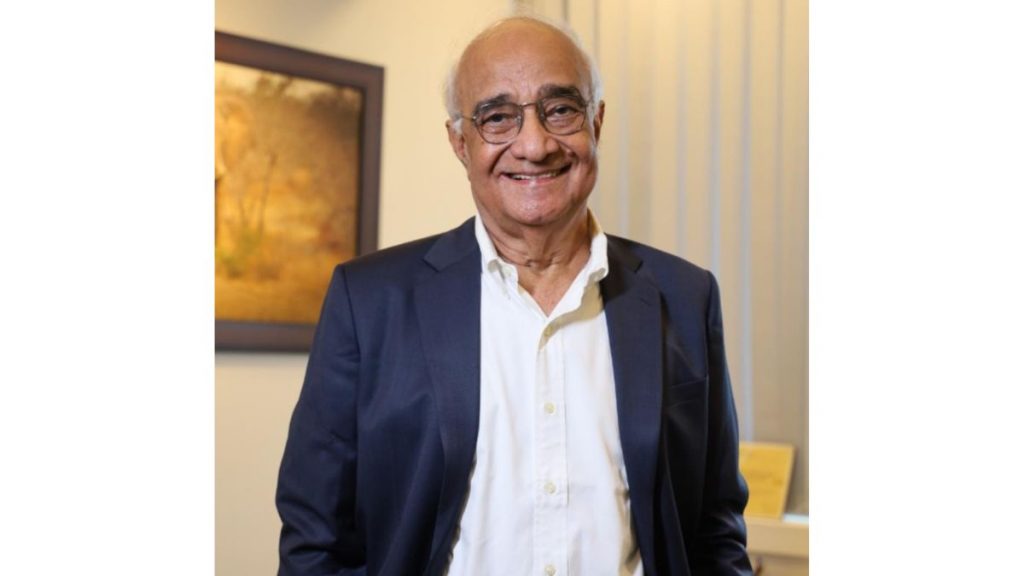
Pune, 30th October 2026: After decades in enterprise technology, Nihilent’s founder and executive chairman is turning his attention towards emotional awareness—bringing together artificial intelligence, Indian aesthetic thought and a lifelong interest in the forces that shape human experience.
Technology has given people increasingly sophisticated ways to measure the world around them. LC Singh wants to turn that lens inward.
“Technology has measured almost everything around us, but very little within us. nSEPIA is a step toward changing that,” he wrote while introducing the application’s private beta. The observation captures the ambition behind his latest endeavour: using artificial intelligence to help people recognise and reflect on their emotional states.
For the founder and executive chairman of Nihilent Limited, this work brings technology into closer conversation with a subject that also occupies his writing: how people understand themselves. Emoscape, the company’s emotion-analysis platform, and nSEPIA, its consumer-facing emotional-wellness application, approach that question through AI. His books, Things We Don’t See and The Collapse of Illusions, explore it through personal history and philosophical inquiry.
Read together, these projects suggest a connection between the technology entrepreneur and the reflective author. Both are interested in what lies beneath outward appearances. The challenge is that observing a signal, interpreting an emotion and understanding a person are not necessarily the same thing.
From Bhatauli to Global Technology Leadership
Singh’s account of his intellectual journey begins in Bhatauli, a village in the Gangetic plains. In a published reflection on the origins of The Collapse of Illusions, he recalled looking at the stars as a child and encountering questions about existence that remained with him through changing countries, professional roles, success and loss.
His formal education took him to the Institute of Technology, Banaras Hindu University, where he graduated in 1970. Company records also document his chemical-engineering background and completion of Harvard Business School’s Advanced Management Programme.
Computing became the foundation of his professional career. He spent 17 years at Tata Consultancy Services, leaving in 1998 as a senior vice-president. Contemporary reporting credited him with helping develop the company’s software-products business and expand its international operations.
He subsequently became president and chief executive of International Computers India Limited, which was renamed Zensar Technologies in 1999. He headed its global operations before founding Nihilent in 2000.
In a 2019 interview, Singh described his TCS years as an opportunity to exercise an entrepreneurial approach across operations, marketing, corporate communications and new markets. His reason for establishing Nihilent, he explained, was to create a distinctive contribution to the technology industry through design thinking.
His interests were never confined to enterprise systems. He also scripted and produced Banaras: A Mystic Love Story, carrying his engagement with questions of human experience into cinema. That creative work provides another context for his subsequent movement into writing and emotional-awareness technology.
Emoscape: An Indian Framework Meets AI
Nihilent announced Emoscape on 14 April 2025 as an AI engine inspired by Navarasa, the nine-rasa tradition associated with Indian performance theory and the Natyashastra. The company positioned it for professional settings, including healthcare, education, sports, marketing and workplace wellbeing.
“At Nihilent, we have always believed that technology should serve a higher human purpose,” Singh said in the announcement.
The company’s proposition is to translate elements of that classical framework into a contemporary system for analysing observable movement. According to Emoscape’s technical description, the platform examines subtle patterns across the face, head and upper body, including facial-landmark dynamics, eye-region cues and head movement. A webcam-based interaction produces what the company describes as an emotional-state assessment.
The distinction matters: the camera records movement; the system interprets those observations through its models. Nihilent’s ambition is to make those interpretations useful in settings where emotional context may inform a conversation, a professional assessment or an individual’s reflection.
In May 2026, Nihilent announced that its emotion-detection framework had secured a patent from the South African Patent Office. The company described the framework as combining Navarasa principles, clinical insights and proprietary AI and machine-learning models.
“Emotion sits deeper than expression, it shapes how we perceive, decide, and act,” Singh said in the patent announcement.
For him, the underlying proposition is broader than identifying a visible expression. It is an attempt to treat emotion as information relevant to human decisions and interactions. Whether a particular system can do that reliably, however, remains a question for evidence rather than aspiration.
nSEPIA: Bringing Emotional Awareness into Everyday Life
While Emoscape is positioned for professional and institutional use, nSEPIA takes the technology into a personal application. Nihilent announced its global launch on 27 August 2026, describing a cycle in which users assess their emotional state, engage with a recommended activity and then reflect on any change.
The application’s website describes a 30-second scan that translates its assessment into a visual representation called an ORB, accompanied by emotional insights and an “Emometer” intended to indicate emotional balance. These are the company’s descriptions of the product’s capabilities, rather than independent findings about its accuracy.
Recommendations span music, meditation, breathwork and yoga. The musical experiences include Indian classical ragas, Western symphonic music and specially created compositions. Users can reassess after an activity, creating a continuing sequence of assessment, response and reflection. Nihilent says the emotional assessment is processed on the user’s device to protect privacy.
“Technology, in this sense, is not replacing human understanding; it is helping us become more aware of ourselves,” Singh said at the launch.
That statement offers a useful way to judge the initiative. Its most constructive role would be to support attention and reflection—not to insist that an algorithm understands a person better than they understand themselves.
The proposed experience also differs from simply offering a catalogue of wellness content. Its starting point is the system’s assessment of the user at that moment, which then guides a suggested response. The intended value lies in that connection between an immediate check-in and a practical next step.
Moving Beyond the Demonstration
Nihilent’s emotion-AI work has also moved into partnerships outside the consumer application.
An August 2026 announcement described fitness brand Urbounce’s integration of Emoscape into its member journey, with a rollout across several Pune centres. The stated aim was to consider emotional state alongside physical-fitness measures, supported by professional interpretation and appropriate guidance.
Such initiatives show where the company sees potential applications. They do not, by themselves, establish that emotional assessment improves fitness, recovery or wellbeing.
In a September 2026 interview, Emoscape business director Sandeep Pendurkar outlined plans for larger clinical studies, more diverse patient groups and longitudinal research. Those priorities are important because the usefulness of an assessment depends not only on producing an output, but also on demonstrating what that output means across people and over time.
For Singh’s vision, adoption is therefore only one part of the story. Another is whether the technology can earn confidence through transparent, reproducible evidence.
The Scientific Question Beneath the Promise
Emotion AI operates in a field where the relationship between outward movement and inward experience remains contested.
A major 2019 review led by psychologist Lisa Feldman Barrett found that facial movements vary substantially across situations, individuals and cultures. Although certain movements occur with particular emotions more often than chance would predict, the review concluded that they are not sufficiently reliable and specific across contexts to serve as definitive indicators of an emotional state.
Other researchers have presented evidence supporting broader recognition of emotional expression, while also describing more nuanced processes involving facial, bodily and contextual information. The debate concerns how emotions are expressed, perceived and inferred—not simply whether cameras can detect movement.
Neither position, in itself, validates or invalidates Emoscape. Product-specific claims require product-specific evidence.
Nihilent’s May patent announcement referred to clinical and academic work, including a validation manuscript that was then under review. That status needs to be distinguished from a completed publication, just as the company’s “medical-grade” description should not be treated, without supporting documentation, as proof of diagnostic performance.
The appropriate editorial distinction is between what a platform observes, what its model infers and what research establishes. A responsible use of emotion AI should preserve those differences rather than collapse them.
Things We Don’t See: Looking Behind Achievement
The inward turn in Singh’s technology work has a personal counterpart in Things We Don’t See.
Launched in Mumbai on 25 March 2026, the memoir examines a life shaped not only by professional achievement, but also by uncertainty, relationships, setbacks and the search for meaning. Its organising interest is less the accumulation of milestones than the experiences surrounding them.
“I did not write this book simply to recount my journey. I wrote it to understand it better,” Singh said at the launch.
That distinction changes the emphasis of a corporate life story. A career can be recorded through appointments, organisations and accomplishments. Understanding it requires attention to experiences that do not fit so neatly into a résumé.
The memoir’s launch account presents those quieter experiences as central to the book: the questions, struggles and reflections that remain less visible in public narratives of success.
In that sense, the memoir offers a different route towards the same broad interest that informs his current technology work. It asks what greater attention might reveal about experiences people ordinarily move through without examining.
The Collapse of Illusions: Questioning the Observer
If the memoir considers the experiences that shape a person, The Collapse of Illusions examines the assumptions through which those experiences are understood.
The book explores identity, fear, memory, belonging and the desire for certainty. Its description introduces concepts including EchoTime and EchoSpace as part of a philosophical inquiry into how people construct and inhabit their inner worlds.
On his website, Singh explains EchoTime as a way of thinking about the emotional duration of experience: why one event may continue to occupy a person long after it has ended, while another passes with little lasting impression. It is presented as a reflective concept, not a clinical measurement.
The book’s questions also provide a useful counterpoint to emotion AI. If perception is shaped by memory, expectation and interpretation, then technological assessments should invite examination rather than demand unquestioning acceptance.
This is where the author and the technologist can productively challenge each other. One seeks structured ways of interpreting emotional signals. The other asks readers to question the structures through which they interpret themselves.
A Human-Centred Vision—and a Test Ahead
Across Singh’s books and technology initiatives, a common interest emerges: making less-visible aspects of experience available for closer attention. The memoir looks behind achievement; the philosophical work questions identity and perception; Emoscape and nSEPIA seek to bring emotional assessment into professional and everyday settings.
The connection is compelling, but it is not proof of technological success.
The test ahead is practical as well as scientific: whether the assessments are dependable, whether their limitations are communicated clearly and whether users gain something meaningful from acting on them. The strongest outcome would not be a machine claiming final authority over a person’s feelings. It would be a tool that helps a person pause, consider an experience and decide what to do next.
For Singh, that would extend a career in technology beyond the transformation of organisations towards a more personal ambition: helping people pay closer attention to themselves.