From Lab to Industry: Dr. Ajit Sapre Highlights India’s R&D Capabilities at CSIR-NCL
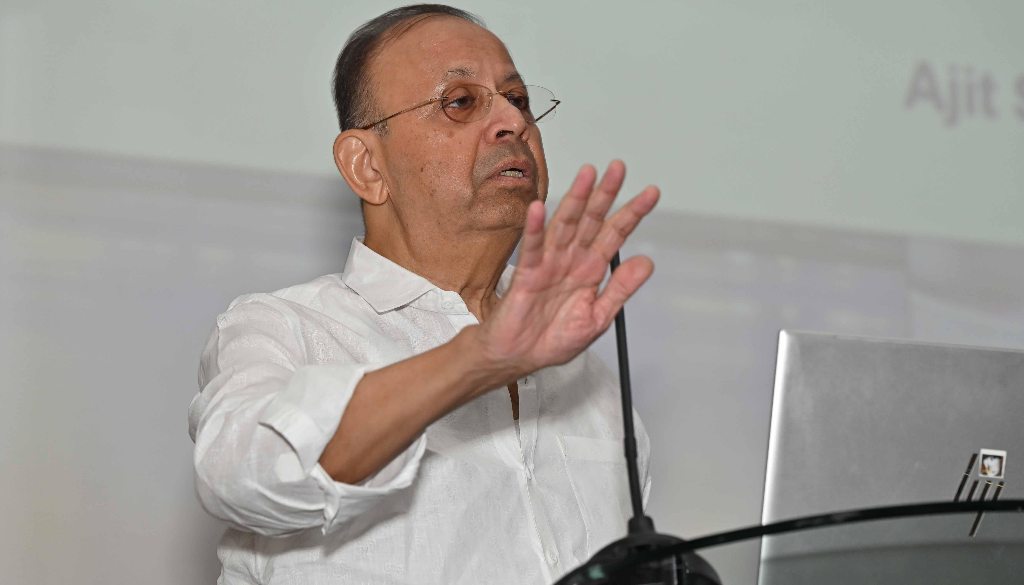
Pune, 7th April 2025: CSIR-National Chemical Laboratory (CSIR-NCL), Pune, organized the esteemed Dr. B. D. Kulkarni Endowment Lecture, celebrating the remarkable contributions of Dr. B. D. Kulkarni, a scientist who played a crucial role in advancing chemical engineering. Dr. Ajit Sapre, Former Group President, R&D, Reliance Industries Ltd., delivered a talk on “Building World-Class Industrial R&D in India – Personal Reflection.”
The lecture commemorates Dr. B. D. Kulkarni, a distinguished scientist who ascended from a PhD student to distinguished scientist at CSIR-NCL. His expertise in mathematical analysis of stochastic reactions, nonlinear dynamics, biochemical process design, scale up and data-driven modeling left a lasting impact on industrial research. He was widely admired for his sharp intellect, problem-solving approach, and mentorship, earning deep respect among his colleagues.
Dr. Ashish Lele, Director, CSIR-NCL, welcomed the audience and introduced Dr. Ajit Sapre as the guest speaker. He remembered Dr. B. D. Kulkani as a chemical engineer par excellence, known for his contributions to mathematical and data driven modeling, which were truly ahead of the time. He also shared personal anecdotes about Dr. Kulkani’s mesmerizing lectures and his gentle demeanor in resolving complex problems.
Dr. Ajit Sapre in his keynote address shared insights from his 18-year journey at Reliance, reflecting on challenges and successes in building a world-class R&D ecosystem in India. He highlighted how a strong multidisciplinary team, including physicists, biologists, and mathematicians, was essential for problem-solving and commercial success. One of his major achievements was spearheading the commercialization of cutting-edge technologies, such as gasoline benzene separation and thermic fluid cleaning, which resulted in significant financial benefits.
Dr. Sapre elaborated on the importance of indigenous innovation and how his team tackled challenges in homogeneous catalysis by developing alternatives that outperformed existing patents. He also discussed a breakthrough in multi-layer zeolite technology, which provided an efficient substitute for clay treaters in aromatics plants. A key highlight of his lecture was the introduction of a revolutionary ultra-high molecular weight polyethylene, which possesses exceptional strength, surpassing Kevlar and steel, making it ideal for applications such as bulletproof materials and high-performance industrial solutions. Demonstrating its robustness, he showcased plastic sheets made from this polymer that could stop bullets, signifying its immense potential in various sectors.
Throughout his lecture, he emphasized the need for confidence in local capabilities and the drive to take research from laboratories to full-scale industrial commercialization, positioning India as a global leader in industrial R&D.
Dr. Sapre placed a strong emphasis on climate change and the urgent need for sustainable industrial practices. He elaborated on several initiatives that can directly address climate-related challenges. These included process intensification techniques that led to reduced carbon emissions, and the development of energy-efficient catalytic processes aimed at minimizing industrial waste and energy consumption. He advocated for an R&D culture focused on low-carbon technologies and circular economy models.