Liquor Shortage in Pune as Excise Duty Hike Disrupts IMFL Supply, Retailers Raise Alarm
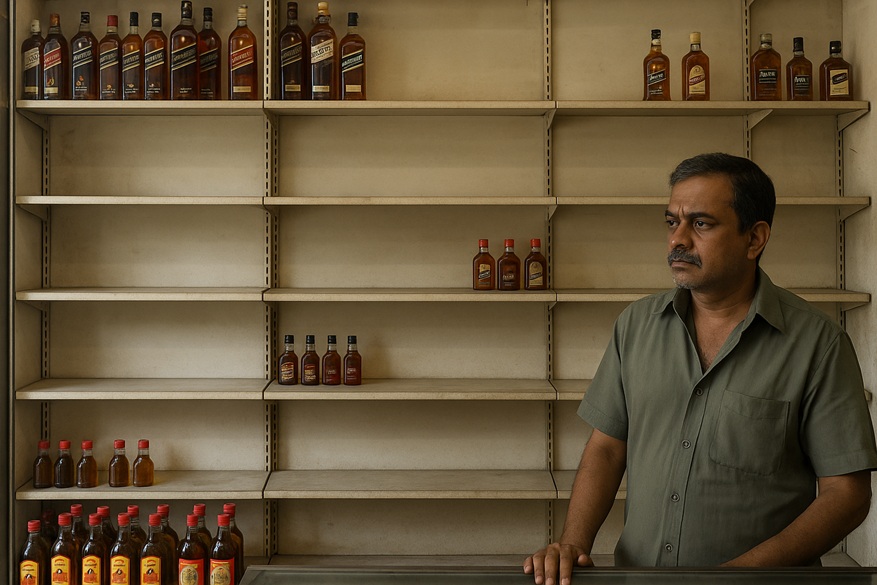
Pune, 3rd August 2025: A significant shortage of Indian-Made Foreign Liquor (IMFL) brands has gripped Pune’s retail market, following the Maharashtra government’s steep hike in excise duty. The impact has been felt across retail outlets and distribution channels, with availability of popular liquor brands dropping by 30 to 40 percent, according to industry insiders.
Retailers and distributors attribute the supply crisis to a combination of price revisions, disrupted production schedules, and logistical delays. The resulting void has also triggered a noticeable consumer shift toward more affordable alternatives, particularly country liquor.
“There is a marked change in consumer behaviour. A substantial number of customers who previously opted for lower-end IMFL brands are now choosing country liquor, simply because their usual brands are unavailable or unaffordable,” said a member of the Pune District Wine Merchants’ Association.
A liquor shop owner described the situation on the ground: “It’s been nearly a month since we started facing irregular supply of mainstream IMFL products. We are only receiving limited pack sizes — mostly 180 ml bottles. Larger sizes like 750 ml, 90 ml, and 1-litre bottles have not been restocked. Many brands that customers ask for daily are simply not coming in.”
He also pointed out a decline in trade incentives. “Earlier, we received trade schemes and cash discounts on bulk purchases. Those benefits have been withdrawn, affecting our margins significantly.”
Another retailer echoed these concerns, stating that the supply shortfall has persisted since the state increased excise duties by over 50 percent. “Liquor companies needed time to recalculate their maximum retail prices (MRPs) to adjust to the new duty structure. Some took up to three weeks to complete the re-registration process,” the retailer added.
The disruption was compounded by multinational liquor firms reportedly reducing production in June. Industry sources said this was partly due to end-of-quarter inventory strategies, where companies limit supply to avoid inflating sales benchmarks for the new financial year.
“After about 20 days of halted production and dispatches, we began to run out of stock. Even now, only a fraction of the demand is being met. For every 100 bottles required, we might get 20 or 50, and not in all the necessary pack sizes,” said another prominent retailer.
He estimated that nearly a quarter of their regular IMFL customers are now switching to lower-cost alternatives, including country liquor or locally manufactured wine products. “There’s a visible 20-25% shift in consumption patterns, especially in the budget-conscious segment,” he added.
Retailers also raised concerns about shrinking profit margins. “Running a wine shop involves substantial operational expenses — the annual licence fee alone is ₹22 lakh and increases by 10% every year. Add rent, electricity, freight, and salaries. Earlier, we earned around 12% margins on most liquor brands; now it’s down to just over 7%. The manufacturers still profit, but the squeeze is on us,” another association member pointed out.
A distributor, requesting anonymity, said: “After the duty hike, most liquor companies delayed fixing their new MRPs to remain competitive. Until the price revisions were finalized, production was stalled. This led to a 20 to 25-day disruption, causing severe stockouts.”
He added, “Even now, the incoming stock is insufficient. The moment a pack size arrives, it sells out instantly. The most popular segments — daily-use brands in the lower to mid-price range — are the hardest hit.”
With the festive season around the corner, retailers fear the situation may worsen unless production and supply stabilize soon.