Railways to Begin High-Speed Safety Trials on Mumbai-Pune Route from Aug 29
Reported by Amit Singh
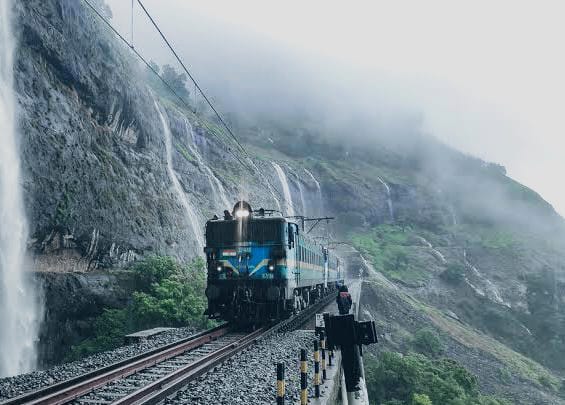
Pune, 28th August 2025: Indian Railways will conduct a high-speed safety and controllability trial on the busy Mumbai-Pune route on Friday, 29th August 2025. The Research Designs and Standards Organisation (RDSO) will operate a special test train comprising a WAP5 locomotive, 24 ICF coaches, and an inspection car between Lonavala (LNL) and Karjat (KJT).
The key objective of the trial is to test the Emergency Braking Distance (EBD), Full Service Braking Distance (FSBD), and overall controllability of long passenger trains on the steep gradients of the Western Ghats section. The trial run will be conducted at speeds up to 60 km/h on the challenging Lonavala-Karjat ghat stretch, one of the most difficult railway terrains in India.
The schedule includes two controllability trials (through runs without halts) and two non-recording runs to validate safety standards and operational reliability. Officials have emphasized that additional locomotives, technical staff, and safety personnel will accompany the test train to ensure seamless operations.
Currently, passenger trains halt at Khandala and Monkey Hill for mandatory brake checks, which leads to a two to five-minute delay. This system will be done away with once speed-sensing devices are in place. Officials said that successful completion of the trials would eliminate the need for such stoppages, thereby improving punctuality and easing congestion.
Railways had earlier conducted a similar trial between Kasara and Igatpuri in the Nashik ghat section, and reports from that test are still awaited. Officials noted that outcomes from both corridors will provide critical inputs for future safety and speed upgrades.
Why It Matters
The Mumbai-Pune section is one of the busiest intercity corridors in the country, with hundreds of passengers commuting daily on premium trains such as Deccan Queen, Intercity Express, and Vande Bharat. Ensuring braking efficiency and controllability of modern LHB (Linke Hofmann Busch) coaches on steep gradients is crucial for passenger safety and faster operations.
Officials highlight that the outcome of these trials could pave the way for smoother and safer handling of longer trains, reduction in travel delays, and improved operational confidence in running premium trains at higher speeds across ghat sections.
Added Benefits
Enhanced Passenger Safety: Validating braking and controllability systems ensures safer train operations in ghat sections prone to accidents.
Improved Efficiency: Trials will help minimize delays caused by banking engines and technical slowdowns.
Faster, Reliable Travel: Successful trials could support future speed increases on the Mumbai–Pune route, reducing travel time.
Operational Modernization: The tests align with Indian Railways’ long-term modernization plan for high-speed and heavy-haul operations.
Authorities have also stressed strict adherence to safety protocols, deployment of competent crew, and round-the-clock security for the test train due to the sophisticated instrumentation onboard.
If successful, these trials will be a significant step forward in making journeys on the Mumbai-Pune route faster, safer, and more reliable for lakhs of passengers.