GST 2.0: Ahead of Festivals, Automakers Cut Prices; Customers to Benefit
Pune, 8th September 2025: The GST Council has reduced the GST rate on cars up to 4 meters in length and with engines up to 1200 cc from 28 percent to 18 percent and has also removed the cess. This has given relief to automobile companies. As a result, with the upcoming festive season of Dussehra and Diwali, companies are ready to pass on this benefit to customers.
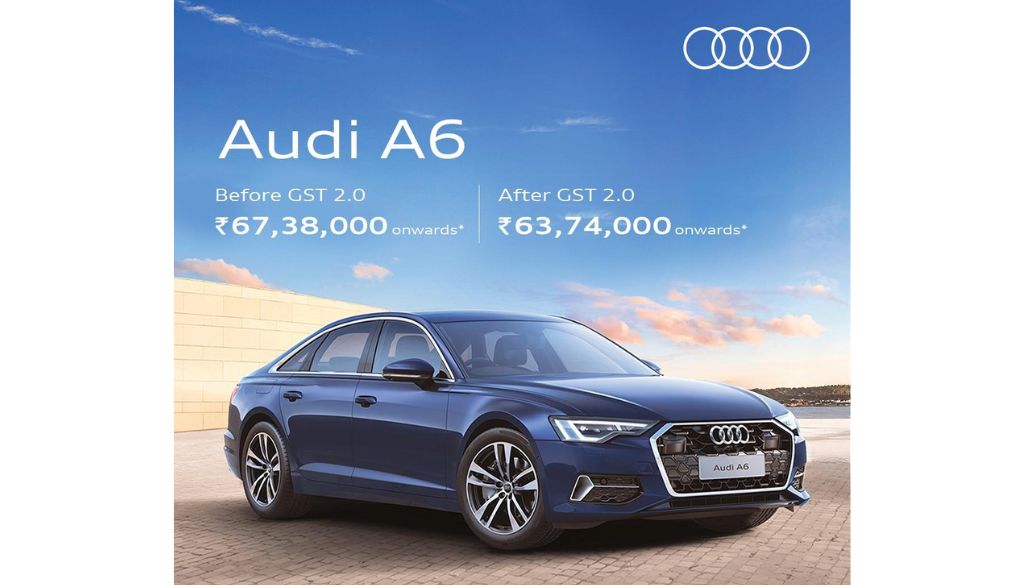
On Monday, Audi India announced a reduction in prices across its entire lineup. The luxury car manufacturer has cut prices across its portfolio by approximately ₹2.6 lakh to ₹7.8 lakh, depending on the model. Commenting on the development, Balbir Singh Dhillon, Head of Audi India, said, “GST simplification is a step in the right direction. It will support industry growth and help us expand the market. It also enhances transparency and aligns with India’s economic vision.
The GST Council’s decision to retain a lower tax rate for EVs is a welcome move. It brings the much-needed clarity and makes our portfolio more accessible to our discerning customers. Such reforms help stabilize the business environment and enable us to frame strategies that benefit all stakeholders.”
Toyota Kirloskar has reduced the price of its popular Fortuner by up to ₹3.49 lakh. Additionally, the company has cut prices of other vehicles by approximately ₹1 lakh to ₹3.5 lakh. Swapnesh R. Maru, Deputy Managing Director, Toyota Kirloskar Motor, said, “We thank and congratulate the Government for this landmark second-generation GST reform, a significant step towards accelerating India’s journey to a stronger and more resilient economy. This reform not only empowers the common man but also boosts market confidence, strengthens consumer sentiment, and stimulates investment — collectively contributing to the nation’s prosperity. The relief extended to smaller vehicles, along with the rationalization of levies on larger ones, will make mobility more accessible and affordable for the common man, while also driving growth across the entire automobile industry.
As the next step, it is essential to reduce fossil fuel imports and achieve our national objectives of energy self-reliance, promotion of biofuels, and decarbonization. With India’s rapid economic growth set to increase energy demand, particularly fossil fuel consumption in the transport sector, it is crucial that all cleaner and greener technologies are promoted and incentivized through suitable policy measures, including taxation, so that consumers prefer these over conventional petrol and diesel vehicles.”
Tata Motors has reduced prices of its various vehicles by ₹65,000 to ₹1.45 lakh. The decision has been taken to pass on the benefit of the GST rate reduction to customers. The new price list will come into effect from September 22.
Providing more details, Shailesh Chandra, Managing Director, Passenger Vehicle Division, Tata Motors, said, “These reforms reflect Prime Minister Narendra Modi’s vision for next-generation GST that prioritizes both ‘Ease of Living’ and ‘Ease of Doing Business.’ The streamlined GST framework goes beyond rate rationalization, introducing structural reforms that enhance long-term confidence in India’s economic environment.
The GST Council’s decision to retain the 5% GST rate on electric vehicles is a forward-looking step that underscores India’s commitment to sustainable, zero-emission mobility and signals long-term policy stability. The reduction of GST on small cars to 18% will make personal mobility more affordable and accessible to a wider section of society. Collectively, these measures will not only accelerate EV adoption but also drive innovation, strengthen domestic manufacturing, and propel India toward a cleaner, smarter, and self-reliant mobility future.”