‘Hard Power Critical in Modern Wars,’ Defence Secretary at Pune Seminar
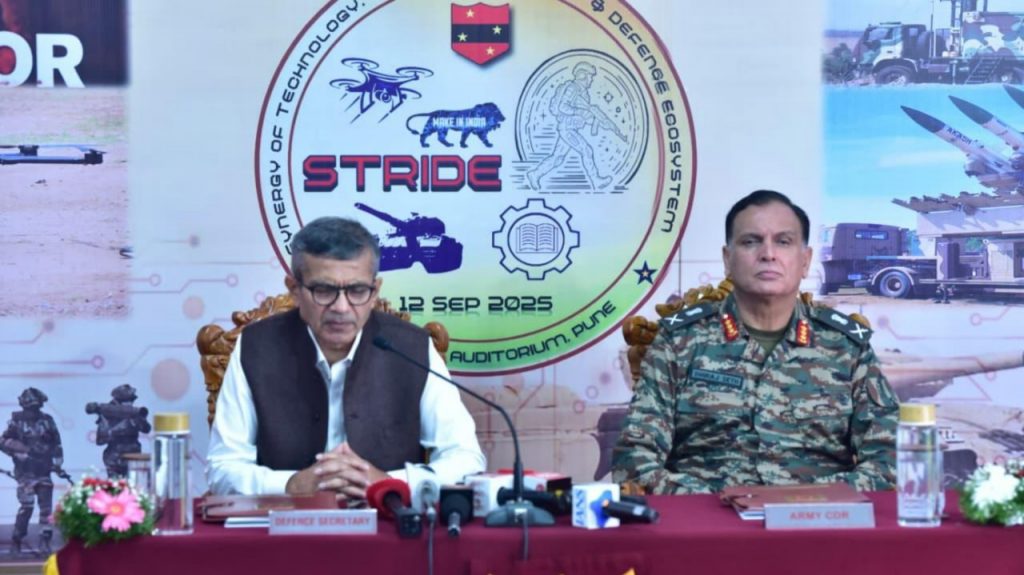
Pune, 12th September 2025: Defence Secretary Rajesh Kumar Singh has stressed the need for closer coordination between private industry, public sector undertakings, research bodies like DRDO, and academic institutions to strengthen the operational edge of the Armed Forces. He was speaking at the inaugural session of STRIDE 2025, a seminar on “Synergy of Technology, Research & Defence Ecosystem,” organised by Southern Command at RSAMI, Pune on Friday.
Singh noted that rapid technological changes are transforming both modern warfare and the way industry operates. He urged all stakeholders to keep pace with global advancements to realise the vision of Aatmanirbhar Bharat. “Technological superiority and industrial strength often determine the outcome of wars. To achieve the goal of a developed India and a $30 trillion economy by 2047, our defence industry must expand in line with overall manufacturing growth,” he said.
He added that this transition was vital not only for national security but also for boosting innovation, strengthening India’s startup ecosystem, increasing the share of manufacturing in the GDP, and generating employment through dual-use technologies.
Placing India’s security in the global context, Singh pointed out that ongoing conflicts had triggered competitive populism, protectionism, and weakening of multilateral institutions. “There is a need to back our soft power as hard power is becoming more and more critical,” he observed.
The Defence Secretary also outlined reforms introduced by the Union Government to stay ahead in the technology race, including changes to the Defence Procurement Manual (2009) and Defence Acquisition Procedure (2020). These revisions, he said, aimed to simplify processes, encourage private participation and startups, and widen India’s defence industrial base.
Acknowledging the private sector’s role in driving self-reliance, Singh encouraged higher investments in research, design, and production capacity. “Defence is a sector where orders may come sporadically. But if you have the technology and engineering strength, you can sustain yourself through both domestic demand and exports,” he remarked.
In his address, Southern Command’s General Officer Commanding-in-Chief, Lt Gen Dhiraj Seth, underlined the need for a “Whole-of-Nation” approach to achieve true self-reliance in defence.
The day-long seminar drew participation from senior Armed Forces officers, veterans, academics, DRDO scientists, PSU officials, and industry representatives. Panel discussions explored ways to fast-track niche technologies, promote industry-supported academic research, and strengthen DRDO’s role in fostering indigenous innovation. Sessions also highlighted strategies to accelerate defence manufacturing through deeper collaboration between the private sector, PSUs, and academia.
An exhibition showcasing cutting-edge indigenous defence equipment and innovations added further momentum to the event, aimed at forging new partnerships and building future-ready capabilities.
The seminar concluded with Southern Command reaffirming its commitment to advancing the national vision of Aatmanirbhar Bharat by strengthening collaboration across the defence ecosystem at both regional and national levels.