Why Maa Shailaputri is Worshipped on the First Day of Navratri
By Rhythm Wagholikar
Pune, 22nd September 2025: The cultural and spiritual heritage of India is rich with festivals that are more than occasions of celebration. They are journeys of the soul, guiding human life to harmonize with cosmic rhythms. Among them, Navratri stands apart as a time of both festivity and deep inner reflection. For nine nights and ten days, people across the land turn their minds and hearts toward the Divine Mother, invoking her as the source of protection, nourishment, and elevation. Navratri is not merely a series of rituals performed in devotion but a spiritual map that reveals how the human being can ascend from the ordinary to the divine.
The very word Navratri means nine nights, and each of these nights is dedicated to one of the nine manifestations of Goddess Durga, collectively called the Navadurga. Each form embodies a quality, a lesson, and a symbol that transcends culture and time. The journey through these nine nights is like climbing a sacred staircase of consciousness. The devotee begins with grounding and purity, ascends through courage, wisdom, compassion, and discipline, and finally reaches the summit of realization and liberation. It is no coincidence that this ascent begins with Maa Shailaputri, the first of the Navadurga. She is invoked on the opening day of Navratri because she represents the foundation itself. The festivities begin with her blessings.
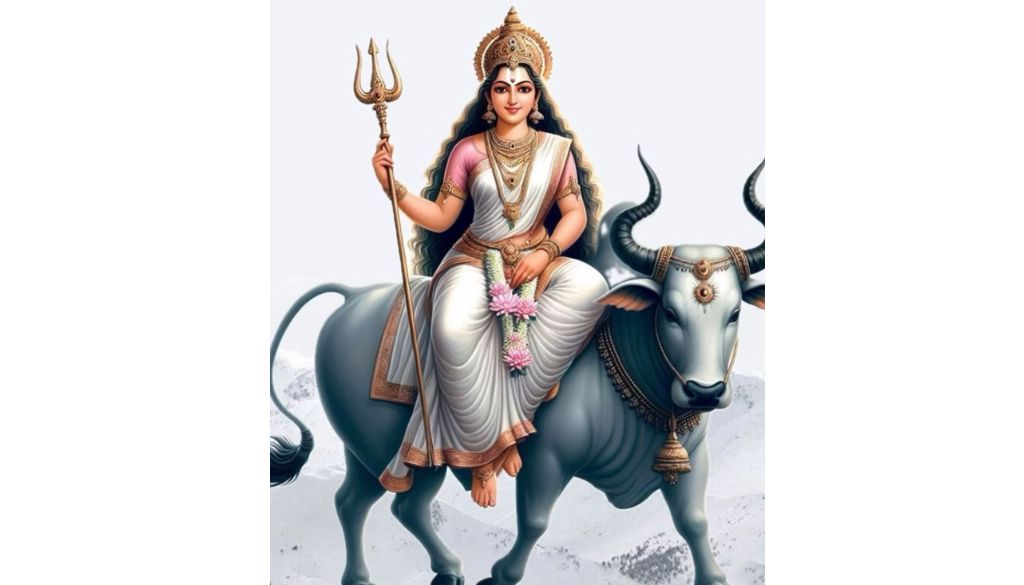
Shailaputri, as her name reveals, is believed to be the daughter of the mountains. Shaila means mountain and Putri means daughter. She is the child of Himavan, the lord of the Himalayas, and Menaka, his queen. She is depicted riding upon the bull Nandi, carrying a trident in one hand and a lotus in the other. In this simple yet majestic image lies profound symbolism. The bull represents strength and endurance. The trident represents courage and determination. The lotus represents purity and spiritual awakening. Together they convey that the first step of any journey must be taken with strength, with courage, and with a pure heart.
To understand her significance, one must turn to her story. In her earlier birth she was Sati, the devoted daughter of King Daksha and the beloved consort of Lord Shiva. Her love for Shiva was unshakable, but her father could not overcome his apprehension. Daksha disapproved of Shiva’s ascetic ways and looked down upon his simplicity. When he organized a great yajna, he invited every deity and sage but deliberately excluded Shiva. Sati, moved by devotion to her father, chose to attend, hoping to ease the conflict. Instead she was met with cruelty. Daksha publicly insulted Shiva in words that cut through her soul. Unable to bear the dishonor of her divine husband, she invoked her inner fire and immolated herself in the sacrificial flames. The universe trembled as Shiva, consumed by grief and fury, wandered across creation with her lifeless body, performing the dance of destruction. From her dismembered body fell sacred pieces that sanctified the earth as the Shakti Peethas, holy sites of divine energy that are worshipped to this day.
But the story of Sati does not end in ashes. It is a tale of rebirth, transformation, and renewal. The union of Shiva and Shakti is eternal, and creation itself requires their presence. Thus Sati was reborn as Parvati, the daughter of Himavan and Menaka. Because she was born of the mountains, she came to be known as Shailaputri. This time she inherited the calm majesty of stone and the serene strength of snow-clad peaks. Shailaputri grew in an environment of reverence. Himavan was humble and wise, and he cherished his daughter, aware that she was divine energy itself.
In her youth she displayed devotion as intense as Sati’s, but now steadied by the patience of mountains. Her heart once again longed for Shiva, and she undertook severe penance to win him as her husband. She meditated for years in forests, braving the harsh elements, fasting, and living in austerity. Her determination moved Shiva, and their union was restored, bringing cosmic balance once again.
This mythology is not just a story of gods and goddesses. It is a mirror of the human soul. It teaches that endings are never the end. Death leads to rebirth, humiliation gives way to dignity, and sacrifice opens the path to renewal. Shailaputri’s story is the eternal reminder that the soul is indestructible, that love rooted in truth cannot be lost, and that every fall is but the preparation for a greater rise. This is why she presides over the first day of Navratri. She is the embodiment of beginnings, of stability, and of the strength to take the first step again, no matter what has been lost.
Her worship is also deeply symbolic in yogic philosophy. She is associated with the Muladhara Chakra, the root energy center in the human body. The Muladhara is the foundation of all spiritual practice. Just as a tree cannot grow without strong roots, a seeker cannot progress without first establishing grounding, stability, and purity. Worship of Shailaputri awakens this root center, anchoring the devotee to the earth, strengthening the body and mind, and preparing the way for the ascent of consciousness through the higher chakras. Without her, the journey upward would be impossible.
The rituals of her worship are simple yet profound. On the first day of Navratri, devotees invoke her presence with mantras and prayers. They light lamps fueled with pure ghee, believed to grant health and strength. They wear white, the color of peace and clarity. They offer flowers, fruits, and devotion, but more than anything, they offer sincerity. For Shailaputri does not demand grandeur; she asks only for purity of heart. To stand before her is to say, “I begin again, with steadiness, with humility, and with devotion.”
What do we learn from Shailaputri? We learn that the foundation of every journey must be strong. We learn that sacrifice, though painful, can lead to renewal. We learn that humility is not weakness but the strength of mountains. We learn that purity and courage must walk hand in hand. We learn that life will always give us opportunities to begin again, no matter how many times we fall. Above all, we learn that the Divine Mother herself accompanies us from the very first step.
In today’s restless world these lessons carry even greater relevance. Surrounded by distractions, noise, and haste, we often lose the grounding needed to walk steadily. Shailaputri reminds us to pause, to root ourselves, and to remember that true success is built not on speed but on steadiness. Her story tells us that dignity is worth more than pride, that devotion is greater than arrogance, and that the soul has the power to rise from any trial. She embodies the truth that renewal is always possible, that beginnings are sacred, and that even after loss, life continues to open new paths.
Navratri itself is a festival of transformation, but its power comes from how it begins. When we start with Shailaputri, we align ourselves with the principle that every journey needs a steady base. Just as the Himalayas stand tall because their foundations lie deep in the earth, our own growth depends on our ability to root ourselves in clarity and strength. Just as the seed first anchors itself in soil before sprouting upward, so too must we anchor our souls in purity before seeking higher realizations.
The lamp lit before Shailaputri on the first day of Navratri is not just a ritual flame. It is the symbol of new beginnings, the declaration of faith, the commitment to walk forward with strength and humility. It is the devotee’s way of saying, “I am ready to start again, and I trust that the Mother will guide me.” And she does, for her presence is not limited to the ancient texts but lives in every act of courage, in every step of renewal, and in every moment when a human being chooses purity over pride.
The worship of Maa Shailaputri is therefore more than tradition. It is a philosophy of life. It tells us that every beginning is sacred, that the first step carries the seed of the journey, and that grounding in purity and strength ensures the success of what follows. To bow before her is to bow before the principle of stability itself, to acknowledge that strength is not noise but silence, not arrogance but humility, not conquest but surrender.
As Navratri begins, the figure of Shailaputri stands at the threshold, serene and steady. She invites every devotee to begin anew, to rise from the past, to root themselves in strength, and to walk with courage into transformation. Her message is timeless. Beginnings matter. Foundations matter. Purity matters. And with her blessings, every seeker can rise like the mountains themselves, unshaken by storms, radiant in devotion, and steady on the path to liberation.