China–Pakistan Alliance Aimed at Constraining India’s Rise, Says Former Foreign Secretary Harsh Vardhan Shringla
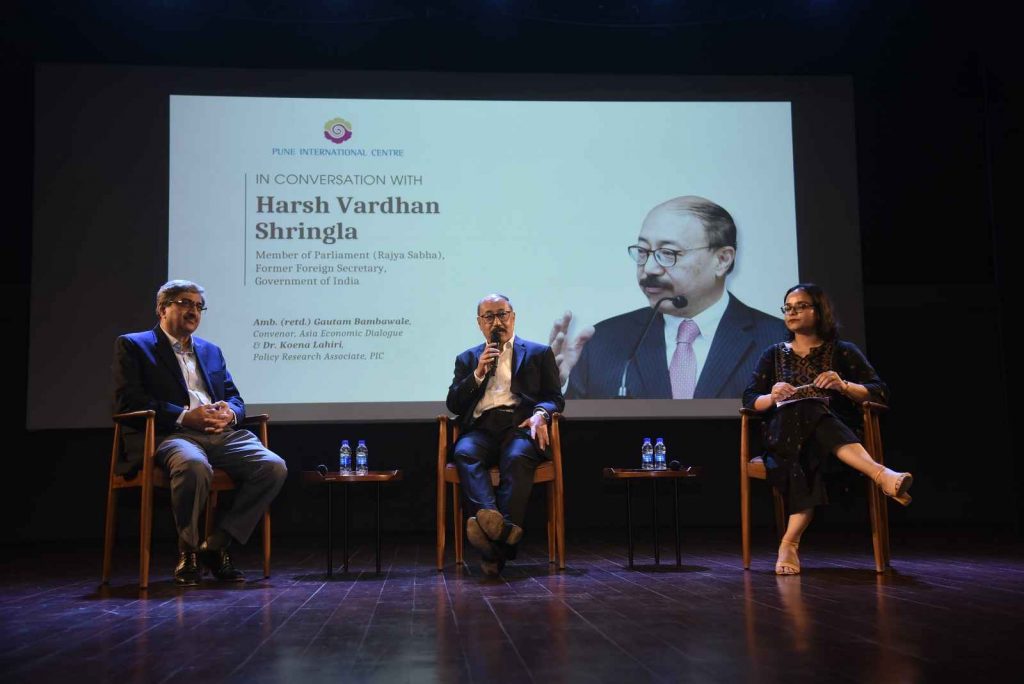
Pune, 3rd November 2025: The Pune International Centre (PIC) hosted Ambassador Harsh Vardhan Shringla, Member of Parliament (Rajya Sabha) and former Foreign Secretary of India, for an engaging conversation on India’s foreign policy and strategic affairs. The discussion was moderated by Amb. (retd.) Gautam Bambawale, Convener of the Asia Economic Dialogue, and Dr. Koena Lahiri, Policy Research Associate at PIC.
Ambassador Shringla, who also served as India’s Chief Coordinator for the G20 Presidency, shared his perspectives on India’s evolving foreign policy, regional dynamics, and strategic priorities in a rapidly changing global order. He emphasised that India’s foreign policy reflects a balance between realism and idealism, guided by developmental imperatives, strategic autonomy, and an inclusive global outlook.
The discussion spanned critical themes, including India’s relations with China and Pakistan, the changing nature of modern warfare, and the increasing role of technology, drones, and cyber tools in defence and diplomacy. Ambassador Shringla underlined the importance of strategic deterrence, skilled diplomacy, and a clear focus on domestic growth to strengthen India’s international position.
Addressing questions on Pakistan’s use of Chinese weaponry during Operation Sindoor, he described the conflict as indicative of a deeper China–Pakistan strategic partnership. He noted that China’s involvement extended beyond defence supplies to include intelligence and diplomatic support, forming an ‘all-weather’ alliance intended to constrain India’s rise. He said that India must respond through capacity building, innovation, and partnerships grounded in its own strategic interests.
On the Pakistan–U.S. dynamic post–Operation Sindoor, Ambassador Shringla observed that Field Marshal Asim Munir had consolidated authority and regained Washington’s attention under the Trump 2.0 administration. Drawing from his experience as India’s Ambassador to the United States, he contrasted Pakistan’s short-term tactical approach with India’s long-term, institutional diplomacy. He highlighted that India’s strength lies in building durable partnerships across the U.S., Europe, the Indo-Pacific, and the Global South—anchored in shared democratic values, trade, technology, and security cooperation.
Ambassador Shringla reaffirmed that India does not accept third-party mediation in bilateral issues, in accordance with the Simla Agreement, and observed that the abrogation of Article 370 has integrated Jammu and Kashmir into the national mainstream, thereby restoring stability, except for sporadic incidents of cross-border terrorism.
Speaking on regional and global balancing, he highlighted the importance of the ‘Neighbourhood First’ policy, alongside deeper engagement with the Global South, West Asia, and Southeast Asia. He also highlighted India’s ambition to emerge as a thought and technology leader, citing the upcoming Global AI Summit as a key step in shaping governance frameworks for emerging technologies.
Discussing the U.S.–China strategic rivalry, Ambassador Shringla remarked that while the global order appears to be moving toward a G2 framework, India must not cede its strategic space. He asserted that India’s growing economic and technological capacity positions it as an indispensable third pole in a multipolar world. He urged a focus on strengthening domestic ecosystems in semiconductors, renewable energy, artificial intelligence, pharmaceuticals, and rare earths to reinforce India’s global standing.
Reflecting on his transition from diplomacy to Parliament, Ambassador Shringla noted that political life demands constant public engagement, empathy, and accountability. While diplomacy functions within structured systems, he said, politics requires a 24/7 connection with citizens, making it a deeply fulfilling mode of public service.
The session concluded with an interactive Q&A, where the audience raised questions on India’s regional strategy, global partnerships, and the future of multilateralism. The event reflected PIC’s continued commitment to fostering informed dialogue on India’s foreign policy and its role in global governance.