Pune: Eminent Environmentalist Madhav Gadgil Dies in Pune at 83, Leaves Behind Enduring Ecological Legacy
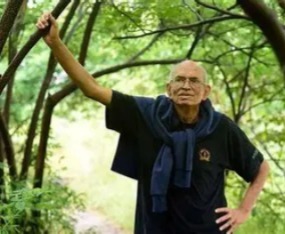
Pune, 8th January 2026: Long before climate disasters became headline news, Dr Madhav Gadgil was warning that nature would eventually push back. On Wednesday night, India lost one of its most uncompromising environmental voices when the eminent ecologist and scientist passed away in Pune after a prolonged illness. He was 83.
The death was confirmed by his son, Siddharth Gadgil. Dr Gadgil was undergoing treatment at Dr Shirish Prayag’s hospital in Pune. His last rites will be held on Thursday at 4 pm, family members said.
Often described as the conscience-keeper of India’s environmental movement, Dr Gadgil devoted more than six decades to studying ecosystems and advocating policies that balanced development with ecological limits. His academic and public life was deeply intertwined with biodiversity conservation, particularly in the Western Ghats — a global biodiversity hotspot he believed was being pushed to the brink by reckless development.
From early in his career, Dr Gadgil challenged the idea that economic growth must come at the cost of environmental damage. He repeatedly cautioned policymakers that ignoring ecological realities would ultimately harm both nature and people.
Dr Gadgil’s most consequential intervention came in 2011, when he headed the Western Ghats Ecology Expert Panel. The panel’s report, later known simply as the Gadgil Committee report, called for strict safeguards in ecologically sensitive areas and urged a shift towards sustainable, locally informed development.
The recommendations triggered intense national debate. Environmental groups praised the report for its scientific rigour and long-term vision, while several state governments opposed it, arguing that the proposed restrictions would stall development projects.
Despite domestic resistance to many of his ideas, Dr Gadgil’s work earned global respect. In 2024, the United Nations Environment Programme honoured him with the ‘Champion of the Earth’ award, acknowledging a career that spanned academic excellence — including time at Harvard University — and advisory roles within the Indian government. UNEP also highlighted his description of himself as a “people’s scientist,” a label that reflected his belief in grassroots participation in environmental governance.
In his later years, Dr Gadgil became an outspoken critic of what he saw as a pattern of ecological neglect behind recurring natural disasters. He linked floods, landslides and cloudbursts to deforestation, mining and unplanned construction, warning that such events were not random acts of nature but consequences of human choices.
He often explained that while regions like the Himalayas are geologically fragile by nature, human interference had sharply increased the scale and frequency of disasters. Similar pressures, he argued, were steadily weakening the Western Ghats, formed from ancient volcanic rock but now exposed to unprecedented environmental stress.
The Gadgil Committee had recommended that the entire 1.29 lakh square kilometre stretch of the Western Ghats be classified as ecologically sensitive. Political pushback led to a subsequent panel under K Kasturirangan, which reduced the proposed protected area to around half. Nearly 15 years on, neither framework has been fully implemented.
The consequences of this delay became painfully visible in 2024, when a massive landslide in Wayanad, Kerala — an area flagged as ecologically sensitive by the Gadgil panel — claimed nearly 250 lives.
With Dr Madhav Gadgil’s passing, India has lost a scientist who consistently spoke truth to power, even when it was inconvenient. His legacy lies not only in his research and reports, but in his enduring warning that development without ecological wisdom extracts a price far higher than it appears — a message that remains as urgent today as ever.