No More Traffic Jams? Mumbai–Pune Expressway Missing Link Finally Opens

Reported by Mubarak Ansari
Lonavala, 1st May 2026: The long-awaited “Missing Link” project on the Mumbai–Pune Expressway was inaugurated on Friday, with Chief Minister Devendra Fadnavis describing it as a landmark in modern engineering that will significantly ease traffic congestion and accelerate economic growth. The Chief Minister said the project should be seen not as a “missing link” but as a “connecting link” that strengthens connectivity between Mumbai and Pune.
Addressing a press conference after the inauguration, Fadnavis highlighted that the ₹7,181 crore infrastructure project is expected to act as a major economic multiplier, potentially contributing up to ₹70,000 crore to the state’s economy. He emphasised that the project is designed with a strong focus on commuter safety and advanced technology.
The event was attended by Deputy Chief Ministers Eknath Shinde and Sunetra Ajit Pawar, along with senior ministers, Members of Parliament, and top officials from the state administration and the Maharashtra State Road Development Corporation (MSRDC).
Key features and safety systems
The Chief Minister said the expressway section incorporates cutting-edge safety measures, including advanced fire-fighting systems, water mist technology, and emergency telephones installed every 50 metres. Cross-passages connecting twin tunnels have been built every 300 metres to facilitate safe evacuation during emergencies.
An intelligent traffic management system with round-the-clock CCTV surveillance has been deployed to ensure lane discipline and monitor violations. The government has also warned that traffic rule violations will result in e-challans being directly issued to vehicle owners.
Engineering challenges and global collaboration
Officials noted that the project was executed in extremely challenging terrain, including deep valleys and forested regions. Machinery had to be transported through difficult landscapes, and work continued despite disruptions during the COVID-19 pandemic. Experts and agencies from seven countries contributed to the project.
The new alignment reduces the distance between Khopoli and Kusgaon by around 6 kilometres and is expected to cut travel time by 25–30 minutes, providing significant relief to commuters who frequently face traffic congestion in the ghat section.
Fadnavis also referred to recent concerns over traffic jams on the expressway, acknowledging public inconvenience. He remarked that with the opening of the new link, commuters are unlikely to face such bottlenecks in the future.
Deputy Chief Minister Eknath Shinde said the project reflects collective efforts across departments and political leadership. He noted that despite earlier delays and challenges, the project regained momentum in recent years and has now been completed successfully. He added that the state is working on a broader access-controlled road network to enable faster inter-city travel.
World-class infrastructure and record-setting tunnel
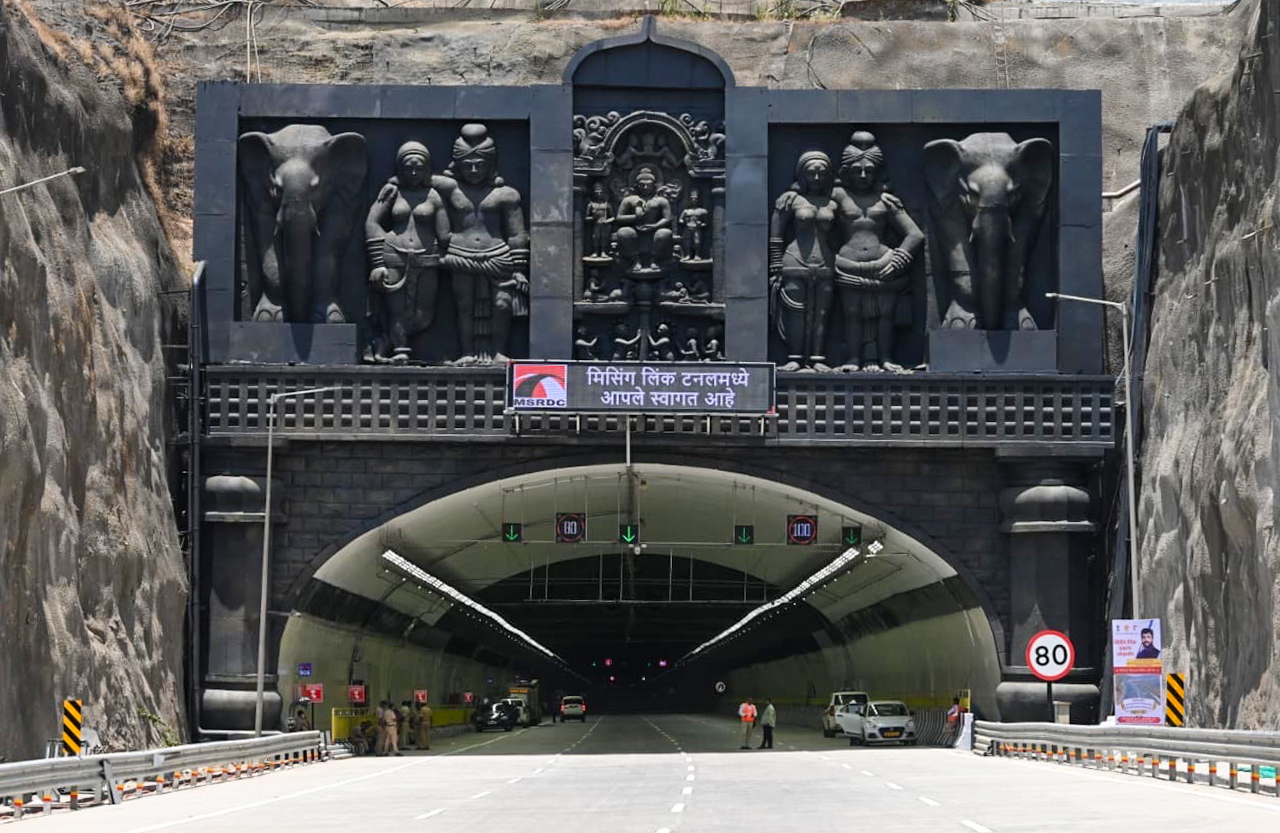
Deputy Chief Minister Sunetra Ajit Pawar highlighted that the project includes one of the widest road tunnels in the world, measuring 23.5 metres in width, and noted that it has been recorded in the Guinness World Records, marking a significant achievement for the state.
She said the project is not merely about reducing travel time but represents a major step towards rapid infrastructure development. The expressway, named after Yashwantrao Chavan, has now reached a new milestone with this addition.
Environmental and economic benefits
Officials said the new route avoids steep curves in the ghat section, leading to reduced fuel consumption and an estimated daily saving of around ₹1 crore. This is also expected to lower emissions and improve road safety by reducing accident-prone stretches.
Project background and technical details
The Mumbai–Pune Expressway was opened in phases starting in 2002. However, the 13.3-kilometre stretch between Khalapur and Kusgaon remained incomplete due to technical and financial challenges, leading to traffic being diverted through a shared national highway section.
The Missing Link project addresses this gap through a 19.16-kilometre modern corridor, including an 8-lane stretch of 5.88 kilometres and a 12.3-kilometre section comprising twin tunnels and viaducts.
Two major tunnels, constructed using the New Austrian Tunnelling Method, form the core of the project. One tunnel is 1.58 kilometres long, while the other stretches 8.86 kilometres, passing approximately 180 metres below a lake near Lonavala. Engineers conducted detailed geological studies to safely execute tunnelling operations in complex rock formations.
Cable-stayed bridge and advanced design
A key highlight is a 650-metre cable-stayed bridge built in the Tiger Valley area at a height of around 125 metres. The structure includes two pylons of 182 metres each and is supported by 240 cables. The bridge underwent advanced testing, including wind tunnel and tensile strength assessments, to ensure structural integrity under extreme conditions.
Officials said the new alignment bypasses accident-prone zones and sharp curves in the ghat section, offering a safer and smoother travel experience.
With improved connectivity, reduced travel time, and enhanced safety features, the Missing Link project is expected to play a crucial role in boosting trade, tourism, and regional development across western Maharashtra, Konkan, and Marathwada regions.