Beyond the Ghats – Satara District’s Most Stunning Escapes
By Samiccha Malik
Satara/Pune, 26th May 2026: If Pune district is where Maharashtra’s history lives in stone and fort walls, Satara is where it breathes. Named after the seven hills – Saat Taras that rise around the city, this district sits in the lap of the Western Ghats with a quiet confidence that comes from centuries of significance. It was once the seat of the Maratha Empire under Chhatrapati Shahu Maharaj. Its rivers, the Krishna and the Venna, have nourished its soil for thousands of years. And its landscapes from wildflower-covered plateaus to roaring waterfalls and mist-wrapped hill stations are among the most genuinely beautiful in all of Maharashtra. Satara does not announce itself loudly. It simply shows you, and lets the views do the talking. Here are ten places in this extraordinary district that are absolutely worth your time.
1. Kaas Plateau : Maharashtra’s Valley of Flowers
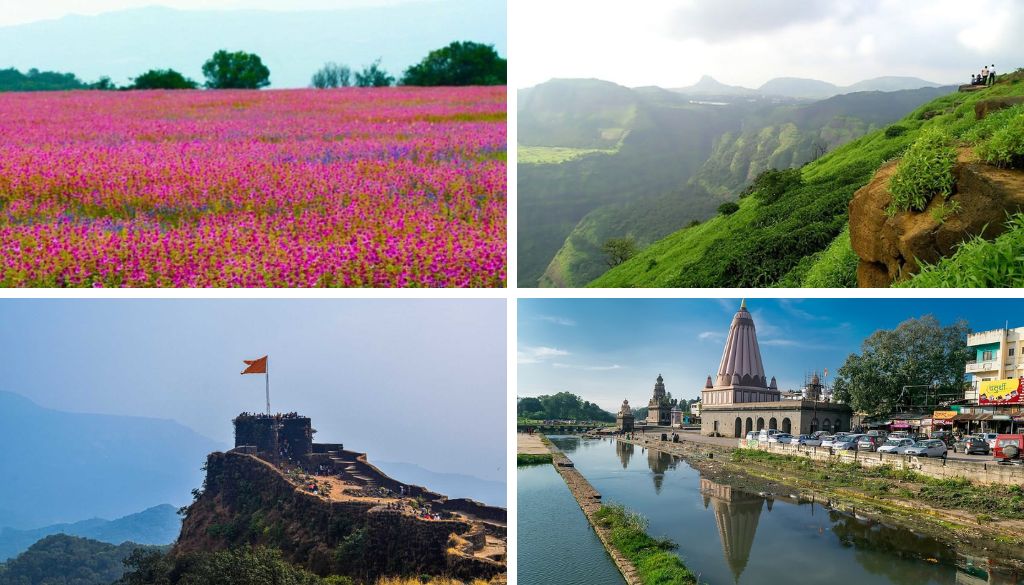
Every year, for a few precious weeks between late August and early October, something remarkable happens on a volcanic plateau about twenty-four kilometres from Satara city. The Kaas Plateau, sitting at an altitude of roughly 1,200 metres, erupts into colour. Hundreds of species of wildflowers many of them rare, some found nowhere else on earth – carpet the entire plateau in waves of purple, yellow, pink, and white. The sheer scale of it is breathtaking. UNESCO recognised Kaas as a Biodiversity World Heritage Site in 2012, and rightly so. One flower, the Aponogeton Satarensis locally called the Waytura exists only here and is now listed as endangered. If you visit during the bloom season, go early in the morning, walk slowly, and resist the urge to rush. Kaas rewards patience.
2. Sajjangad Fort
Sajjangad is not just a fort. For millions of devotees across Maharashtra, it is a place of deep spiritual significance the final resting place of Samarth Ramdas Swami, the revered saint, philosopher, and spiritual guide of Chhatrapati Shivaji Maharaj. Originally built by the Bahamani rulers and known as Parali Fort, it was captured by Shivaji Maharaj in 1673 and renamed Sajjangad meaning Fort of Good People after he invited Samarth Ramdas to make it his permanent home. The saint lived out his final years here, and his samadhi within the fort complex draws a steady stream of pilgrims year-round. Beyond the spiritual weight of the place, the fort offers sweeping views of the Satara valley and the surrounding hills that are genuinely stunning particularly at dawn.
3. Thoseghar Waterfalls
About twenty-six kilometres from Satara city, tucked into the folds of the Sahyadris, the Thoseghar Waterfalls are among the most spectacular natural sights in western Maharashtra. This is not a single waterfall but a series of cascades tumbling down the hillside, the tallest of which drops from a height of roughly two hundred metres. During the monsoon the falls are thunderous white water crashing through dark rock, mist rising in clouds, the roar audible from a distance. The viewpoints are well set up and the scenery around the falls, with green hills stretching to the horizon, makes it the kind of place where you will find yourself standing much longer than you planned.
4. Vajrai Waterfall
If Thoseghar is spectacular, Vajrai is staggering. Cascading in three grand tiers from a height of approximately two hundred and sixty metres, Vajrai is one of the tallest waterfalls in India. Fed by the Urmodi River, it is located close to the Kaas Plateau and makes for a natural pairing on any visit to the area. The waterfall is most impressive between August and November when the river is running full. The landscape around it – forested hills, open sky, the sound of water hitting rock far below is the kind of thing that puts everyday concerns in their proper perspective. There is also a layer of local legend here, with stories connecting the site to Samarth Ramdas Swami adding a quiet spiritual dimension to what is already a dramatic natural setting.
5. Mahabaleshwar
No list of Satara’s finest escapes would be complete without Mahabaleshwar. Sitting at an altitude of over 1,350 metres in the Western Ghats, this is Maharashtra’s most celebrated hill station and it earns that reputation honestly. The viewpoints here are remarkable: Arthur’s Seat looks out over a vast green valley that stretches all the way to the coast on a clear day. Wilson Point catches the first light of sunrise. Kate’s Point offers a panoramic sweep of the Dhom Dam and the plains below. Then there are the strawberry farms – Mahabaleshwar produces the majority of India’s strawberries, and eating them fresh from a roadside stall with cream is a ritual the place is famous for. Add ancient temples, quiet forest walks, and the pleasant weather that holds through most of the year, and you begin to understand why people keep returning.
6. Panchgani
Twenty kilometres from Mahabaleshwar and softer in its beauty, Panchgani is the kind of hill station that gets under your skin quietly. Named for the five hills that surround it, the town is known for its colonial-era boarding schools, its red-roofed bungalows half-hidden in trees, and a tableland – a vast flat expanse of basalt rock that offers some of the most sweeping views in the district. The sunsets from the tableland are extraordinary. Panchgani is also a popular location for paragliding, with the thermal winds above the valley making it one of the better spots in Maharashtra for the activity. The town has a certain old-world gentleness to it that is harder and harder to find in modern India.
7. Pratapgad Fort
Twenty kilometres from Mahabaleshwar, rising to 3,500 feet above sea level, Pratapgad is one of the most historically charged sites in all of Maharashtra. It was here, on 10 November 1659, that one of the most pivotal battles in Maratha history took place. Chhatrapati Shivaji Maharaj met the Bijapur general Afzal Khan in what was officially a peace negotiation but turned into a deadly confrontation one that ended with Afzal Khan’s death and a decisive Maratha military victory. The fort itself is magnificent a commanding structure on a ridge with sheer drops on multiple sides and a statue of Shivaji Maharaj that has become one of Maharashtra’s most iconic landmarks. The views from the battlements on a clear day are unforgettable.
8. Ajinkyatara Fort
Satara city has its own fort rising directly above it, and Ajinkyatara is one that locals climb as naturally as others take an evening walk. The name translates to Impregnable Star of Hope and the fort lives up to it both in structure and in the views it commands. From the top, the entire spread of Satara city lies below, ringed by hills and river valleys. The fort also houses a temple dedicated to Goddess Bhavani, giving it a spiritual weight alongside its historical significance. It is less visited by outsiders than the more famous forts of the region, which makes it all the more enjoyable – quieter, more personal, and completely rewarding.
9. Wai : The Temple Town
Wai is one of those places that feels like Maharashtra before the modern world arrived. Sitting on the banks of the Krishna River, this ancient town is lined with beautifully preserved temples built in classic Maratha style – intricately carved, deeply atmospheric, and maintained with obvious care and devotion. The ghats along the river, particularly the Ganpati Ghat, are extraordinarily picturesque and have made Wai a favourite location for Bollywood filmmakers over the decades. Walk along the riverfront at dusk, with temple bells sounding across the water and the hills visible in the distance, and you will feel the quiet pull of a town that has been sacred for centuries.
10. Vasota Fort : The Forest Fort
For those willing to work for their reward, Vasota is extraordinary. Hidden deep within the Koyna Wildlife Sanctuary, this ancient hill fort can only be reached after a boat ride across the Shivsagar Lake followed by a trek through dense, untouched forest. The journey takes you through some of the wildest and most beautiful landscape in the district – thick canopy, narrow trails, the sound of birds you cannot name. The fort ruins at the top overlook the backwaters of the Koyna Dam in a scene of such complete natural beauty that many trekkers describe it as the finest view in Maharashtra. It is not an easy day, but it is one you will not forget.
Best Time to Visit
Satara rewards visitors differently across seasons. The monsoon, from June to September, is when the waterfalls are at full force and the ghats turn impossibly green. Late August to mid-October is the unmissable window for the Kaas Plateau flowers. October to February brings cool, clear weather ideal for fort treks and hill station visits. Mahabaleshwar and Panchgani are particularly lovely in the cooler months, though they are busy through the year.
Getting There
Satara district is well connected by road and rail to major cities across Maharashtra. The Satara railway station serves as a key entry point, and the district’s internal road network makes most destinations accessible by road in under an hour from the city centre. For Vasota Fort, a boat service from Bamnoli village is the starting point.
Satara is a district that asks nothing of you except your attention. Give it that, and it gives back something far greater – the feeling that Maharashtra, in its most natural and most historic form, is alive and magnificent and entirely worth exploring.