CJP To Announce Education Manifesto At Pune Protest; Sonam Wangchuk going to Join Demonstration
Reported by Shoaib Tadvi
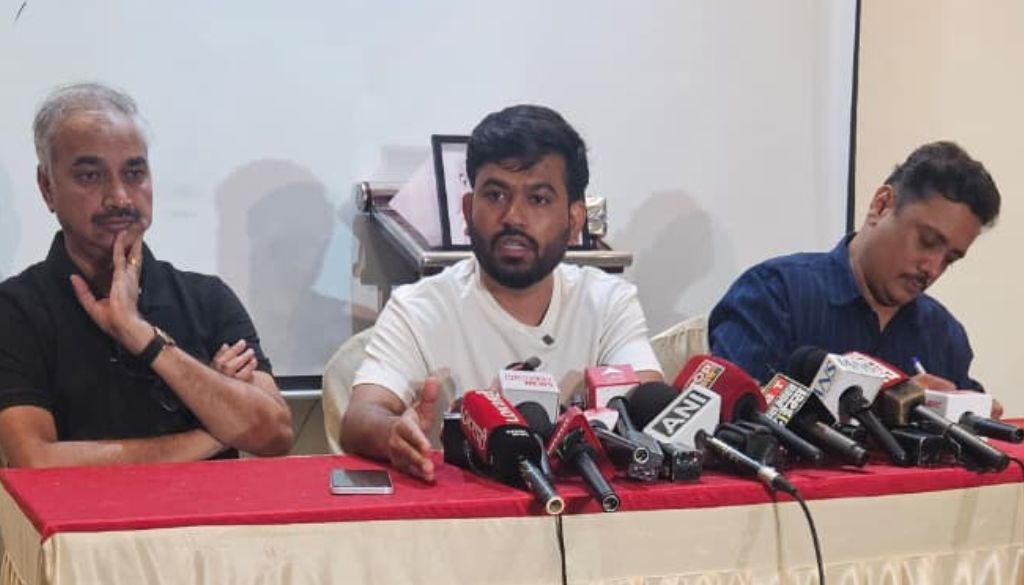
Shivajinagar, 11th June 2026: Hours before its scheduled protest at Savitribai Phule Pune University (SPPU), the Cockroach Janata Party (CJP) held another press conference at in Pune on Thursday morning, outlining its plans for the agitation and unveiling what it described as a broader movement for education reforms in the country.
The press conference was addressed by CJP founder Abhijeet Dipke, accompanied by noted advocate and social activist Asim Sarode and Vishwambhar Choudhari at JM Four Hotel in Shivajinagar.
Dipke announced that the protest, scheduled for 4 pm at the Dr Babasaheb Ambedkar Statue on the SPPU campus, would not only focus on the NEET paper leak and examination irregularities, but would also witness the release of the organisation’s proposed Education Manifesto.
According to Dipke, the manifesto would include recommendations on how the government can improve the conduct of examinations such as NEET and other competitive tests to ensure greater transparency, fairness and accountability.
“We are going to announce our manifesto during today’s protest. It will be an education manifesto suggesting what the government should do and how the examination system can be improved,” he said.
Dipke further claimed that education reform had become the central objective of the movement and thanked the youth for the overwhelming support received over the past few days.
“I had no plan and no intention of doing all this initially. The support from people forced me to step forward. I thank everyone for their support,” he said.
He also announced that while the Pune protest would be held at SPPU, he was planning to continue the campaign across the country, including a proposed protest in Nagpur before travelling to Lucknow.
The CJP founder further stated that noted education reform advocate and environmentalist Sonam Wangchuk was expected to join the Pune protest and would raise issues related to environmental concerns alongside the education movement.
Addressing allegations levelled against the movement on social media, Dipke reiterated that his social media accounts had previously been hacked and claimed that he had been branded “anti-national” and even accused of having links with Pakistan.
He rejected such allegations, stating that a majority of his supporters were Indians.
“People have called me anti-national and even Pakistani. Some have claimed that my followers are from Pakistan. I have screenshots showing that 94.6 per cent of the audience is from India. Making such allegations is unfair,” he said.
Dipke also criticised what he described as a tendency to label dissenting voices as anti-national.
“If the media asks questions or if citizens speak against the government, they are called anti-national. This is not fair,” he said.
Speaking at the press conference, social activist Vishwambhar Choudhari clarified that his presence alongside Dipke should not be interpreted as an attempt to control the movement.
“I told Abhijeet that this movement should remain youth-led and be led by people under the age of 35. We are only here to support him. This movement is just 15 days old and should be given time to evolve,” Choudhari said.
“We can advise him, but we cannot take decisions on behalf of the movement. Every decision will remain with the young leadership,” he added.
Advocate Asim Sarode described the initiative as a possible turning point in public participation against systemic failures.
“This can become a revolution against the system. This is only the beginning. Let us see what happens,” Sarode said.
At the same time, he emphasised that support for the movement was not unconditional.
“If Abhijeet is wrong, we will come before the media and say so. We will publicly point out if something inappropriate is being done. But at this stage, he deserves time and an opportunity,” he said.
Referring to Sonam Wangchuk’s expected participation, Sarode said the activist was likely to raise environmental concerns that he had highlighted in his public addresses.
Dipke also claimed that the authorities had granted permission for the protest considering the anticipated turnout.
“We don’t have any political backing. The administration knows that if permission is denied and people still gather, the situation can become difficult to manage,” he said.
The agitation, which initially emerged around concerns over the alleged NEET paper leak, has now expanded into a wider call for reforms in India’s examination system and educational governance.
Dipke didn’t answer the following questions asked by Punekar News:
Why was Pune chosen after Delhi?
What is the next phase if Dharmendra Pradhan does not resign?
Is CJP becoming a political party?
How is the movement funded?
What are your specific solutions beyond demands for resignation?
Why was Pune University chosen as the site for the protest?