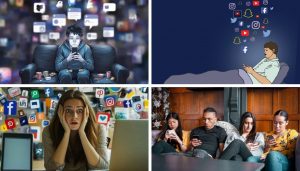
The Scroll That Never Ends : How Social Media Is Quietly Stealing Our Youth
By Samiccha Malik
Pune, 11th June 2026: There is a particular kind of exhaustion that comes not from doing too much, but from watching too much. It settles somewhere behind your
eyes, a dull ache that you carry from the moment you wake up phone already in hand to the moment you fall asleep, the screen still glowing. We have a word for it now, though we rarely say it out loud : addiction. And an entire generation is living inside it.
Social media was supposed to connect us. In many ways, it did. But somewhere between the first “like” and the ten-thousandth reel, something shifted. What began as a tool became a mirror and then a trap. Today, young people in India and across the world are spending upward of five to seven hours a day on their phones, not working, not learning, not even truly resting. Just scrolling. Always scrolling.
And the reason we cannot stop is not weakness. It is chemistry.
Every notification, every like, every reel that autoplays sends a small hit of dopamine through the brain the same chemical released when you eat something you love, when you hear good news, when someone you like smiles at you. Platforms are engineered, deliberately, to keep that loop alive. The variable reward system sometimes ten likes, sometimes a hundred, you never quite know mirrors the exact mechanism used in slot machines. It is not accidental. Former insiders from
companies like Meta have openly admitted these systems were built not for connection, but for maximum engagement. In other words, for dependency. And yet we keep scrolling, chasing a hit of validation that never quite satisfies.
The productivity crisis this quietly creates is devastating. Students sit through lectures with one eye on the board and one thumb on Instagram. Professionals draft half-finished emails while their attention drifts to trending posts. The ability to sit with a single task to think deeply, to even be bored is becoming a lost skill.
Researchers at Microsoft found that average attention spans have dropped from twelve seconds in 2000 to around eight seconds today. Shorter, famously, than a goldfish. We are a generation that cannot wait two minutes for a video to load without opening another app in the meantime.
But it is not just productivity that suffers. It is the mind itself.
Boredom has always been where creativity lives. In the quiet, unoccupied moments the mind wanders, connects dots, solves problems it did not know it was carrying. When every spare second is packed with content reels, memes, stories, shorts that space disappears. What moves in instead is a restlessness that is hard to name and harder to shake. Research from the Indian Psychiatric Society has flagged a sharp rise in social media-related anxiety among adolescents,
especially post-pandemic. Studies show that young people spending more than three hours daily on these platforms are significantly more likely to report depression, loneliness, and broken sleep. A study published in JAMA Pediatrics found that adolescent girls who cut screen time by just one hour a day showed measurable improvements in mood within weeks. The brain recovers fast if you give it the chance.
There is also a specific kind of anxiety that social media manufactures not sharp or identifiable, just a low, chronic unease that hums underneath everything. The fear of missing out. The fear of being irrelevant. The quiet dread of opening your phone and finding that nobody noticed you today. Psychologists call it “compare and despair” the result of measuring your ordinary Tuesday against someone else’s curated highlight reel. A young girl in Pune is no longer just comparing herself to her classmates. She is holding herself up against influencers with lighting rigs, editing teams, and perfected aesthetics and quietly finding herself lacking. Studies link heavy Instagram use directly to body image dissatisfaction and rising social anxiety in teenagers. The cruel irony is that the more inadequate the
platform makes you feel, the more compulsively you return to it.
And then there is the content creator paradox perhaps the most telling sign of where we have arrived.
Somewhere along the way, simply existing online stopped being enough. Now everyone must also perform. Every meal is a photo opportunity. Every trip becomes a vlog. Every opinion needs to be a reel with the right audio and the right caption. An entire generation has quietly internalized the idea that a moment only has value if it is being witnessed liked, shared, saved. That is not creativity. That is performance anxiety wearing a filter. When living becomes secondary to
documenting, when a young person spends more energy thinking about how something will look than how it actually feels we are talking about a generation performing their life rather than living it.
The cost of all this cheap dopamine shows up everywhere. In classrooms where nobody can focus for twenty minutes straight. In therapy rooms where young adults cannot explain why they feel hollow despite being constantly connected. In a generation more informed than any before it and somehow more lost.
Social media is not going anywhere. Neither are the phones. But there is one question worth sitting with, away from the noise, away from the
feed : are we using social media or has it started using us?
Because there is a difference. And more and more young people are beginning to feel it in the restlessness, the exhaustion, the endless comparison, the sense that no matter how much they consume, something still feels missing.
The scroll never ends. But the life you are not living while you scroll that one does.