Bridging Demographic Gaps: Japan and Northeast India’s New Opportunity
By Gargi Kashyap
New Delhi, 14th August 2026: Japan is facing labour shortages due to an ageing population and a declining workforce, and job opportunities exist in areas such as healthcare, hospitality, agriculture, IT and manufacturing sectors.
Japan is facing a serious demographic challenge. Its fertility rate is about 1.2 children per woman, well below the replacement level of 2.1. The working-age population has been shrinking for nearly 30 years. Today, more than 29% of people in Japan are aged 65 or above, making it one of the oldest societies in the world. As a result, the country is experiencing labour shortages across key sectors such as elderly care, construction, hospitality, manufacturing, agriculture and transport. Experts warn that Japan could be short of several million workers by 2040 if productivity does not improve or immigration does not increase.
Recognising this situation, Japan introduced the Specified Skilled Worker (SSW) status of residence in 2019 to deal with labour shortages in sectors that do not have enough workers. The programme was an important change from Japan’s earlier strict rules on foreign workers and has slowly grown as the country continues to look for long-term solutions to its labour needs.
Japan introduced the Specified Skilled Worker (SSW) status of residence in 2019 to address severe labour shortages in 16 fields due to its ageing population. This programme allows foreign workers to obtain a working visa to work in Japan for five years, and for this, one must know the Japanese language and pass a specified skills test.
Northeastern states of India like Assam, Mizoram and Manipur are actively supporting this and also aim to set up language centres and provide proper training to students. This opportunity provides professional growth and better economic prospects for youth from these regions, where there are limited local employment opportunities, despite these regions being among the country’s youngest and most educated populations. For example, Mizoram ranks among the most educated states in India and has one of the highest literacy rates in the country
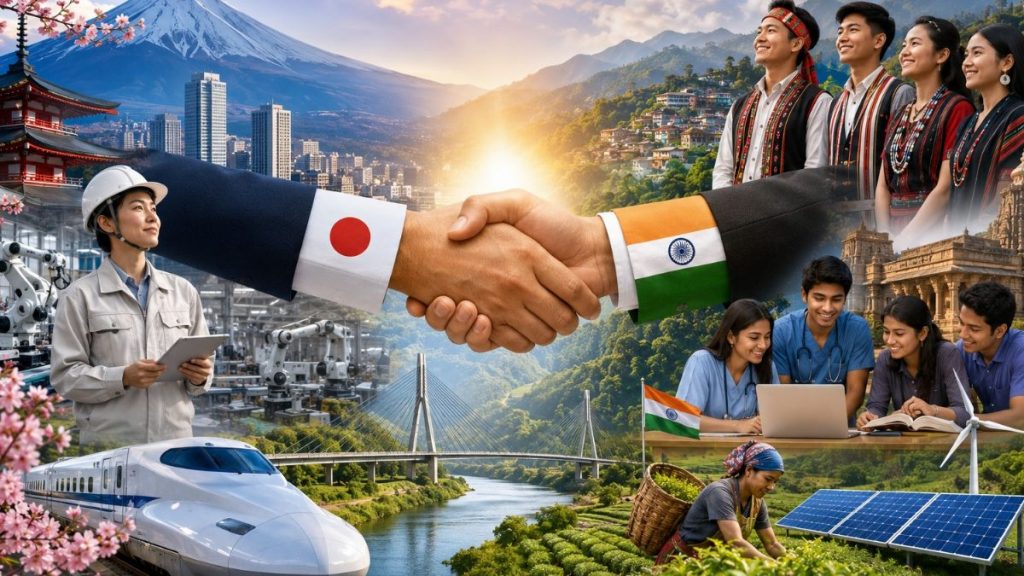
India can offer Japan a large young workforce, better technical skills, English-speaking workers, and stronger ties between the two countries. The partnership therefore has the potential to benefit both countries: Japan needs workers, while India’s young population needs employment opportunities, skills and international exposure.
So, this India-Japan partnership would be beneficial for the young population.
But one of the major barriers for Indians wanting to work in Japan is the Japanese language. Therefore, the Northeast is investing in Japanese language education.
Assam is already developing this connection. Assam Government has launched the Chief Minister’s Foreign Languages Initiative for Global Human Talent (CM-FLIGHT) in October 2025.
The programme provides: Japanese-language training, cultural orientation, and overseas placement assistance. The target sectors mostly include, Nursing and elderly care, Food services, construction, and IT
The Assam Skill Development Mission aims to prepare more than 50,000 young people over three years for opportunities under Japan’s SSW programme.
The Assam Cabinet has revised the payment system for the Foreign Language Training-cum-Implementation Partner (FLTIP) under the CM-FLIGHT scheme on 11 August 2026. The goal is to make cash flow easier and reduce the financial burden on students taking foreign language training.
Now, the ₹1 lakh training support will be given in three parts:
₹30,000 after three months of training
₹30,000 after six months
₹40,000 after finishing the course and submitting the Foreign Language Proficiency Test certificate
Other benefits of the scheme remain the same, such as the ₹50,000 post-placement support, eligibility rules and institutional setup. The Cabinet also confirmed that this change will not add any extra financial cost to the state government.
Also, Meghalaya has developed a similar partnership with Japan.
The Meghalaya State Skill Development Society has partnered with Japan-based ASEAN ONE to provide training opportunities for young people.
In the first phase, more than 500 young people will receive training.
Over the next five years, the programme aims to train around 5,000 candidates.
Plans are also underway to establish Japanese-language academies and direct recruitment channels to help candidates find employment opportunities in Japan.
The partnership not only benefits Japan but also Northeast India, as workers who work in Japan and later return to India will possess work experience, technical skills, work practices and savings, further strengthening industries in Northeast India such as manufacturing, healthcare and hospitality.
This partnership benefits Japan as it strengthens economic relations with India, educational exchanges and security cooperation.
Japan can offer Northeast India’s young population what it needs most, better employment opportunities, skill development and international exposure. At the same time, Northeast India can provide Japan with what it increasingly needs, a young and trainable workforce. This demographic connection creates an opportunity for a new form of cooperation between Japan and Northeast India. Instead of focusing only on sending workers abroad, the partnership can also promote skill development, knowledge sharing, economic growth, and stronger people-to-people and cultural connections between the two regions.