Pune Traffic Alert: Why Baner-Balewadi Roads Are Getting More Congested Every Day
Reported by Shoaib Tadvi and Priyanshu Banerjee
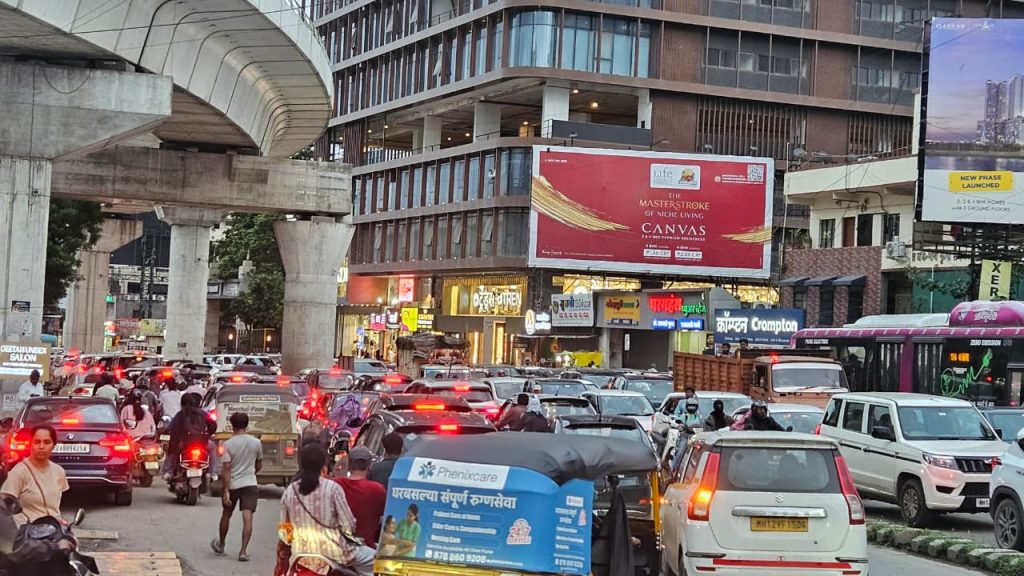
Baner, 13th August 2026: Despite Baner-Balewadi emerging as one of Pune’s major residential and IT hubs, traffic congestion during peak hours continues to trouble residents, office-goers, schoolchildren and patients travelling to hospitals in the area. Residents say the problem has persisted for years, with congestion becoming particularly severe during morning and evening peak hours.
The Baner-Balewadi Nagrik Manch (BBNM) has raised concerns over the growing traffic burden and urged the Pune Municipal Corporation (PMC) to conduct a Potential Future Traffic Impact Study before the proposed Balewadi-Kasapate Vasti bridge becomes operational.
According to residents, the area has witnessed rapid residential and commercial development in recent years, but road infrastructure and traffic management have not kept pace with the growing number of vehicles. They have pointed to congestion at several important junctions, including Dasara Chowk, Mamta Chowk, Radha Chowk, Croma on Baner Road, Kalamkar Chowk, the Kia showroom underpass and Nannavare Chowk.
‘How can traffic be managed without signals?’
Residents have particularly raised concerns over the absence of traffic signals at several important locations. Mamta Chowk and other busy stretches reportedly do not have proper signal arrangements despite witnessing heavy movement of school buses, private vehicles, office commuters, auto-rickshaws and pedestrians.
A resident said traffic management becomes difficult when busy junctions do not have signals or a proper traffic-control mechanism.
“At places like Mamta Chowk, there is not even a proper signal system to regulate the movement. When so many vehicles, school buses and pedestrians use the junction at the same time, how can traffic be managed without proper signals and planning?” the resident said.
Residents said traffic police personnel or temporary traffic arrangements may provide some relief during peak hours, but a permanent solution requires proper junction planning, signals, road markings and designated movement patterns.
Another resident said traffic congestion has become a daily experience for people travelling through Baner and Balewadi.
“Every day, commuters spend a lot of time crossing these junctions. The problem is not limited to residents. Schoolchildren, office employees, patients and their relatives also get stuck in traffic. We need both immediate traffic management and long-term infrastructure solutions,” the resident said.
School timings add to peak-hour congestion
The traffic problem is not limited to office hours. Residents said school buses, private vehicles and parents picking up or dropping off children contribute significantly to congestion during the morning and afternoon/evening periods.
Several schools in the area reportedly have similar dispersal timings, resulting in a large number of vehicles entering the roads simultaneously.
Mamta Chowk has emerged as a major trouble spot, with residents raising concerns over parents parking their vehicles along the road while waiting for or picking up schoolchildren. They said roadside parking further reduces the available road space and creates traffic bottlenecks.
A resident said authorities should coordinate with schools to create designated pick-up and drop-off arrangements.
“School timings are almost the same at many schools in the area. In the morning, school buses and parents’ vehicles add to the traffic, and at dispersal time, vehicles again gather around the schools. At Mamta Chowk, roadside parking by parents makes the situation worse. There should be proper traffic planning around schools,” the resident said.
Auto-rickshaws, markets and encroachments worsen congestion
After office hours, another problem emerges, residents said. Auto-rickshaws reportedly gather outside IT companies as employees leave their offices, reducing available road space and contributing to congestion.
Encroachments and roadside markets, including vegetable and fish markets, have also been cited as factors worsening the situation. Traffic near Croma on Baner Road is another major concern due to commercial activity, roadside parking and heavy vehicle movement.
Residents have demanded strict action against encroachments and illegal parking, along with proper parking arrangements in commercial areas.
Residents highlight missing road links
Residents have also highlighted several missing road connections that they believe could provide alternative routes and distribute traffic more evenly if completed.
The missing links identified by residents include:
F Residency to National Highway 48
Patil Nagar to NH-48
Wakad-Balewadi bridge
Jupiter to Wakad Road
According to residents, these road connections should be completed at the earliest to provide commuters with alternative routes and reduce pressure on existing roads.
“The missing road links need to be completed as soon as possible. If these connections are developed, traffic can be distributed across different routes instead of putting all the pressure on existing roads. This could provide some relief to commuters who are currently stuck for long periods during peak hours,” a resident said.
Residents said merely widening or improving individual junctions will not be sufficient unless the wider road network is planned properly. They want better connectivity between internal roads and NH-48 so that traffic does not remain concentrated on a handful of major routes.
BBNM seeks traffic impact study before new bridge
The BBNM has submitted a representation to the PMC Commissioner regarding the traffic situation and the proposed Balewadi-Kasapate Vasti bridge.
The representation states that Baner-Balewadi has experienced rapid residential and commercial growth and that traffic congestion, illegal parking and pressure on existing roads have already become serious concerns.
Residents have warned that once the bridge becomes operational, traffic pressure on the internal roads of Balewadi and Baner could increase substantially. They have therefore sought a Potential Future Traffic Impact Study before the bridge is opened so that possible traffic consequences can be assessed in advance and corrective measures planned.
The residents have suggested that the study should examine several aspects, including:
Installation of traffic signals wherever required.
Identification and notification of no-parking zones.
Proper planning of P1 and P2 parking areas.
Assessment of the requirement for traffic islands and rotaries.
Development of adequate pedestrian facilities.
Fixing suitable timings for the movement of heavy vehicles.
Installation of proper signage.
The BBNM has also called for coordination with the Pune Traffic Police before the bridge and other major projects are implemented.
Metro expected to help, but residents want road planning too
The Hinjawadi-Shivajinagar Metro Line 3 is also expected to provide relief to commuters travelling towards the IT hub. However, residents say Metro connectivity alone cannot solve Baner-Balewadi’s traffic problems.
They want civic authorities to simultaneously address missing road links, junction management, parking, encroachments, pedestrian infrastructure and traffic regulation.
The BBNM representation also points out that the area is connected to National Highway 48, making it an important route for movement into and out of the city. Residents said some internal roads remain incomplete due to issues such as land acquisition, adding further pressure on the existing road network.
‘Traffic planning must happen before the situation gets worse’
Residents said the rapid growth of IT offices, residential societies, schools, hospitals and commercial establishments has increased the number of vehicles using the Baner-Balewadi road network.
One resident said authorities need to look at the entire area as a single traffic network rather than addressing individual junctions only after congestion becomes severe.
“Baner-Balewadi is being developed as a major IT and residential area, but the traffic infrastructure has not developed at the same pace. There are junctions without signals, missing road connections, roadside parking and encroachments. Proper planning has to happen now; otherwise, congestion will become even worse in the coming years,” the resident said.
Residents claim that during severe peak-hour congestion, commuters can spend nearly an hour negotiating a relatively short stretch, with traffic barely moving at several junctions.
With the area continuing to witness rapid development, residents fear traffic pressure will only increase unless missing infrastructure projects are completed and a comprehensive traffic plan is implemented.
The BBNM has therefore urged the PMC to coordinate with the Pune Traffic Police and other concerned agencies and conduct the proposed traffic impact assessment before the Balewadi-Kasapate Vasti bridge becomes operational.
For residents, the demand is not merely for temporary traffic regulation but for a long-term mobility plan covering traffic signals, missing roads, parking, school traffic, auto-rickshaw management, encroachments, pedestrian facilities and junction planning.
As Baner-Balewadi continues to grow as an IT and residential corridor, residents say authorities must address traffic infrastructure before the existing congestion turns into an even bigger daily crisis.