The Menopause Gap: How Society Fails Women at Their Most Vulnerable
Ms. Avni Jain and Dr. Garima Rajan
Department of Psychological Sciences, FLAME University, Pune.
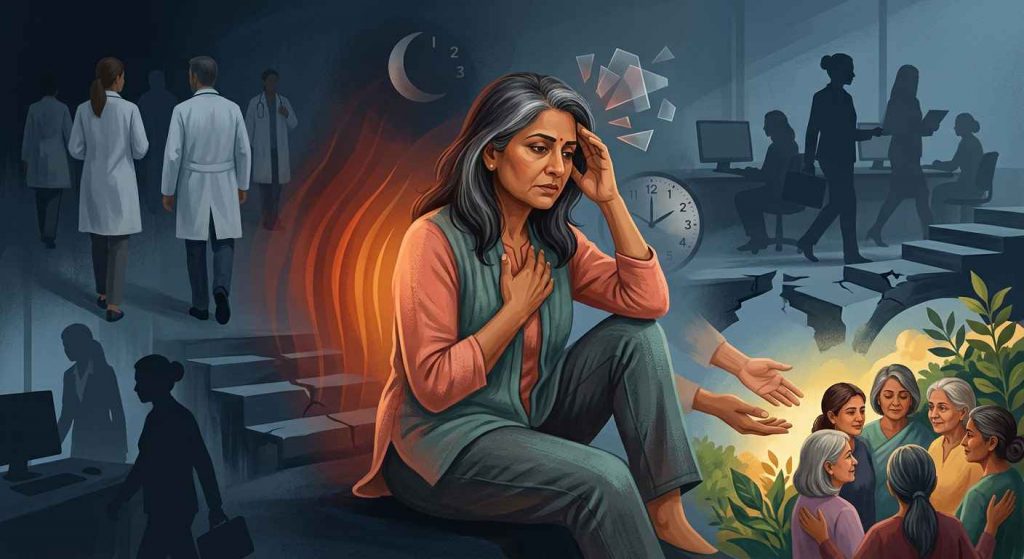
Pune, 17th August 2026: Women spend decades dealing with hormonal transitions like puberty, menstruation, contraception, pregnancy, and postpartum recovery. Still, once they hit menopause, which is one of the biggest biological shifts they’ll ever face, they find not support but silence. This is not a coincidence. Menopause remains severely under-researched, under-discussed, and socially minimized despite affecting millions of women globally (World Health Organization [WHO], 2024). While society expects women to expertly manage those hormonal changes across their reproductive years, it at the same time treats menopause like it’s just an inevitable hassle, not really a condition that deserves proper medical attention and real emotional care.
A Lifetime of Hormonal Management
From the onset of puberty, women begin a lifelong relationship with hormonal fluctuation. They manage menstrual cycles, endure the side effects of contraception, shoulder the primary responsibility for reproductive health, and navigate the profound physical changes of pregnancy and postpartum recovery. Each transition demands adaptation, often with minimal systemic support. The expectation is simple: women should handle it.
Then comes perimenopause and menopause. After decades of managing their bodies’ hormonal demands, women are expected to endure yet another transition, this time in near-total silence. The menopausal transition can last several years and affects physical, emotional, mental, and social well-being (WHO, 2024). Yet this universal experience is treated as a private burden, not a public health priority. Women are left to navigate symptoms like hot flashes, mood changes, and sleep disturbances without the medical infrastructure or cultural support they deserve.
The Silence Around Menopause
Menopause is shrouded in cultural discomfort. Aging women are rendered invisible in media, healthcare, and the workplace. Unlike pregnancy, which receives widespread medical attention and social validation, menopause is framed as something to whisper about, not discuss openly (National Institute on Aging [NIA], 2025). This silence extends into the workplace, where menopausal symptoms remain largely unacknowledged despite their significant impact on productivity and career trajectories.
Research reveals the economic toll of this silence: the U.S. economy loses $26.6 billion annually due to lost productivity and healthcare expenses from menopausal symptoms, with nearly 11% of women missing work in the past year due to symptoms like hot flashes and sleep disturbances (Faubion et al., 2023). Women experiencing severe symptoms report changing jobs or leaving the workforce entirely, just as they reach the pinnacle of their careers (Kapoor, 2024). The stigma around discussing symptoms openly creates a vicious cycle: women suffer in isolation, employers remain unaware, and the issue perpetuates itself.
Psychological and Emotional Devastation
The mental health impact of menopause is profound yet persistently overlooked. Women in perimenopause are two to four times more likely to experience a depressive episode compared to their premenopausal years (Let’s Talk Menopause, n.d.). Fluctuating estrogen and progesterone levels affect every major organ system, including the brain, contributing to increased vulnerability to anxiety and depression (Unverferth, 2023).
Beyond clinical depression, women report brain fog, memory problems, irritability, and overwhelming emotional exhaustion. These symptoms are not merely uncomfortable; they fundamentally disrupt identity, relationships, and work performance. Yet when women seek help, they are often dismissed. Their symptoms are normalized as “just aging” rather than treated as legitimate medical concerns requiring intervention. This dismissal is a form of medical gaslighting that leaves women questioning their own experiences and sanity.
Medical Neglect and Research Gaps
The medical establishment has systematically failed menopausal women. Despite menopause affecting half the global population, it receives shockingly little research funding. According to recent analyses, conditions like premenstrual syndrome, menopause, maternal health conditions, cervical cancer, and endometriosis constitute 14% of the women’s health burden but received less than 1% of cumulative research funding between 2019 and 2023 (World Economic Forum, 2025). Less than 5% of global health research funding addresses women’s health beyond the reproductive years (The Partnering Initiative, 2025).
The National Institutes of Health (NIH) doesn’t even assign menopause a unique identifier in its funding taxonomy, making it difficult to track the limited research funding that exists (Nature, 2023). In 2023, menopause research received only $56 million from the NIH (Salinas, 2025), a pittance for a condition affecting millions.
The consequences of this research gap are devastating. Healthcare providers receive as little as 1 hour of menopause-related training throughout their medical education (The Partnering Initiative, 2025). This knowledge deficit means that when women do seek help, they encounter providers who lack the training to recognize symptoms, offer evidence-based treatments, or provide compassionate care. The medical system that once monitored women’s reproductive health with meticulous attention now abandons them at menopause.
Reframing Menopause: A Positive Psychology Approach
Despite these systemic failures, there is a path forward. Positive psychology offers a framework for reframing menopause not as a decline but as a transition, an opportunity for reassessment, growth, and flourishing (WHO, 2024). This perspective recognizes that resilience does not mean silent endurance. Women deserve emotional support, community connection, and access to evidence-based care.
Creating menopause-friendly workplaces, expanding medical education, and building peer support networks are not luxuries; they are necessities. When women receive proper support during this transition, they can thrive. The question is whether society is willing to provide that support.
Conclusion: A Public Health Imperative
Menopause is not a niche issue. It is a universal public health concern, a gender equity crisis, and a psychological well-being emergency. Women should not spend decades expertly managing hormonal transitions only to encounter systematic neglect during one of the most significant biological changes of their lives.
The silence must end. We need increased research funding, comprehensive medical education, workplace accommodations, and cultural transformation. We need to recognize that women’s health matters beyond their reproductive years. We need to acknowledge that menopause is not a private inconvenience but a shared societal responsibility. Until menopause receives the medical attention, research funding, and social support it deserves, we will continue to fail half the population at their most vulnerable.
About the Authors:
Ms. Avni Jain is an Undergraduate Psychology Student at FLAME University, Pune and Dr. Garima Rajan is an Assistant Professor of Psychology at FLAME University, Pune.
References
Faubion, S., Larkin, L., Stuenkel, C., Bachmann, G., Chism, L., Dalkin, A., … & Shifren, J. (2023). Management of menopause-associated vasomotor symptoms: Position statement of The North American Menopause Society. Menopause, 30(5), 573-590. https://www.mayoclinic.org/about-mayo-clinic/newsnetwork/press-releases/mayo-clinic-study-puts-price-tag-on-cost-of-menopause-symptoms-for-women-in-the-workplace
Kapoor, E. (2024). Menopause in the workplace: Challenges, impact, and next steps. Maturitas, 183, 107928. https://www.sciencedirect.com/science/article/abs/pii/S0378512224000781
Let’s Talk Menopause. (n.d.). How menopause affects your mental health.
https://www.letstalkmenopause.org/menopause-mental-health
National Institute on Aging. (2025). Menopause. U.S. Department of Health and Human Services, National Institutes of Health. https://www.nia.nih.gov/health/menopause
Nature. (2023). Women’s health: End the disparity in funding. Nature, 617(7960), 225. https://www.nature.com/articles/d41586-023-01472-5
Salinas, A. (2025, December 12). Rep. Salinas urges NIH to continue funding landmark menopause study. https://salinas.house.gov/media/press-releases/rep-salinas-urges-nih-continue-funding-landmark-menopause-study
The Partnering Initiative. (2025, June 3). Rewriting the future of women’s health: Why the world needs bold partnerships to close the menopause gap. https://thepartneringinitiative.org/general-news/rewriting-the-future-of-womens-health-why-the-world-needs-bold-partnerships-to-close-the-menopause-gap/
Unverferth, K. (2023). Treating the mental health side of menopause. UCLA Health. https://www.uclahealth.org/news/article/treating-mental-health-side-menopause
World Economic Forum. (2025, January 17). There’s a women’s health gap. Here’s how to close it. https://www.weforum.org/stories/2025/01/theres-a-womens-health-gap-heres-how-to-close-it/
World Health Organization. (2024, October 16). Menopause [Fact sheet]. https://www.who.int/news-room/fact-sheets/detail/menopause