Underwater Domain Awareness (UDA) must evolve beyond a security and surveillance framework – Gen Manoj Pande
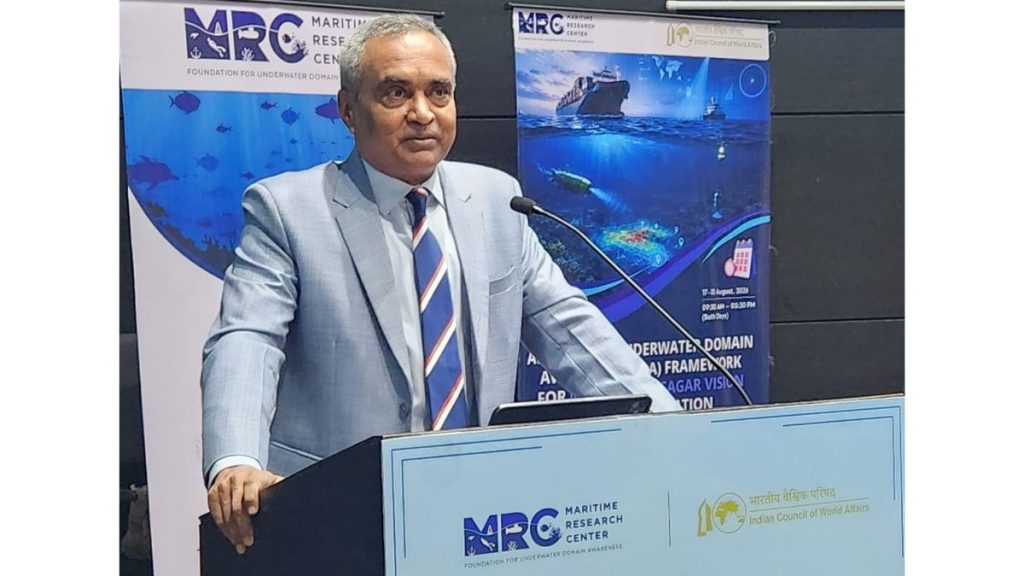
Pune, 18th August 2026: Underwater Domain Awareness (UDA) must evolve beyond a security and surveillance framework to encompass marine ecology, navigational safety, sustainable resource use and the protection of critical infrastructure, former Chief of the Indian Army General Manoj Pande said on Tuesday. Dr. (Cdr) Arnab Das, Founder of the Maritime Research Centre was present on the dais on the occasion.
Speaking at the program “Advancing Underwater Domain Awareness Framework for India’s Mahasagar vision and its Realization”, organized by the Maritime Research Center (MRC), Pune, in association with the Indian Council of World Affairs (ICWA), General Pande said India’s growing dependence on the oceans had coincided with an increasingly complex, contested and environmentally vulnerable maritime domain.
“Awareness of the underwater domain cannot be viewed only through the lens of security or surveillance,” he said, stressing the need for a wider, multidisciplinary approach.
Unlike the surface maritime domain, the underwater environment is largely invisible, dynamic and difficult to monitor. Yet it contains critical infrastructure, ecosystems, natural resources and activities that have a direct bearing on India’s security and economic interests.
“You cannot secure what you do not understand, and you cannot effectively manage what you cannot adequately observe,” General Pande said.
He described UDA as a shared knowledge framework bringing together information, technology, institutions and expertise to create a comprehensive picture of developments beneath the surface. Such a framework, he said, could not be the responsibility of any single agency as the underwater domain cuts across defense, shipping, ports, fisheries, environmental protection, scientific research, offshore infrastructure and the wider blue economy.
General Pande highlighted four areas where UDA could play a critical role including sediment management and navigational safety; blue accounting and marine environmental economics; biofouling, anthropogenic noise and ecological resilience; and sustainable fisheries, aquaculture and marine bio-resources.
He said better underwater information could improve navigation, support more efficient utilization of marine resources, protect critical infrastructure and enable informed environmental decisions. The approach would also be relevant to India’s inland water transport projects, particularly in the northeastern region.
“What gets measured gets managed,” he said, underlining the need to better assess the economic value of marine ecosystems and the costs arising from their degradation.
Calling for greater integration, technology adoption and sustainability, General Pande said defense organizations, government agencies, scientific institutions, industry and academia must work together while respecting security and data requirements.
Emerging technologies such as sensors, autonomous systems, artificial intelligence, data analytics and seabed mapping offered significant opportunities, he said, but technology should ultimately serve decision-making. He said the Mahasagar Vision offered an opportunity to integrate security, development, sustainability and cooperation, with UDA emerging as an important enabler of this holistic approach.