AI Is Creating More Jobs Than It Is Destroying in India, Says Nomura Report
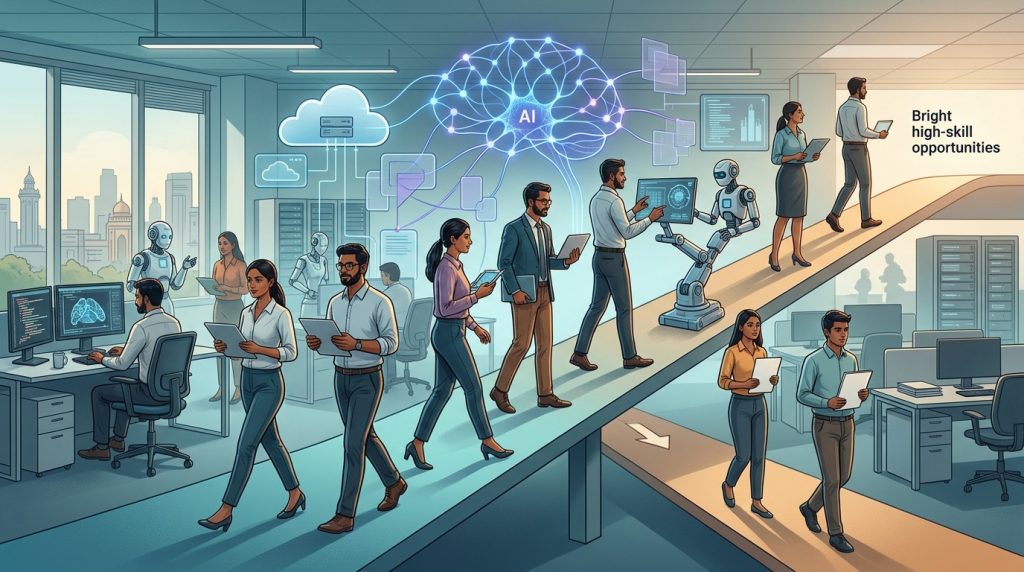
New Delhi, 24th August 2026: Artificial intelligence (AI) is creating more employment opportunities than it is eliminating in India, according to a report by Japanese financial services company Nomura. However, the rapid adoption of AI is creating a growing divide in the job market, with freshers and junior employees facing greater challenges while demand for experienced professionals is rising.
The report said India, China and the Philippines are among the countries where employment has increased alongside the adoption of AI, challenging concerns that the technology will lead to widespread job losses.
AI creates a K-shaped job market
Nomura described the emerging employment trend as a “K-shaped split”, with the job market moving in two different directions.
Demand for fresh graduates and junior-level employees is declining, while companies are increasingly looking for experienced professionals with strong management capabilities and a deeper understanding of business operations.
A similar trend has been observed in South Korea, particularly in sectors that have adopted AI more extensively, according to the report.
Companies reducing fresh hiring instead of mass layoffs
The impact of AI is not necessarily appearing through large-scale layoffs. Instead, companies are increasingly reducing or stopping the recruitment of new employees while retaining existing staff.
This trend has been described as “silent firing”, where organisations effectively reduce opportunities for new entrants rather than conducting large-scale workforce cuts.
Campus recruitment has also declined significantly as companies reduce their dependence on college placements.
Technology sector accounts for most new AI-related jobs
More than 90% of the new employment opportunities created alongside AI adoption are emerging in the technology sector, according to the report. Other sectors account for less than 10% of these new opportunities.
In India, recruitment is growing in areas such as data annotation, linguistics and AI-related IT services, where workers help prepare data for AI systems and support the development and deployment of AI technologies.
China, however, is moving further towards higher-skilled AI development. While India is seeing growth in support and service-oriented roles, Chinese companies are hiring highly skilled graduates to develop new AI models and technologies.
Opportunities outside the technology sector remain limited, with emerging roles including AI risk analysts in banks and specialists working on autonomous vehicles.
AI poses a challenge to India’s traditional IT model
The report highlights a particular challenge for India because of the country’s position as a global back-office and IT services hub.
Many traditional IT jobs in India are built around relatively routine and repetitive tasks that can increasingly be performed by AI systems. This could put pressure on conventional entry-level and service-oriented roles in the country’s technology sector.
At the same time, India’s large pool of engineers and technology professionals could become a major advantage if workers and companies successfully upgrade their skills to meet the demands of the AI-driven economy.
AI is also rapidly evolving beyond tools designed to perform individual tasks. The development of agentic AI systems, which can independently carry out tasks and make decisions within defined parameters, could further reshape the employment market in the coming years.
The Nomura report suggests that while AI is unlikely to simply eliminate jobs across the board in India, its impact will be uneven. The ability of workers to acquire advanced technical, analytical and business skills could determine who benefits from the next phase of the AI-driven job market.