Pune Ganeshotsav 2026 Guide: When and Why Kasba, Guruji Talim, Rangari and Other Manache Ganpatis Were Started
Pune, 14th September 2026: On the occasion of Ganesh Chaturthi, let’s stroll down the path of history and take a look at some of the oldest and most iconic Ganpati Mandals in Pune and Mumbai!
The oldest Ganpati Mandals in both cities are over a hundred years old, carrying a rich history of culture and tradition, and bringing communities together in the name of the festive spirit.
- Tulshibaug Ganpati Mandal, Pune
Established in 1901, Tulshibaug Ganpati (often called “Manacha Chowtha Ganapati”, the fourth most respected Ganpati of Pune) grew out of the Tulshi Baug Ram Mandir complex in Budhwar Peth. It emerged as part of the early wave of public Ganeshotsavs that followed Lokmanya Tilak’s push for sarvajanik celebrations, and over time became one of the city’s “Manache” (honoured) Ganpatis. An interesting point is that despite being younger than some of the older mandals, it holds a fixed place in the traditional procession order of Pune’s most respected Ganpatis.
- Akra Maruti Chowk Sarvajanik Ganeshotsav Mandal, Pune
This mandal’s Ganpati idol dates back to 1893, making it over 130 years old. The idol was first installed inside the famous Dagdusheth Ganpati Mandir before moving to its own setup at Akra Maruti Chowk in Shukrawar Peth. It thus shares deep historical links with Dagdusheth and the early public Ganesh movement in Pune. A notable fact is that its idol is among the oldest continuously worshipped public Ganpati idols in the city, connecting today’s celebrations directly to the 1890s.
- Kesari Wada Ganpati Mandal, Pune
Started in 1894 by Lokmanya Bal Gangadhar Tilak through his Kesari Trust, this mandal began at Vinchurkar Wada (Tilak’s ancestral home) and later shifted to Kesari Wada in 1905. It was explicitly conceived as a platform to gather people under the banner of Ganeshotsav and spread nationalist ideas through cultural events. An interesting fact: from its inception, the Kesari Ganpati has been closely tied to Tilak’s newspapers and trust, making it almost a living extension of his socio-political work.
- Keshavji Naik Chawl Ganpati, Girgaon, Mumbai
Founded in 1893, this is Mumbai’s oldest sarvajanik (public) Ganpati mandal. It was started by Tilak’s close associates, Raobahadur Limaye, Naraharashastri Godse, Baburao Dhakas, Appasaheb Gokhale, and Madhavrao Nandivdevkar, after Tilak’s call to use Ganesh Chaturthi as a unifying public festival against colonial rule. The celebration began with a small murti in Godse’s apartment, then moved to the chawl’s courtyard to accommodate crowds. A striking fact: in 1901, Tilak himself visited the chawl to deliver a lecture and praise the residents’ Ganpati celebrations, cementing its place in freedom-struggle history.
- Shri Chhatrapati Rajaram Mandal, Pune
This mandal was also established by Bhausaheb Laxman Javale (Bhau Rangari) around the same time as his main Rangari Ganpati, in the early 1890s. In 1892, Rangari commissioned a sculptor named Naik to make three Ganpati idols: one for himself, one for what became the Shrimant Bhausaheb Rangari Ganpati Trust, and the third for the Chhatrapati Rajaram Mandal. So this mandal effectively originated as a “sister” idol from Rangari’s original set. An interesting fact: its very existence is tied to that trio of idols crafted in 1892, linking it directly to the birth of sarvajanik Ganeshotsav in Pune.
- Kasba Ganpati Mandal, Pune
The Kasba Ganpati temple and idol were installed in 1639 by Queen Jijabai Bhosale, and her son, Chhatrapati Shivaji Maharaj, who made it Pune’s local deity (Gramdaivat) after rebuilding the war-ravaged city. In 1893, when Lokmanya Bal Gangadhar Tilak transformed Ganesh Chaturthi into a public, nationalist festival, he gave Kasba Ganpati the honour of “Manacha Pahila Ganapati” and began his immersion processions from here, but he did not found the temple or install the idol. An interesting fact: the idol is considered “swayambhu” and iconographic studies suggest it may predate even the 17th century, while in 2026 about 900 kg of centuries-old sindoor was removed from it, revealing its original form under layers accumulated over hundreds of years.
- Shrimant Bhausaheb Rangari Ganpati Trust, Pune
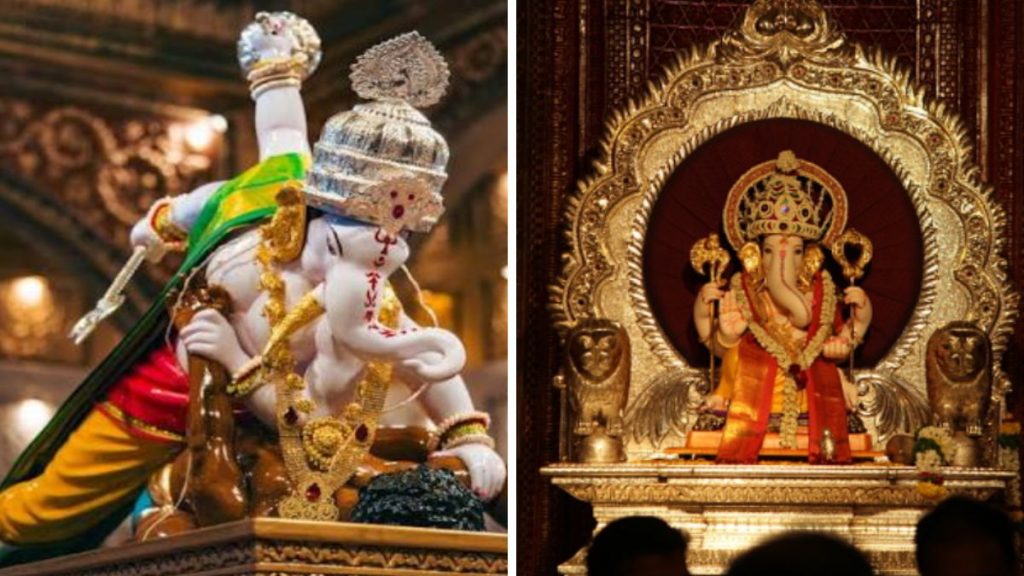
Established in 1892 by Bhausaheb Laxman Javale (Bhau Rangari), a social reformer and freedom fighter, this is widely regarded as India’s first sarvajanik (public) Ganpati mandal. Rangari wanted a common, safe space where revolutionaries could meet and communicate without British suspicion; he chose Ganesh Chaturthi as the cover and installed an idol of Ganesha slaying a demon, symbolising the British. A well-known interesting fact: the idol’s theme (Ganesha killing a demon) was a coded political statement, making this mandal not just religious but also a cradle of anti-colonial organising.
- Guruji Talim Ganpati Mandal, Pune
Founded in 1887, Guruji Talim is one of Pune’s oldest public Ganpati mandals and is known as “Manacha Tisra Ganapati” (the third most honoured Ganpati). It was established jointly by two Hindu and two Muslim families, notably the Shinde and Nalband families, who ran a wrestling centre (talim) called “Guruji Talim,” from which the mandal gets its name. Its origin as a Hindu–Muslim initiative made it an early symbol of communal harmony in Pune’s Ganeshotsav. An interesting fact: it began as a public Ganpati even before Tilak’s 1893 push, showing how local community efforts predated and fed into the larger sarvajanik movement.
These eight Ganpati mandals: Kasba, Guruji Talim, Bhausaheb Rangari, Chhatrapati Rajaram, Tulshibaug, Akra Maruti, Kesari Wada and Mumbai’s Keshavji Naik Chawl, are not just religious centres but living chapters of Maharashtra’s social and freedom-struggle history. Knowing when they were established, who founded them, and the stories behind their idols makes every darshan during Ganesh Chaturthi more meaningful and connects today’s celebrations to their 19th‑century (and older) roots.