Before You Buy Modak or Peda in Pune, Here’s What the FDA Found
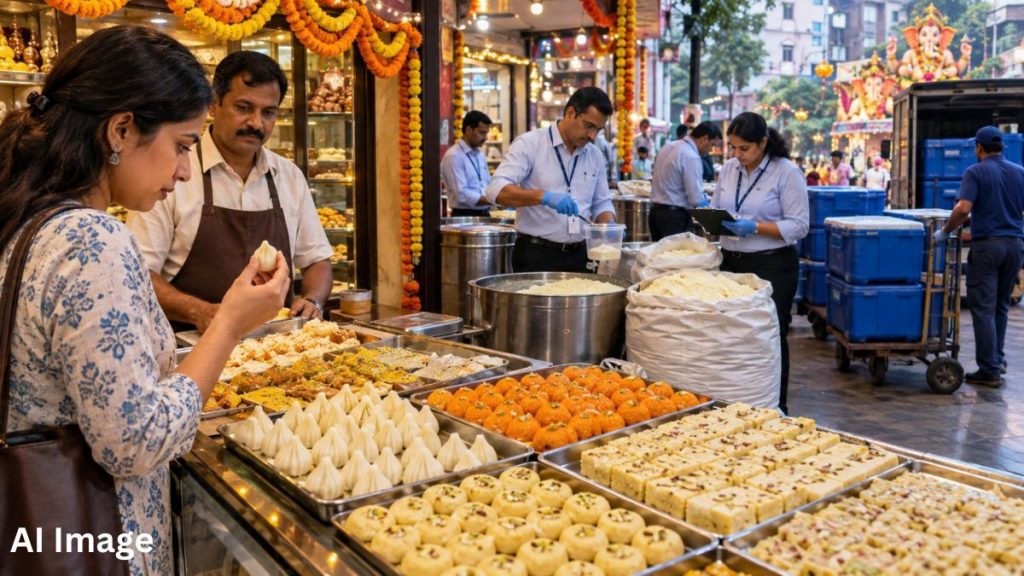
Pune, 17th September 2026: Despite intensified action by the Food and Drug Administration (FDA) against food adulteration, questions are being raised over the quality, safety and traceability of sweets being sold across Pune during the festive season.
With Ganeshotsav underway, demand for khoya, malai modak, peda, ladoo, barfi and other sweets has increased. However, consumers purchasing loose sweets often do not receive clear information about when the products were prepared or how long they can safely be consumed.
At several shops, consumers are reportedly given verbal assurances that sweets were prepared on the same day when they ask about their freshness. However, information such as the date of preparation and applicable shelf-life details may not always be clearly available at the point of sale.
The lack of clear information can make it difficult for consumers to establish how old a product is and whether it has been transported and stored under appropriate conditions.
The issue assumes greater significance during the festive season, when large quantities of sweets are prepared and sold over a short period. The quality and shelf life of sweets can be affected by the time between preparation and consumption, transportation, storage conditions, hygiene and temperature control.
Concerns Over Low-Priced Sweets
Questions have also been raised over relatively cheaper products such as malai peda and modak sold at some sweet shops in different parts of Pune.
Concerns are sometimes raised about the possible use of lower-quality fats or vanaspati in inexpensive sweets. However, such claims cannot be established merely on the basis of taste, smell or price and would require appropriate food testing.
Some consumers have reported symptoms such as throat irritation, a burning sensation or digestive discomfort after consuming certain sweets. However, these symptoms alone do not establish that the products contained vanaspati, adulterated ghee or any other specific substance.
Similarly, repeated heating of cooking fats during the preparation of products such as motichoor ladoos can affect their quality. Changes in smell or taste may indicate that a product requires closer scrutiny, but such observations alone cannot establish adulteration.
Consumers have therefore been advised to exercise caution when purchasing sweets, particularly products that appear unusually cheap, and to pay attention to significant changes in their colour, smell, taste or texture.
Long Supply Chain Adds to Food Safety Concerns
The increased demand for sweets during Ganeshotsav, Dussehra and Diwali is met through a supply chain involving manufacturers, wholesalers and retailers. Products such as modak, peda, barfi and ladoos may pass through multiple stages before reaching consumers, particularly when smaller retailers source them from outside suppliers.
The longer the period between production and consumption, the more important proper transportation and storage become. Temperature control, hygiene and storage conditions at different stages can affect the quality and shelf life of milk-based sweets.
For consumers buying loose sweets, establishing the exact date of preparation can also be difficult when such information is not clearly communicated at the point of sale.
Why Preparation and Shelf-Life Information Matters
Clear information about preparation and applicable shelf-life periods can help consumers make informed purchasing decisions, particularly when buying milk-based products such as khoya, peda and modak that require appropriate handling and storage.
The FDA has been conducting inspections and taking action involving milk, khoya, mawa, paneer and other food products. The continued concerns surrounding festive-season food sales underline the importance of regular inspections, proper storage practices and consumer awareness.
4,627 Kg of Unlabelled Khoya Seized
In a recent action in central Pune, 4,627 kg of khoya brought from Barshi and Karnataka for sale in the city was reportedly found without proper identification or labelling.
Food safety officials from Sangli inspected the stock and collected one sample each from 33 separate lots for laboratory analysis. The absence of proper identification on the stock has raised concerns about traceability and the ability to establish its source and quality.
In separate actions at three locations in the city, FDA teams seized a total of 18,070.5 kg of khoya, valued at approximately ₹43.27 lakh. A total of 69 food samples were collected during these operations for further analysis.
The seizures come amid increased demand for khoya and other milk-based ingredients used in sweets during Ganeshotsav.
Questions Over Coordination
The recent action has also raised questions about coordination between FDA officials at the local and senior levels.
Pune-based FDA officials were reportedly initially unaware of some details of the operation, while local officials were unable to provide complete information about the action until late at night.
This has led to questions over whether the operation was coordinated directly by senior officials at the state level. However, there has been no official confirmation that the operation reflected any lack of confidence in Pune-based officials.
With the festive season underway, food safety officials face the challenge of monitoring not only raw materials such as khoya and other milk products but also finished sweets reaching consumers through different retail channels.
For consumers, purchasing sweets from reliable sellers, being cautious about products that appear unusually cheap and checking their appearance, smell, taste and texture can help reduce the risk of buying poor-quality products. At the same time, regular enforcement, proper storage and transparent information about the preparation and applicable shelf-life of sweets remain important aspects of food safety during the festive season.