
Hip Replacement Options for Younger Patients: Understanding DAA Surgery and Hip Navigation Technology
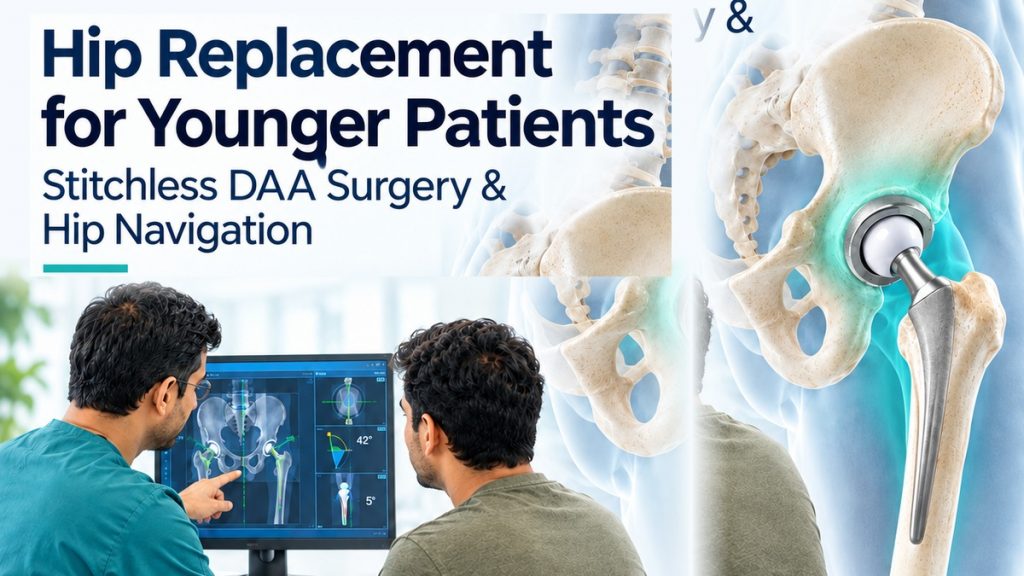
Wakad, 22nd October 2026: Hip replacement is no longer a procedure associated only with older adults, as conditions such as avascular necrosis (AVN), which affects the blood supply to the hip bone, can lead to severe joint damage in younger and middle-aged patients.
Dr. Neeraj Adkar, Chief Robotic Joint Replacement Surgeon and Sports Injury Specialist at Saishree Vitalife Hospitals, Pune, explains how advances in hip replacement techniques and technology-assisted surgical planning are being used to address hip pain and help patients regain mobility.
Hip pain often develops gradually, affecting everyday activities such as climbing stairs, walking and travelling. As the condition progresses, patients may find it increasingly difficult to carry out routine tasks. In cases where the hip joint is severely damaged, hip replacement may be considered after an appropriate medical assessment.
What is the Direct Anterior Approach to hip replacement?
The Direct Anterior Approach (DAA) is a surgical technique in which the surgeon accesses the hip joint through an incision at the front of the hip, working between muscles rather than cutting through them. A variation known as the bikini incision uses an incision placed along a natural skin crease.
The approach may offer some early recovery benefits for selected patients, including reduced pain and improved hip function during the initial months after surgery. However, these benefits vary, and current evidence does not establish that DAA consistently produces better long-term outcomes than other established surgical approaches.
The suitability of the technique depends on factors such as the patient’s anatomy, the underlying condition and the surgeon’s assessment.
How hip navigation technology assists surgeons
Saishree Vitalife Hospitals uses the VELYS™ Hip Navigation System to support hip replacement procedures. The hospital describes itself as the first centre in India to introduce the technology.
According to the hospital, digital templating before surgery helps with planning, including the assessment of leg length. During surgery, navigation technology provides real-time guidance to assist the surgeon in assessing implant positioning, cup angles, hip offset and leg length.
Such systems are intended to support surgical planning and decision-making. They do not replace the surgeon’s clinical judgement, experience or responsibility for the procedure.
Stitchless bikini incision: What patients should know
The hospital also offers stitchless closure techniques for selected patients undergoing hip replacement through the Direct Anterior Approach.
Depending on the patient’s condition and the surgeon’s assessment, these techniques may eliminate the need for conventional external stitches and subsequent stitch removal. The approach is intended to simplify aspects of wound care, although healing time and scar appearance can vary from patient to patient.
Dr. Adkar said the growing number of younger patients with conditions such as AVN has changed the way hip replacement is viewed.
“Today, we are seeing patients with conditions like AVN at a much younger age, and for them, hip replacement is not just about relieving pain—it is about getting their life back. Ultimately, technology is valuable when it helps us deliver better care and greater confidence to our patients,” he said.
Hip replacement can help eligible patients with advanced joint damage reduce pain and improve mobility, potentially allowing them to return to activities such as walking and travelling more comfortably.
For patients considering surgery, an evaluation by an experienced orthopaedic surgeon can help determine whether hip replacement is appropriate and which surgical approach best suits their individual condition.
Technology-assisted navigation and newer incision and closure techniques may form part of the discussion, depending on clinical suitability.