
India’s SMEs do not have a technology gap but have an integration gap
By Arun Meena
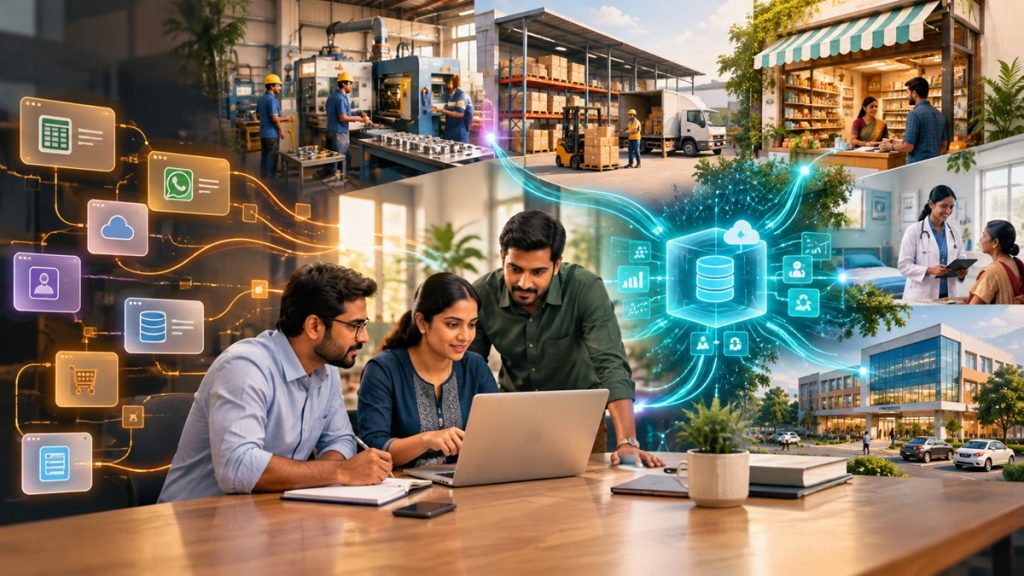
Pune, 2nd November 2026: India’s small and medium businesses are often described as slow adopters of technology. That description is no longer accurate. Walk into a growing manufacturer, healthcare provider, logistics company, retailer or professional-services firm today, and you will usually find accounting software, a CRM, inventory tools, WhatsApp Business, spreadsheets, cloud storage and, increasingly, some form of AI assistant. The problem is not that these businesses lack technology. The problem is that their technology does not talk to each other.
Sales data sits in one system. Inventory sits in another. Customer conversations live on WhatsApp. Financial reconciliations happen at month-end. Operations teams maintain their own trackers. Leadership receives reports that are already weeks old. Everyone is busy, but nobody has a complete, current view of the business.
This is the quiet operational crisis facing many Indian SMEs. It does not appear in a balance sheet as a named expense. It shows up as delayed decisions, repeated manual work, avoidable errors, working capital locked in the wrong places, and growth that becomes harder to manage precisely when it should become easier.
The cost is visible across sectors
In an auto-ancillary unit, sales orders, production plans and procurement often sit in separate systems. When a customer changes a delivery schedule, sales may learn about it first while planning and procurement continue working to the earlier requirement. The result can be excess inventory, missed dispatches or avoidable overtime.
A restaurant group may use one platform for online orders, another for dine-in billing, WhatsApp for reservations and spreadsheets for supplier purchases. Without integration, management may not quickly see which outlet is losing margin, which menu items create waste or why delivery times vary. Schools face a similar challenge. Admissions, fee collection, attendance, transport and parent communication often run on separate tools. Delayed fee visibility or transport exceptions can affect both cash flow and parent experience. A mall deals with footfall, parking, tenant sales, promotions, maintenance and security. If these systems remain disconnected, management may know how many people visited but not whether those visits converted into sales or where costs are rising. In each case, the constraint is not the absence of software. It is the absence of connected, decision-ready operations.
Digital transformation has been misunderstood
For years, digital transformation was sold as a simple equation: buy software, become digital. Many businesses purchased tools, migrated files to the cloud, built websites and apps, and digitised forms. Yet the day-to-day experience of running the company did not change much.
The reason is straightforward. Digitising a process is not the same as improving it. Technology should not merely record what a business is doing. It should help the business understand what is happening, identify what needs attention and enable people to act faster. That is the difference between having systems and having operations that can think.
Data must become decision-ready
Indian businesses generate more data than ever before. But data by itself has limited value. A dashboard filled with numbers is not insight. A report that arrives after the decision has already been made is not intelligence. For data to be useful, it must be reliable, timely and connected to a decision.
This requires clean data pipelines, shared definitions, clear ownership and workflows that connect insight to action. Many organisations begin their analytics journey by buying a dashboard, only to discover that the underlying data is inconsistent, duplicated or incomplete. The dashboard becomes another source of confusion rather than clarity.
Businesses should start differently. Instead of buying a dashboard, they should first identify the decisions that matter most: pricing, procurement, capacity, credit, customer retention, working capital or service delivery. They should then work backwards to determine what data is required, where it originates and who is accountable for its quality. This approach ensures that technology is built around business priorities rather than around reports that look impressive but do not improve decision-making.
AI will not fix a broken operating model
AI can read documents, summarise conversations, detect anomalies, draft responses, forecast demand and automate repetitive workflows. But AI amplifies the condition of the business it is applied to.
If customer data is inconsistent, AI-generated insights will be inconsistent. If approval processes are unclear, automation will simply speed up confusion. If financial and operational data are not reconciled, AI-led forecasting will produce confident answers based on weak foundations. The value of AI comes when it is applied to a defined process, supported by reliable data and governed by clear human accountability. A practical approach is to begin with high-friction, repeatable tasks: invoice processing, customer-query routing, document extraction, inventory alerts or management reporting.
Companies such as RHA Technologies and RHA OneAI work in this space by helping organisations connect data, applications and knowledge so that AI can support real workflows rather than remain a standalone experiment. The useful question is not “Which AI tool should we buy?” but “Which decision or process becomes better if AI is introduced responsibly?”
The founder’s role is changing
In many Indian SMEs, the founder remains the central nervous system of the business. They know every major customer, every key supplier and every important number. This deep involvement is a strength in the early years. But as the organisation grows, it can become a limitation.
A founder cannot personally review every exception, approve every purchase or resolve every operational dispute. At some stage, the business needs systems that carry institutional knowledge, enforce consistency and surface exceptions automatically. This does not mean removing human judgement. It means freeing human judgement for the decisions that genuinely require it.
The most effective leaders do not ask for more reports. They ask better questions: What changed since last week? Which customers are at risk? Where are we losing time? Which decisions can be standardised? Which exceptions need my attention?
Technology should be designed to answer those questions quickly. When it does, leadership meetings shift from reviewing history to shaping the next move.
What SMEs should do next
Businesses do not need to transform everything at once. A more practical path is to start with one operational pain point that affects revenue, cash flow or customer experience. Map the current process honestly. Identify where data is created, where it is duplicated and where decisions stall. Then connect the systems involved, standardise the data and introduce automation only where the process is stable.
The objective should be measurable: reduce turnaround time, improve forecast accuracy, shorten the financial close, reduce stock-outs or free up management time.
Technology partners can build and implement systems, but the business must own its data definitions, processes and decision rights. Without that ownership, even the best-designed platform will eventually drift back into manual workarounds.
The real competitive advantage
India’s SME sector does not lack ambition. It lacks operational leverage. The businesses that will grow sustainably over the next decade will not necessarily be those with the most advanced technology. They will be the ones that can see their operations clearly, respond to exceptions quickly and make decisions based on reliable information.
The next competitive advantage will not come from buying another tool. It will come from building an operating system for the business: connected data, disciplined processes, automation where it adds value and AI where it improves judgement. Technology should not be a layer placed on top of a business. Done well, it becomes part of how the business thinks. To achieve this, businesses need a technology partner that understands the founder’s priorities and brings a business view, rather than an application-first view, to every decision.

(Arun Meena is the Co-Founder & CEO, RHA OneAI, RHA Technologies)