IISER Pune Hosts Awareness Programme on National Certification for Tissue Culture Plants
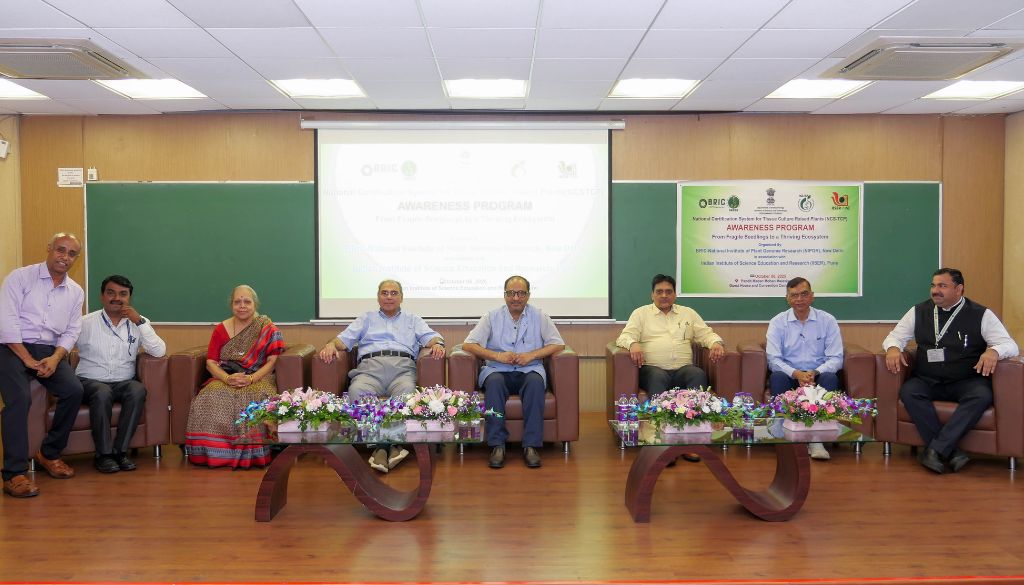
Pune, 6th October 2025: In collaboration with BRIC-National Institute of Plant Genome Research (NIPGR), New Delhi, IISER Pune has co-organised a half-day awareness programme on National Certification System for Tissue Culture raised Plants (NCS-TCP) titled “From Fragile Seedlings to a Thriving Ecosystem” on Monday, October 6, 2025, at IISER Pune campus.
This is part of the National Certification System for Tissue Culture Raised Plants (NCS-TCP) Programme of the Department of Biotechnology (DBT), Ministry of Science and Technology, Government of India. Representatives from plant tissue culture industries in Maharashtra, some of whom also set up stalls at the event with displays of their plant tissue culture products.
The Inaugural Session included short presentations by the following members:
Prof. Anjan Banerjee, Professor in Biology and Dean (Research and Development), IISER Pune, is plant biologist at IISER Pune working on molecular mechanisms that govern plant development. As the local organiser of this event, he welcomed the participants and initiated the proceedings of the awareness event.
Dr. Debasis Chattopadhyay, Director, BRIC-National Institute of Plant Genome Research (NIPGR), Co-ordinator, NCS-TCP, New Delhi, India, said, “BRIC-National Institute of Plant Genome Research (NIPGR) is the organiser of the October 6, 2025 awareness programme in collaboration with IISER Pune. NIPGR is the Coordinator of the Certification Programme for tissue culture raised plants on behalf of the Department of Biotechnology, Government of India. Accredited laboratories conduct the testing of samples as part of the certification process.”
Dr. Chattopadhyay added, “This is a unique certification programme by the Government of India’s Department of Biotechnology. Due to the plants being generated by tissue culture, all plants are free of disease and are uniform in their quality. In the last 4 years, 65 crore plants have been certified through this programme by NIPGR, New Delhi, before the private production facilities release them to farmers. More importantly, ~35 lakh plants that did not meet the quality control standards have been discarded thus preventing poor quality and diseased plants from being circulated.”
Dr. Manoj Kumar Modi, Nodal Officer, NCS-TCP and Scientist ‘F’, Department of Biotechnology (DBT), Ministry of Science and Technology, GoI, New Delhi, spoke about the genesis and overview of the DBT’s certification programme for plants raised through tissue culture. He said, “The DBT’s certification programme for plants raised through tissue culture was launched in 2006 following a gazette notification. The objective of the certification programme is to produce virus-free and genetically uniform plants, and to develop protocols for the production and use of tissue culture plants for the benefit of all stakeholders especially farmers. Since inception, 1.4 billion tissue culture plants have been certified.”
Prof. Pramod Tandon, Chairperson- PMEC (NCS-TCP); Secretary of Plant Tissue Culture Association of India; Formerly Vice-Chancellor, NEHU, Shillong, said, “The certification process ensures higher productivity and quality, builds farmer and industry confidence, and improves income for farmers. In the future, tissue culture facilities should explore incorporating new techniques such as CRISPR technology and automated micropropagation systems for improving outputs. He advised students to develop technical business skills and entrepreneurs to explore new markets.”
Dr. Ashutosh Pandey, Principal Investigator NCS-TCP and Scientist IV, BRIC-NIPGR, New Delhi, presented the vote of thanks and encouraged plant tissue culture production facilities and farmers to choose certified plants for better outputs.