Joint Venture Development and Power of Attorney: Legal Safeguards Every Landowner Must Insist Upon
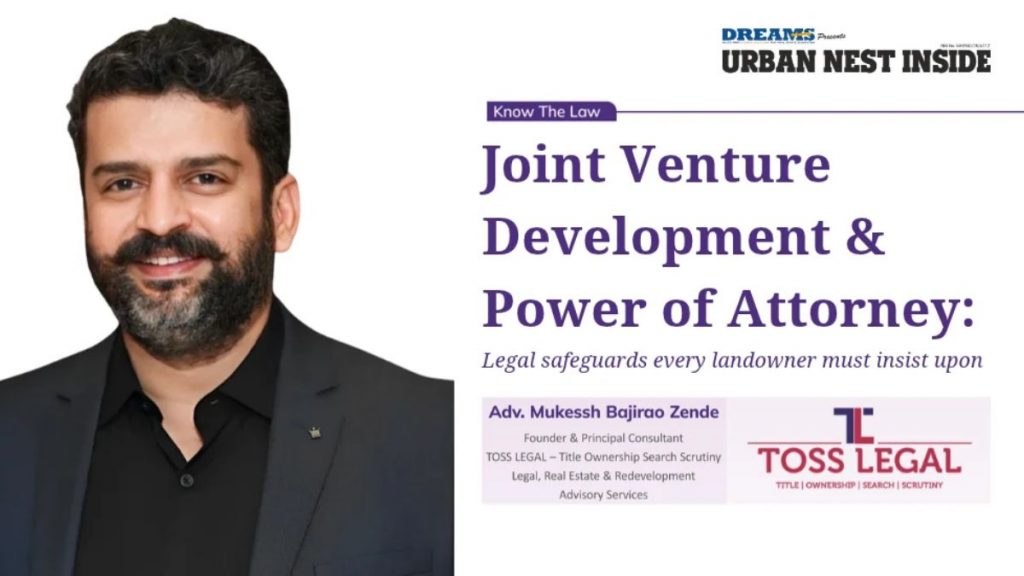
Authored by Adv. Mukessh Bajirao Zende
Pune, 20th November 2026: With escalating land values and increasing complexities in project development, Joint Venture Development has emerged as a preferred model in the real estate sector. The landowner contributes the most fundamental asset, the land, while the developer brings capital, expertise, approvals, construction capability and marketing infrastructure. However, a commercially attractive proposal can become legally vulnerable if the Development Agreement and Power of Attorney are not carefully structured.
Define Development Rights and Entitlements
A Joint Venture Development Agreement must clearly identify the property, development potential and rights granted to the developer. More importantly, the
landowner’s consideration, whether
constructed area, revenue share, profit share or a hybrid model, must be unambiguous.
The agreement should specifically determine entitlement to basic FSI, TDR, premium or fungible FSI and any future enhancement in development potential. In modern real estate, development potential itself represents substantial economic value and should never remain undefined.
Financial Security and Project Timelines
The Power of Attorney accompanying a Development Agreement deserves particular attention. It should grant only those powers genuinely necessary for approvals, development, RERA compliance, construction and legitimate project transactions.
Authority to mortgage the land, borrow against it, create security, transfer development rights, delegate powers or create third-party interests should never arise through broad or ambiguous drafting.
Under Section 201 of the Indian Contract Act, 1872, agency may terminate in circumstances recognised by law. Section 202 creates an important exception where the agent has an interest in the property forming the subject matter of the agency. Consequently, merely describing a Power of Attorney as “irrevocable” cannot substitute for careful examination of the underlying rights and interests created by the transaction.
RERA, Indemnity and Third-Party Exposure
The Development Agreement must clearly allocate responsibilities under RERA and other applicable laws. Landowners should carefully evaluate circumstances in which their participation may expose them to promoter-related obligations.
Comprehensive indemnities should protect the landowner against liabilities arising from purchasers, contractors, employees, lenders, taxation, construction activities and statutory violations attributable to the developer.
The Real Protection Lies in the Documentation
A successful Joint Venture requires more than an attractive sharing ratio. It requires contractual control over development rights, finance, timelines, mortgage, RERA obligations, default, termination and exit.
Commercial negotiations determine the landowner’s return; carefully drafted legal safeguards determine whether that return. and the land itself, remain protected.