National Security: Centre Alerts on Foreign Influence via Hospitality Offers to State Govt Officials
Reported by Mubarak Ansari
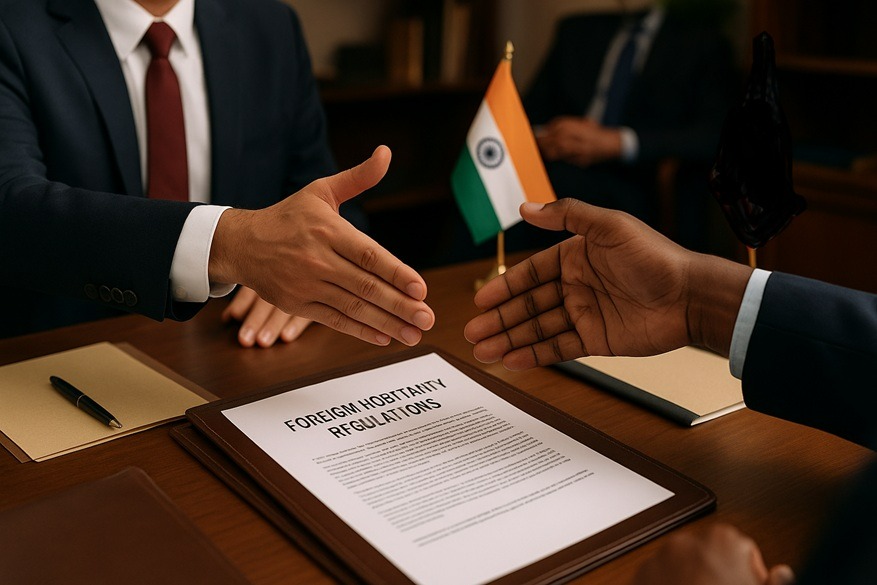
New Delhi/Pune, 16th July 2025: The Ministry of Home Affairs (MHA) has issued a stern advisory to all states and Union Territories, cautioning officers against accepting foreign hospitality without prior permission, as mandated under the Foreign Contribution (Regulation) Act, 2010 (FCRA). Simultaneously, the Centre has flagged concerns over certain foreign diplomatic missions allegedly misusing privileges by bypassing established communication protocols and accessing sensitive areas.
In a formal communication addressed to Chief Secretaries of all states and UTs, the Foreigners Division of the MHA highlighted that several government officers were found to have accepted foreign hospitality without securing prior approval through the FCRA portal (Form FC-2), which is a mandatory legal requirement.
“Acceptance of foreign hospitality without permission or from hosts not specified in the application is a direct violation of the FCRA, 2010, and constitutes a punishable offence,” the advisory noted. It also cautioned that engaging with foreign hosts flagged in adverse security reports could pose serious national security risks.
The advisory, signed by Joint Director Saurabh Bansal, urged immediate dissemination of this directive to all relevant officials to ensure strict adherence to the FCRA guidelines.
Diplomatic Access Under Scrutiny
The Ministry of External Affairs (MEA) has also expressed concern over the conduct of some foreign diplomatic and consular missions in India. According to government sources, there have been instances where these missions attempted to access sensitive locations and sought information by circumventing standard communication channels.
“Some foreign missions are increasingly engaging with multiple Indian agencies directly, bypassing the Ministry of External Affairs, which can compromise national interests,” the MEA noted in its communication, which has also been circulated.
The government reiterated that all matters relating to foreign affairs fall under the Union List in the Constitution and are exclusively within the jurisdiction of the Central Government. As per established protocol, any substantive engagement with foreign missions must go through the MEA, especially in matters involving foreign trade, international cooperation, or sensitive diplomatic issues.
Protocol Clarified
The advisory references the Protocol Handbook of the Ministry of External Affairs, which outlines the required channels of communication. It emphasizes that foreign missions must not directly approach state governments or union territories on significant matters, including external aid or collaborative projects. While certain Commonwealth representatives may reach out for routine information, all substantial matters must be routed through the MEA.
Moreover, departments dealing with issues such as dual citizenship, PIO card schemes, FCRA matters, or overseas NGOs are required to consult the MEA beforehand to ensure alignment with national policy.
The Centre has called for all ministries, departments, and state-level authorities to scrupulously follow the protocols to maintain a unified approach in India’s external engagements. The government has also reminded foreign missions to adhere to diplomatic norms and avoid unauthorised interactions that may undermine the country’s sovereignty or policy coherence.