Pune: Khaki clad Impostors harassing residential society locals in NIBM Area for money and grocery, Residents demand police crackdown
Kondhwa, 19th July 2025: A disturbing trend of organized impersonation and soft extortion has come to light in Pune’s upscale NIBM Annexe area, where residents allege that criminal gangs disguised as government officials and social workers are targeting senior citizens, women, and affluent individuals.
A formal complaint highlighting this menace has been submitted by a local citizen, Jaymala Dhankikar, to the Union Home Secretary, Maharashtra Director General of Police (DGP), and Pune Police Commissioner, demanding swift and firm action under the Maharashtra Control of Organised Crime Act (MCOCA) and Indian Penal Code.
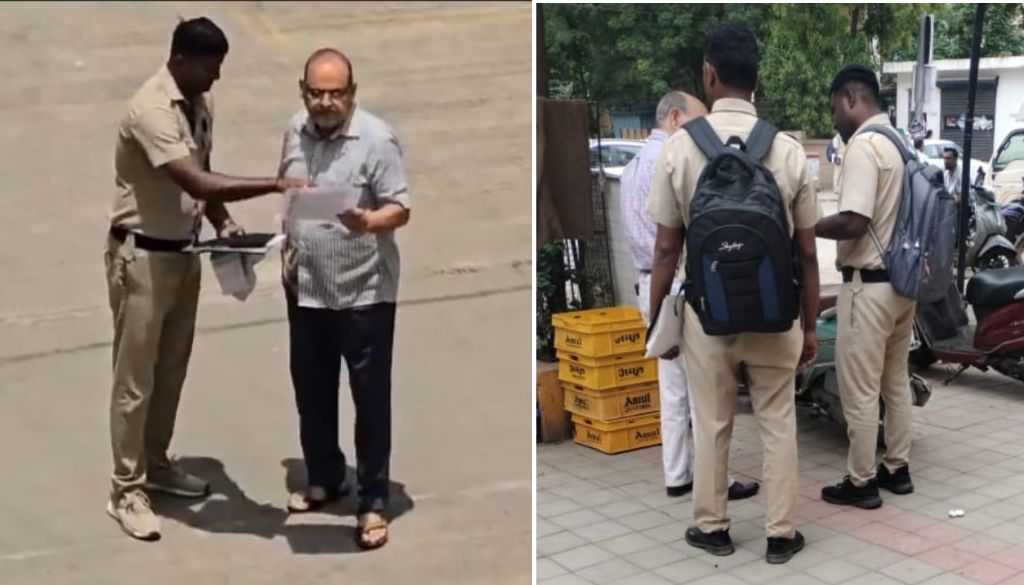
The complaint reveals that these so-called “Bahurupiya” gangs are operating under the guise of khaki-clad officials, carrying large backpacks and posing as tax officers, civic enforcers, or survey agents. According to residents, these impostors approach vulnerable citizens under false pretenses, demand identity verification, and then intimidate them into paying bribes or handing over personal belongings. Most of their targets are elderly individuals walking alone, women shopping, or people carrying cash or goods.
These gangs have been spotted around several key areas, including Ganga Kingston, Ganga Florentina, Gemini, opposite Tribeca Mall, Imperial Housing Society, Raheja Premiere, S. M. Ghule Chowk, and the Dorabjee Mall precinct. Residents believe that these impostors keep a close watch on people who display signs of financial affluence, targeting them systematically.
In a parallel and equally alarming development, another group of individuals—mostly well-dressed, tech-savvy youths—pose as social workers soliciting donations for the poor. They approach shoppers at grocery stores and housing societies claiming to collect money and rations for the needy. However, residents have noted that these individuals own expensive smartphones, ride high-end motorbikes, and appear to live comfortably. The complaint describes them as “freeloaders in disguise,” exploiting public sympathy for personal gain.
The letter to authorities outlines that these gangs, both impostors and fake social workers, are part of an emerging organized criminal ecosystem that uses deception, coercion, and emotional manipulation rather than outright violence. Yet the psychological trauma inflicted on victims—particularly senior citizens and women—is severe. The community demands that these gangs be legally treated as organized crime syndicates and booked under MCOCA, along with applicable sections of the Indian Penal Code for extortion, cheating, impersonation, and intimidation.
Strong criticism has also been levelled at the Pune Municipal Corporation (PMC) in the letter. Residents claim that despite contributing over ₹200 crore annually in taxes, the NIBM Annexe area continues to suffer from serious law and order issues. The letter accuses the PMC of “inhuman failure” in protecting citizens, failing to install CCTV cameras, provide emergency police boxes, or ensure routine patrolling in high-risk zones.
“It is unacceptable that so much money is collected in taxes from these areas, yet there are no surveillance systems, no emergency call boxes, and barely any visible patrolling. This is a direct violation of the citizens’ right to a secure environment,” the complaint reads. The letter demands the installation of at least 100 CCTV cameras and emergency police contact systems across key intersections, housing society gates, and commercial zones.
In addition, the residents are calling for daily police combing operations between 8 a.m. and 2 p.m. in the targeted areas. They want coordinated action between the local police, crime branch, special branch, and intelligence units. The complaint stresses the need for preparation of full dossiers on these gangs, just as the police prepared extensive profiles for the notorious “Koyta Gang” that previously plagued Pune.
The letter further questions the lack of action from the local police despite repeated complaints. “Why must citizens constantly remind police of their duties?” the letter asks. It warns that should any untoward incident occur in the future, the PMC and police leadership will be directly responsible. It also expresses disappointment that special units like the Intelligence Branch and Crime Branch have not taken adequate notice of this growing threat.
Residents have also requested an official gazette notification recognizing these gangs as an organized threat to urban safety. The letter suggests that a multi-agency task force be constituted to deal with the issue with the same seriousness as the state treated earlier organized gang threats.
The complaint ends with a heartfelt plea: “Our women, girls, and elderly citizens are not safe. The government must act now, or risk letting our communities fall victim to criminals hiding in plain sight.”
Enclosed with the letter are eyewitness accounts, incident photographs, resident testimonies, and petition signatures from housing societies across the affected zones.
As this complaint now reaches the highest levels of government and law enforcement, pressure is mounting on PMC and Pune Police to act quickly, restore public trust, and bring these impersonators to justice. With clear demands and detailed intelligence provided by residents, the ball is now in the court of those entrusted with ensuring the safety of Pune’s citizens.
Prominent NIBM Annexe based social activist Ashok Mehendale, known for his grassroots legal advocacy, has strongly condemned the rise of impersonation-based extortion in the NIBM Annexe–Mohammadwadi area. Speaking on the matter, Mehendale remarked, “Any individual who uses the guise of state authority to extort money or harass citizens is not just committing fraud—they are undermining the very fabric of constitutional governance. Such impersonation is not a petty crime; it is an attack on the dignity of the State itself.” He added that the use of khaki uniforms, fake credentials, and official-sounding language by these gangs is a deliberate ploy to bypass legal safeguards and manipulate vulnerable populations.
Mehendale further emphasized that Section 170 and 171 of the Indian Penal Code, which deal with impersonation of public servants, must be invoked along with organized crime provisions like MCOCA, given the coordinated nature of these activities. He warned that “if institutions fail to act against impostors exploiting state symbols, it creates a dangerous vacuum where crime wears the mask of authority.” According to him, this isn’t just a case of street-level crime—it is a systemic threat to citizen trust in the police, governance, and democracy. His statement has added significant legal weight to the residents’ demand for immediate and visible enforcement action.