RELIVING INDIAN HISTORY
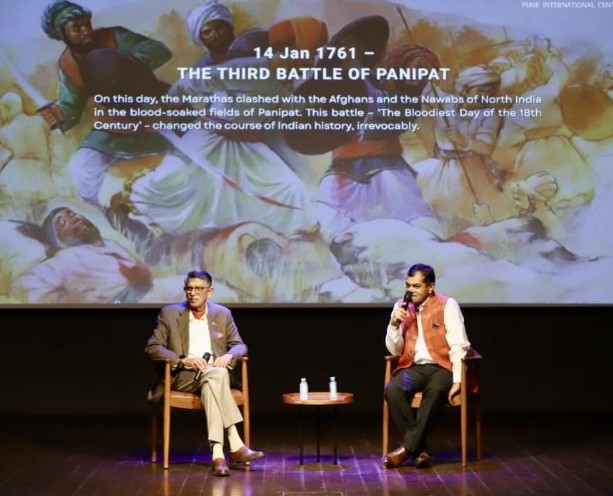
Pune, 12th February 2026: The Third Battle of Panipat was perhaps the most momentous battle in Indian history. On 14 January 1761, the Maratha Army clashed with the Afghan coalition under Ahmad Shah Abdali in the blood-soaked fields of Panipat. That clash of arms often called “The Bloodiest Day of the 18th Century” changed the outcome of Indian history. The battle finds special resonance here in Pune. It was from Pune that the Maratha army set out for the campaign under Sadashiv Bhau; and virtually every home lost a family member in this war.
The Centre for National Security Studies at Pune International Centre conducted a fascinating discussion on the Third Battle of Panipat on 07 February. Chaired by Gen Vinayak Patankar – a soldier-scholar of great repute – it featured Colonel Ajay Singh, an international-award winning author and military historian, who provided a compelling story-telling and discussion on the momentous battle. This was followed by a very lively interaction with the audience, which bought out differing viewpoints and indicated the depth of sentiment that the battle still evokes.
The talk traced the background to the battle, bringing out the rise of the Marathi Empire from the time of Shivaji. It highlighted the Maratha way of war, especially they manner in which they used light fast cavalry moving “half a day’s march ahead of their opponents” to strike and hit hard at unexpected locations. It also brought out the background to the battle which led to the Marathas moving from the Deccan to contest the Afghans in North India. The battles they fought en route – especially the capture of Delhi and Kunjpura – were unravelled. The manner in which the battle of Panipat unfolded was bought with great military insight, highlighting both the valour and chivalry of the Maratha fighters and the cardinal errors that were made which eventually decided the outcome. It brought out the recovery of the Marathas and also the fact that the weakening of the Marathas eventually cleared the way for the British to establish themselves in India.
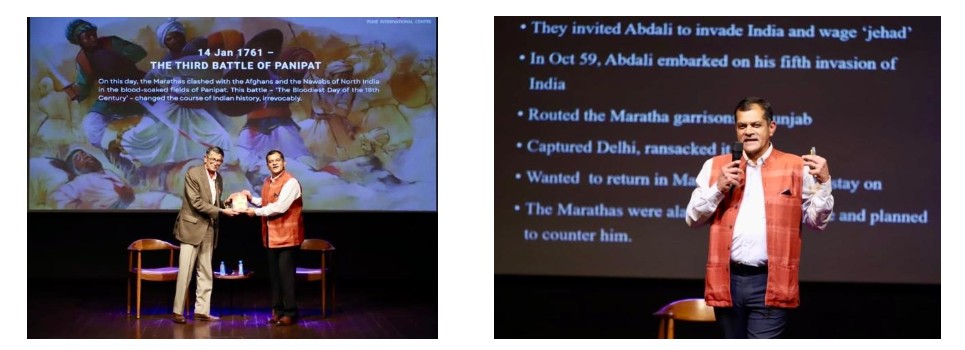
Gen Patankar and Col Ajay Singh during the talk
The discussion invariably veered to the most important question. “What if the Marathas had had won the Third battle of Panipat?” That is a question that historians ponder upon even now. Perhaps the entire course of India would have changed thereafter.
Pune International Centre has helped highlight a very important aspect of Indian history and brought it alive to the audience. As was bought out by General Patankar, “We need to know our history, because those who forget history are condemned to repeat it.” That is very true. Indian history has often been neglected and some of its most significant events have been forgotten. Events such as this help create awareness that ensures that our history and heritage remain alive and the story of India is presented in an objective and factual manner.