The AI Race: Are We Forgetting What Makes Us Human?
By Gayatri Kshirsagar
Pune, 24th November 2026: As Artificial Intelligence transforms how we learn, work and communicate, perhaps it is time to ask whether we are making equal progress as human beings.
Interestingly, Cambridge Dictionary has chosen ‘Human’ as its Word of the Year for 2026. At a time when Artificial Intelligence is becoming part of almost everything we do, perhaps we are beginning to realise the value of something we have always taken for granted being human.
Not long ago, the word ‘organic’ became a mark of authenticity. Today, we increasingly come across terms such as ‘human-made’, ‘human-written’ and ‘human-created’ to distinguish what people create from what AI generates. Something that was once so natural is now becoming a quality that needs to be identified and valued. It makes me wonder: have we reached a point where we need to prove that something was created by a human being?
AI is no longer confined to research laboratories or technology companies. It has entered our classrooms, workplaces, homes and everyday conversations. There is a growing rush to learn AI. Students are enrolling in courses because they believe these skills will make them employable. Working professionals are constantly updating their knowledge to remain relevant. Educational institutions are trying to keep pace with new tools and technologies.
There is excitement and curiosity, but also an underlying fear of being left behind. It almost feels like a race in which everyone must keep running, even when we are not entirely sure where the finish line is.
Are we learning AI because we are curious about its possibilities, or because we are afraid of becoming irrelevant without it?
There is no denying what AI can offer. It can support medical research, help farmers make informed decisions, predict environmental changes, assist teachers, and make knowledge more accessible. Imagine a farmer receiving timely weather information, a student accessing quality learning resources in their mother tongue, or a doctor identifying a disease at an early stage with the help of AI. These are the applications that make technology meaningful when it makes a difference to people’s lives.
But while celebrating this progress, we must also look at the inequalities that already surround us.
Our country has not even bridged its existing digital divide between Bharat and India, and we are already entering another. A student in a well-equipped urban school may have access to high-speed internet, digital devices and AI-powered learning tools. Another student in a rural school may still be struggling with basic connectivity, infrastructure and access to trained teachers. Will both have the same opportunity to benefit from this transformation?
There is also a language divide. India is home to hundreds of languages and dialects, yet much of the digital and scientific knowledge available today remains concentrated in English and a few widely used languages. AI has the potential to change this. But translation alone is not inclusion. Our technologies must understand local contexts, cultures and the diversity of people who use them. A child should not have a lesser learning experience simply because they choose to learn in Marathi, Hindi or another Indian language.
Another question we need to ask is: who controls these technologies, the data behind them and the knowledge they generate? Will we simply remain consumers of AI platforms developed elsewhere, or will we also build solutions that reflect India’s own needs and realities? As access increasingly depends on paid subscriptions, computing infrastructure and proprietary platforms, affordability and control will become important questions of equity.
This brings me to education, an area where I believe we need to pause and reflect.
Having worked with students and educators over the years, I have always felt that learning is not just about acquiring information. It is about curiosity, experimentation, asking questions and sometimes even making mistakes. Today, if AI can write essays, solve equations and provide instant answers, what should we really teach our children?
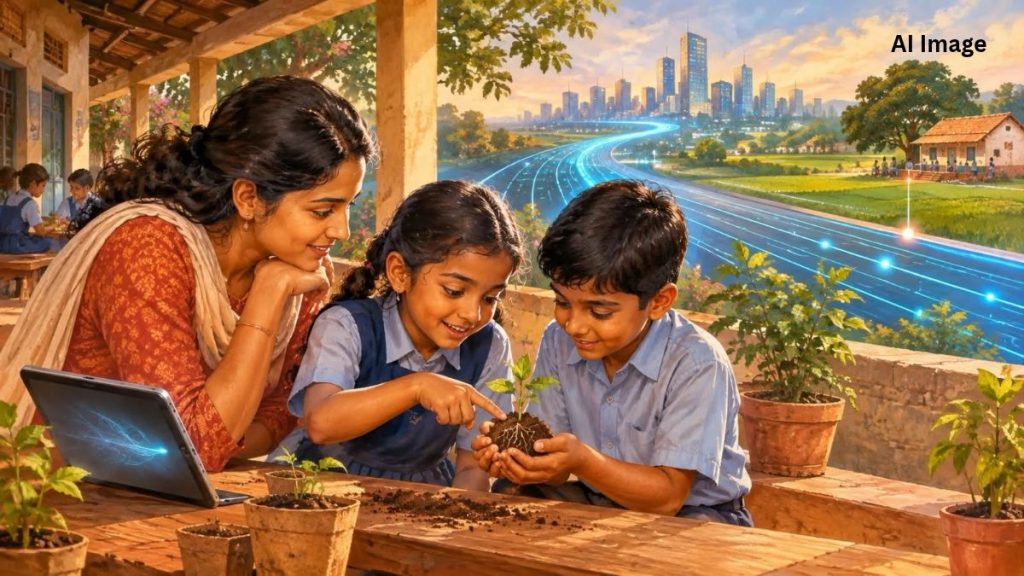
Of course, children must learn how to use AI. But equally, they must learn when to question it, how to recognise its limitations and why independent thinking matters. A classroom should continue to be a place where children explore, imagine, experiment and learn from one another. We should not reduce education to teaching children how to generate better answers with better prompts.
And perhaps the bigger question is what is happening beyond classrooms and workplaces.
As more of our interactions move to screens and become automated, are we paying enough attention to human emotions, relationships and the world around us? Technology can make communication faster, but it cannot replace the reassurance of a teacher, the patience of a parent, the warmth of a face-to-face conversation or the joy of discovering something in nature.
We speak so much about making machines more intelligent. But are we investing equally in emotional intelligence, empathy, compassion and the ability to understand another person’s experiences?
Having recently initiated AInspire – Artificial Intelligence for Society & Impact, a series of conversations exploring AI and its relevance to society, I have been thinking about these questions even more. Through these conversations, I hope we can look beyond the technology itself and discuss how AI can address real-world challenges, benefit communities and contribute to a more inclusive society. After all, the conversation around AI should not be limited to what machines can do, but should also explore what we, as humans, choose to do with these possibilities.
The next five years will be particularly important. AI will continue to evolve, new jobs will emerge, and existing roles will change. Automated systems will increasingly support many decisions. But who will ask the difficult questions? Who will decide what is fair, what is ethical and what is right? And who will take responsibility when technology gets it wrong?
We must remember that a machine can provide an answer, but the responsibility for decisions that affect human lives must remain with people. Human judgment, accountability and compassion cannot be outsourced.
The responsibility for making AI inclusive cannot rest with technology companies alone. Governments, educational institutions, researchers, industries and civil society must work together to ensure that its benefits reach those who need them most.
For me, the most important question is not whether AI will transform our future. It already is. The real question is whether we will use this transformation to address problems that have existed around us for decades. Can AI help reduce hunger, improve healthcare, strengthen public education, support farmers and protect biodiversity? Can robotics and intelligent machines make hazardous work, such as cleaning sewers and septic tanks, safer, so that no sanitation worker has to risk their life doing it? Can technology reach communities that have been left behind and help reduce inequalities rather than create new ones?
I am certainly not against the race to learn AI. We must understand it, engage with it and use it responsibly. But perhaps, in this constant race to keep up, we also need to remind ourselves to slow down occasionally, look beyond our screens and reconnect with the people and world around us.
As we look towards an AI-driven future, one question continues to stay with me: Are we becoming more intelligent as a society, but slowly forgetting what makes us human?
We are investing in artificial intelligence. Let us also invest in human intelligence, empathy, curiosity and compassion.
After all, the real measure of progress should not be how intelligent our machines become, but how much better we become as human beings.
(About the Author:
Gayatri Kshirsagar is a professional with over 12 years of experience in driving social impact through STEM education and capacity building. She has conceptualised and led several educational initiatives focused on strengthening learning ecosystems, empowering educators and creating opportunities for students.)