
The Eternal Birth of Hope: Janmashtami’s Message for the Modern Soul
By Rhythm Wagholikar
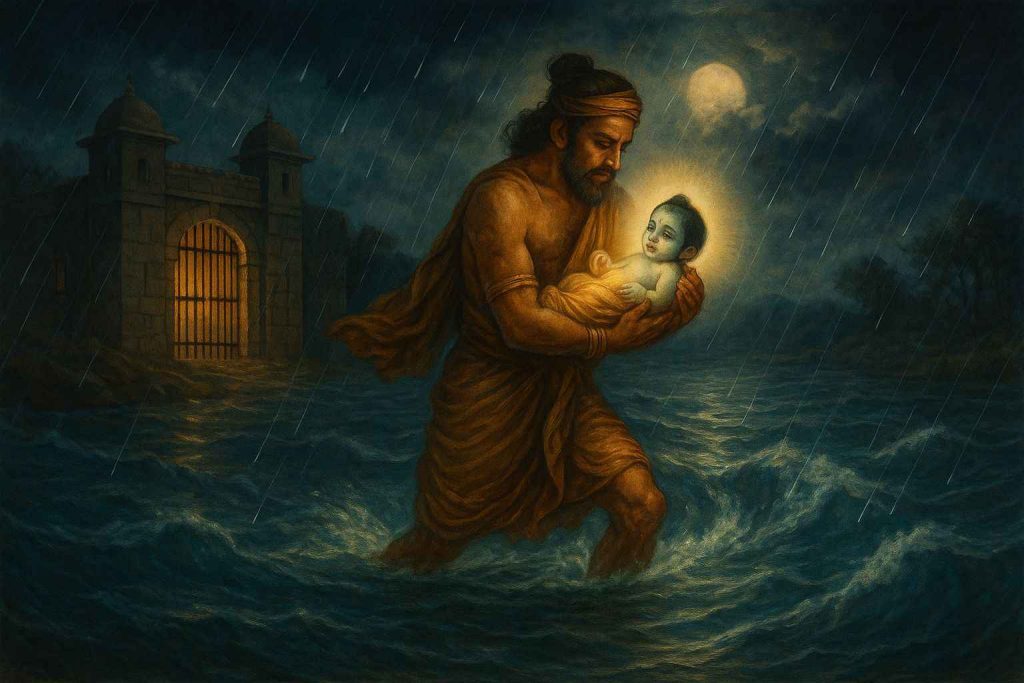
Pune, 16th August 2025: Midnight. The world seems to hold its breath. Rain-laden clouds weep over a land heavy with fear. A city lies restless under the cruel hand of a tyrant, its people too afraid to dream. In the silence of a guarded prison, two parents sit chained, their hearts trembling yet clinging to hope. And in that darkness, a cry pierces the night not of despair, but of birth. A child has arrived, radiant, born not in a palace of gold, but in captivity, behind iron doors. His name is Krishna.
There are no royal drums to announce him, no courtiers to bow before him. Instead, the chains that bound his parents fall loose, the prison gates open of their own accord, and a father steps into the storm, carrying his infant son across the Yamuna. The river itself parts, recognising the divine passage. That night, in the heart of oppression, light takes its first breath.
This is no ordinary tale of antiquity. It is not only the record of a birth that took place thousands of years ago. It is the eternal story of life itself, repeated wherever fear is broken by courage, wherever despair yields to hope, wherever cruelty is conquered by compassion. It is the timeless reminder that in the darkest of nights, when all seems bound and suffocated, a new beginning is still possible. The story of Krishna’s birth is not only about Mathura and Kansa; it is about us. It is about the prisons we find ourselves in, the chains that keep us captive, the rivers we fear to cross, and the moments when life unexpectedly parts the waters to make a path.
When we speak of Janmashtami today, it is easy to pause at the surface of festivity. We see the joyful swings adorned with flowers, the bright lamps, the rhythm of flutes filling the night, and the Dahi Handi that breaks amid cheers. All this is beautiful, but to understand the significance of Krishna’s birth, we must look beyond the celebration and enter its meaning. The birth of Krishna is not a historical event to be remembered once a year, it is a recurring possibility in every human life.
Krishna’s arrival is the awakening of light in us when we had nearly forgotten it. It is the birth of courage where there was fear, clarity where there was confusion, and compassion where there was cruelty.
The world Krishna was born into was ruled by Kansa’s terror. It was a world of fear, where people’s lives were dictated by cruelty. Though centuries have passed, our world today bears its own tyrannies. We may not see a single man with a crown and sword, yet we are bound by forces just as oppressive. Greed corrodes the spirit, noise drowns out truth, division turns neighbour against neighbour. These are the Kansas of our time. They may not sit upon thrones, but they thrive wherever fear, distraction, and separation rule the human heart. And here lies the lesson of Janmashtami. The answer to tyranny is not always the louder sword.
Sometimes, it is the quiet birth of a consciousness that cannot be chained. Krishna’s life shows us that the divine does not descend with a display of force but with a quiet presence. He does not come to annihilate the world but to transform it from within. He plays, he loves, he advises, he protects. He does not reject imperfection, he enters it, and by his presence he changes it. As a child in Gokul, his joy was not found in riches but in the simple act of sharing food with friends, dancing by the Yamuna, playing in the fields. Even under the shadow of Kansa’s cruelty, Krishna laughed. His laughter itself became resistance, for it declared that joy is not an escape from reality but a refusal to let cruelty break the human spirit. This is one of the the first lesson Krishna offers us: that joy is not to be postponed until perfection arrives. Joy is to be lived in the very midst of imperfection.
As an adult in Kurukshetra, Krishna reveals another dimension. He does not wield the bow himself, though he could have. Instead, he becomes Arjuna’s charioteer, his guide, his counsellor. He does not fight Arjuna’s battles for him; he awakens Arjuna’s strength to fight them himself. This is leadership at its purest form, not one who commands but one who empowers. It is here that the voice of Krishna resounds in the Bhagavad Gita, echoing across ages, not as a command but as wisdom for every human being.
One of the ost important teachings he gives Arjuna is the immortal verse:
कर्मण्येवाधिकारस्ते मा फलेषु कदाचन।
मा कर्मफलहेतुर्भूर्मा ते संगोऽस्त्वकर्मणि॥
“You have the right only to perform your prescribed duties, but never to the fruits of your actions. Do not let the fruits of action be your motive, nor let your attachment be to inaction.”
This is a truth as profound today as it was in Kurukshetra. Human beings are often chained by expectations of reward. We measure our worth by outcomes, forgetting that the only thing truly in our control is the sincerity of our effort. Krishna’s teaching here is not an invitation to apathy but to freedom. By detaching from fruits, we liberate ourselves from fear and disappointment. We act with integrity not because of what we may gain but because it is right to act. In our age, where every pursuit is entangled in profit, recognition, or applause, this teaching asks us to rediscover the dignity of effort itself. It reminds us that true peace lies in offering our labour to a higher purpose, free from the restlessness of result.
Another shloka resounds with eternal relevance.
यदा यदा हि धर्मस्य ग्लानिर्भवति भारत।
अभ्युत्थानमधर्मस्य तदात्मानं सृजाम्यहम्॥
“Whenever there is a decline of righteousness, O Bhārata, and a rise of unrighteousness, at that time I manifest Myself.”
At first glance this speaks of the cosmic descent of divinity whenever the world is overcome by darkness. Yet its meaning is not only cosmic, it is deeply personal. Whenever unrighteousness rises within us, whenever truth falters in our own decisions, whenever the forces of selfishness or anger begin to rule our heart, the inner Krishna too seeks to manifest. To remember this verse is to remember that the divine is not far away, waiting in heaven for a distant moment of crisis. The divine rises in us whenever we turn toward dharma, whenever we awaken to the higher path. The birth of Krishna in Mathura is mirrored by the birth of Krishna within us whenever we reclaim our integrity, our compassion, and our courage.
Another shloka we may reflect upon reveals the secret of balance.
सुखदुःखे समे कृत्वा लाभालाभौ जयाजयौ।
“Treat alike pleasure and pain, gain and loss, victory and defeat.”
This verse is not a denial of human feeling. It is not a command to numbness. It is a call to equanimity. Life will always oscillate between joy and sorrow, success and failure, triumph and defeat. To remain unmoved is not to cease feeling but to cease being enslaved by those feelings. It is to taste life fully yet remain rooted in a deeper centre that is beyond all opposites. How necessary this wisdom is today, when the human mind is constantly pulled by external applause or crushed by criticism, uplifted by gain and broken by loss. Krishna reminds us that true strength is not the absence of emotion but the presence of steadiness. To live by this verse is to cultivate resilience, to walk through storms without losing our direction, to welcome fortune without arrogance and endure misfortune without despair.
Thus, the voice of Krishna across these shlokas forms a rhythm of freedom, integrity, and steadiness. He does not ask us to flee from life, he asks us to enter it with courage. He does not ask us to renounce action, he asks us to act without bondage. He does not ask us to destroy emotion, he asks us to refine it into compassion and balance.
Krishna’s own life becomes a living demonstration of this wisdom. In his childhood, he teaches us the lesson of joy amidst adversity. In his youth, he reveals the lesson of love that does not seek possession but delights in connection. In his adulthood, he embodies the lesson of duty carried with compassion, a reminder that true power lies not in domination but in service.
Janmashtami, therefore, is not merely the remembrance of a birth long ago. It is an invitation to birth anew within ourselves the very qualities that Krishna embodied. It is a personal question that comes each year: What chains still bind us? Which rivers do we still fear to cross? What is the Krishna within us, waiting silently to be born?
We live in an age where speed is exalted above depth, where noise overwhelms silence, and where connection is more virtual than real. Yet Krishna reminds us that the deepest truths emerge in stillness, that the sweetest music is heard by the heart when it becomes quiet, and that the greatest battles are won not over others but within ourselves. The call of Janmashtami is not only to sing songs of Krishna but to live his song in our daily choices, in our relationships, and in our work.
When midnight comes again, whether in the outer world or in the shadows of our own lives, may we remember that it is also the hour of transformation. It is the hour when chains lose their power, when rivers make way, and when the impossible becomes possible. It is the hour when light is born without asking permission to enter the darkest room. That is the eternal promise of Janmashtami. It happened once in Mathura. It can happen again tonight, within you.