Undersea cables vulnerable to disruption, India needs robust underwater domain awareness: Admiral Karambir Singh (Retd.)
Pune, 17th August 2026: With undersea communication cables carrying a growing share of the world’s internet traffic and data, India must urgently strengthen its underwater domain awareness and develop seabed warfare capabilities to protect critical maritime infrastructure, former Chief of Naval Staff Admiral Karambir Singh (Retd) said on Monday.
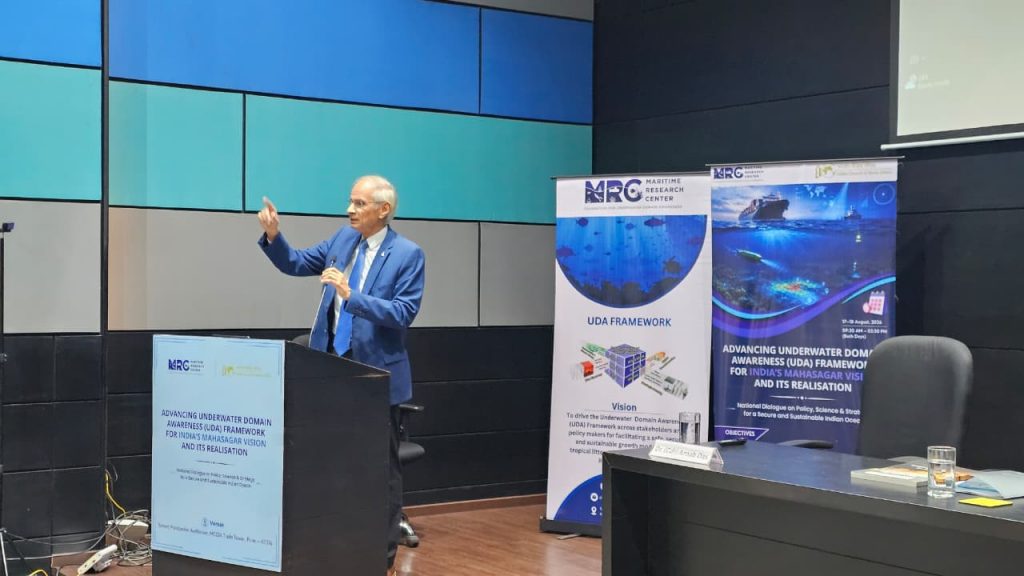
“Undersea cables are already 80 to 90 percent utilized, with demand continuously rising. Given this high utilization, even a single severed cable can cause severe, widespread disruption,” Singh said, highlighting the growing vulnerability of India’s subsea networks. He was speaking at a program titled “Advancing Underwater Domain Awareness Framework for India’s Mahasagar Vision and its Realization”, organized by the Maritime Research Center (MRC), Pune, and the Indian Council of World Affairs (ICWA), New Delhi. Vice Admiral Anil Jaggi, Commandant of the National Defense Academy, Dr. (Cdr) Arnab Das from MRC and Arudra Singh from ICWA were also present on the dais.
Singh said the protection of undersea cables must become a strategic priority, noting that the United Nations General Assembly has recognized undersea cables as critical information infrastructure requiring protection. He called for India to proactively develop seabed warfare strategies, drawing lessons from the French and Royal Navy, while also supporting international cooperative frameworks such as Singapore’s Guidance for Underwater Infrastructure Defense Exchange.
“Managing the unique challenges of the Indian Ocean Region requires transforming our naval approach towards comprehensive underwater domain awareness,” Singh said. He pointed out that the concentration of entry and exit routes through vulnerable choke points, coupled with extensive shallow waters, creates complex operational challenges for sonar and mine warfare.
During his inaugural keynote address Vice Admiral Anil Jaggi, Commandant of the National Defense Academy, said the need for UDA had become increasingly important as India’s maritime vision evolved from the Sagar doctrine to the expanded Mahasagar framework. “The ocean beneath the surface will define future security and prosperity,” he said.
Jaggi noted that seas account for 80% of global merchandise trade by volume, while nearly 99% of the world’s data, including internet traffic, is carried through submarine networks. Despite the strategic and economic importance of the underwater domain, more than 80% of the world’s underwater environment remains unexplored, unobserved and unmapped, he said.
Flagging emerging security challenges in the Indian Ocean Region, Jaggi pointed to increasing extra-regional activity, particularly by China. He said China operates approximately 64 ocean-surveying vessels for seabed, hydrographic and oceanographic data collection. Chinese-origin autonomous underwater vehicles and gliders have also been recovered in Indonesia and the Philippines near strategic sea lanes and choke points.
Jaggi proposed a “JAI” framework for India’s UDA efforts, J for Jointness across services, agencies and partners, A for Aatmanirbharta or self-reliance in technologies and platforms, and I for Innovation. He said such an approach would strengthen India’s ability to detect and counter underwater threats, protect maritime infrastructure and communication networks, secure sea lanes and support credible deterrence.
The underwater domain also presents significant economic opportunities, Jaggi said, highlighting deep-sea exploration, critical minerals and the blue economy. India has deep-sea exploration contracts covering more than 90,000 sq km in the Central Indian Ocean Basin and along the Carlsberg Ridge, giving it access to polymetallic nodules and rare earth elements.
Drawing attention to China’s 2020 Fendouzhe crewed-submersible dive to the Challenger Deep, Jaggi said India must accelerate its own capabilities in extreme-depth exploration. He also called for greater focus on fisheries, maritime transport, coastal tourism, offshore renewable energy and underwater infrastructure.
Dr (Cdr) Arnab Das, Founder, MRC, said India’s UDA framework should adopt a regional approach involving all relevant stakeholders, while accelerating capacity and capability building, localised research and development and innovation. “Security and growth have to be integrated while addressing classified data concerns and keeping the greater public good in mind,” he said.
Das added that Marine Spatial Planning could prove to be a game changer in this regard, with the participation of smaller island nations being particularly important for achieving wider public benefit.