Unsung Mentors of Phule Couple Finally Get Their Due in New Book
By Camil Parkhe
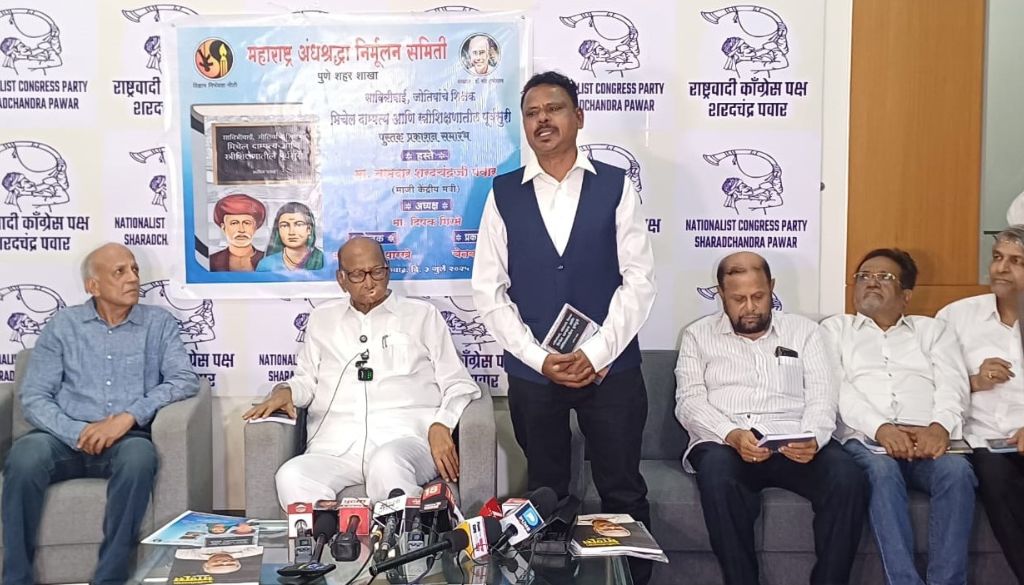
Pune, 4th July 2025: A newly released Marathi book sheds light on a little-known but significant chapter in the history of Indian social reform — the role of Christian missionaries who influenced and trained the iconic Phule couple in their early journey toward social transformation.
Titled ‘Savitribai, Jotibanche Shikshak Mitchell Dampatya Aani Stree Shikshanatil Purwasuri’ (The Mitchell Couple Who Taught Savitribai and Jotiba Phule and Pioneers in Female Education), the book explores the vital contributions of American and Scottish missionaries such as Cynthia Farrar, Rev. James Mitchell, and his wife Margaret Shaw Mitchell — figures who played a formative role in shaping the educational and reformist vision of Savitribai and Jotiba Phule.
Author and veteran journalist Camil Parkhe meticulously traces the connection between the Phules and these missionaries, relying on original documents, historical accounts, and the writings of Jotiba Phule himself. The book, published by Pune-based Chetak Books, is now available online.
Missionary Roots of a Revolutionary Movement
The Phule couple’s association with missionary-run institutions is widely acknowledged in history circles but often overlooked in popular narratives. The recently released Hindi biopic Phule brought this connection to the mainstream, portraying a scene where Jotiba and Savitribai arrive at Cynthia Farrar’s school in Ahilyanagar (formerly Ahmednagar) in a horse-drawn buggy to seek admission for Savitribai into a teacher training program.
Similarly, the Marathi film Satyashodhak opens with a young Jotiba studying at a school in Pune operated by Scottish missionary Rev. James Mitchell (1800–1866). Mitchell’s wife, Margaret Shaw Mitchell, later played a critical role in managing schools for girls started by the Phules.
In his memorandum to the Sir William Hunter Education Commission, Jotiba Phule candidly acknowledges the impact of the missionaries on his vision. “About 25 years ago, the missionaries had established a female school at Poona, but no indigenous school for girls existed at the time,” he wrote. “I was therefore induced, around 1851, to establish such a school, in which my wife and I worked together for many years.”
Phule went on to explain how this initiative led to the establishment of more schools — not just for girls but also for marginalized castes like the Mahars and Mangs. He notes that the original school was eventually placed under the management of a native committee and later taken over by the government, with Mrs. Mitchell managing it.
A Forgotten Legacy Unearthed
Despite their foundational role in nurturing one of India’s most iconic reformist couples, very little is known about Cynthia Farrar, James Mitchell, Margaret Shaw Mitchell, and John Murray Mitchell, who was also the principal of Pune’s Sanskrit College (now Deccan College).
“This book aims to fill that gap,” says Parkhe. “These missionaries were not just educators; they were visionaries who stood against caste and gender barriers long before it became part of India’s social reform agenda. Their legacy deserves recognition.”
Drawing on archival material, the book offers an engaging and informative account of how these educators contributed to the broader movement for women’s and Dalit education in 19th-century India. It highlights how their pioneering work served as both inspiration and infrastructure for the revolutionary activism of the Phule couple.
Available Now
‘Savitribai, Jotibanche Shikshak Mitchell Dampatya Aani Stree Shikshanatil Purwasuri’ is a significant contribution to the historiography of India’s reform movement. Published by Chetak Books, Pune, the book is now available for purchase on major online platforms.