Rakhis, Promises, and the Passage of Time: Rhythm Wagholikar on Rakshabandhan
Pune, 9th August 2025: Rakshabandhan is not merely a day in the Indian festive calendar, for many it is an enduring sentiment, probably a ritual that has carried the fragrance of love, trust and remembrance through centuries. The very name comes from the Sanskrit “raksha”, meaning protection and “bandhan”, meaning bond, yet even this translation cannot encompass its depth. On the surface, it appears like it is the moment when a sister ties a rakhi, a delicately adorned thread on her brother’s wrist, and he, in turn, vows to protect her. But this gesture itself is only the visible tip of something far more profound, a quiet promise, an affirmation of a relationship that endures not because of obligation, but because of choice, loyalty, respect and affection.
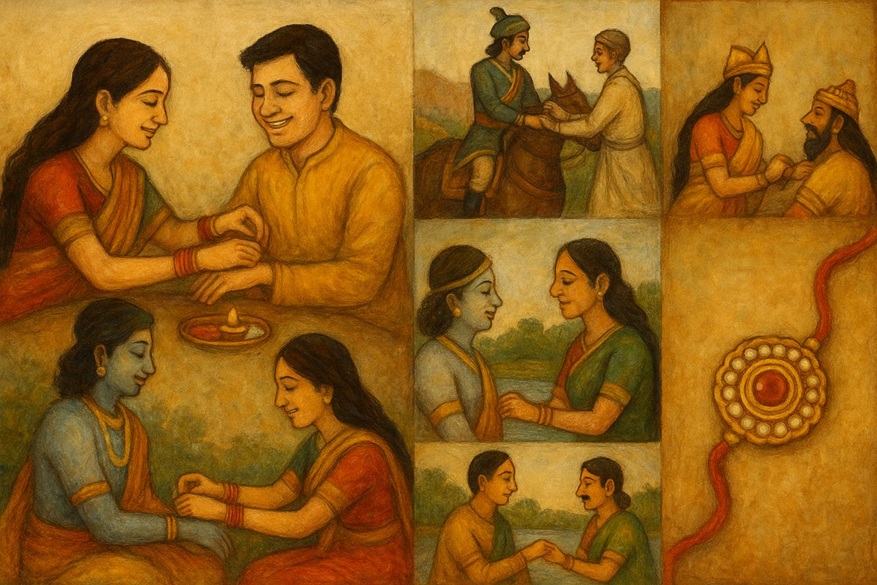
History has seen traces of this beautiful festival too. Its history shows that Rakshabandhan has never been confined solely to the walls of a household. The tying of a protective thread was once a gesture of alliance and trust that crossed familial lines. In the sixteenth century, Rani Karnavati of Mewar, facing the threat of attack, sent a rakhi to Mughal Emperor Humayun. That simple thread carried the weight of an appeal greater than treaties or armour. Humayun, honouring its sanctity, set aside political and religious differences to come to her aid. In ancient India, it was also common for priests to tie sacred amulets on kings before they rode into battle, invoking divine protection. These moments in history remind us that a rakhi, though simple in appearance, has long been a seal of honour, a token strong enough to bridge divides and bind people in loyalty.
There is another tale of Alexander, Roxana and King Porus. According to popular legend, Roxana (or Roshanak), Alexander’s wife, played an important role in this historical anecdote. Concerned for her husband’s safety, she sent a rakhi to King Porus, asking him to protect Alexander on the battlefield. Touched by this gesture, Porus accepted the rakhi and vowed not to harm Alexander personally during the battle. Legend says that at the critical moment, Porus hesitated from delivering the fatal blow, struck by the gesture’s weight and spared Alexander. This tale, though found in certain historical anecdotes, remains more symbolic.
Another reference also states that, in 18th-century Punjab, the spirit of Rakshabandhan found an unusual expression in what was called the Rakhi System. During a time of frequent raids and unrest, chiefs offered protection to villages, traders, and farmers in exchange for a fixed tribute known as “Rakhi.” The payment symbolised trust, much like the festival’s sacred thread, and bound the protector to a moral duty of safeguarding the giver. In this way, the idea of Rakhi extended beyond family ties to embrace entire communities.
Then there are some stories from ancient literature, too. Mythology enriches the festival with tales that linger in memory like old songs. The Mahabharata offers one of the most moving one ….Lord Krishna, wounded during battle, had injured his hand, and it was bleeding. Draupadi tore a strip from her sari and bound the wound. It was a simple act of care, yet in that moment, Krishna vowed to protect her always. That vow became the force behind his intervention in her darkest hour, when her dignity was under assault in the Kaurava court. Another cherished legend tells of the goddess Lakshmi, who, in her longing for Lord Vishnu’s return, tied a sacred thread on the demon king Bali. Touched by her grace, Bali promised her his protection and consented to Vishnu’s departure. These stories remind us that Rakshabandhan is not merely about siblings by blood, it is about the bonds that are forged through compassion, trust and shared fate.
There is also a tale on the River Yamuna. In certain regions of India, particularly in folk traditions of Rajasthan and Gujarat, there is the story of Yama, the god of death, and his sister Yamuna. It is said that Yamuna tied a rakhi to Yama, and in return, he granted her immortality. Moved by her love, Yama declared that any brother who had a rakhi tied by his sister and promised to protect her would be blessed with long life. This tale is often used to explain the festival’s association with longevity and well-being.
Thus, on the day of Shravan Purnima, when the sun leans golden and the monsoon winds carry the scent of wet earth, devotees remember River Yamuna and her vow to her brother. The river’s waters are said to carry the memory of that moment still, each ripple echoing the timeless truth that love, once given freely, can outlast even the march of time.
While Rakshabandhan’s origins lie deep in ancient tradition and mythology, its popularisation in modern India owes much to the efforts of social and cultural reformers who saw in it a means to foster unity and fraternity. Nobel laureate Rabindranath Tagore played a particularly significant role in the early twentieth century, during the period of Bengal’s Partition in 1905. Tagore encouraged a lot of people to tie rakhis to one another as a symbolic act of solidarity, transcending religious boundaries and reaffirming mutual protection. This reimagining of the festival transformed it from a primarily familial ritual into a broader social gesture, aimed at strengthening the fabric of community and nationhood. In doing so, Rakshabandhan became not only a celebration of personal bonds but also a quiet instrument of harmony in the public sphere, carrying forward its message of trust and unity into the heart of modern India.
The beauty of Rakshabandhan, however, is not only found in epic tales or royal histories. It is in the way the festival stirs everyday memories. It may be a brother recalling how his sister’s laughter lightened his most difficult days, or a sister remembering the countless ways her brother stood by her without being asked. It may be a rakhi that arrives in the post, carrying the scent of home across oceans, or a quiet moment over tea after the ritual, when words are fewer but hearts are full. Over time, Rakshabandhan has widened its circle. Now the “brother” can be a cousin, a dear friend, a mentor, or anyone who has stepped into the role with steadfastness, and the “sister” can be someone bound not by ancestry but by an unshakable sense of belonging.
What gives the festival its rare grace is its resistance to limitation. In rural India, it may be celebrated with simple cotton threads tied under a neem tree and sweets made at home. In cities, it may unfold in decorated living rooms, with gifts, flowers and photographs capturing the moment. Yet the meaning remains unchanged: protection is not merely the defence of the body, but the safeguarding of the heart, the spirit and the dignity of the one you love. It is about presence, being the person who is there in times of need, whose promise is felt even in silence.
With each passing year, Rakshabandhan becomes more than a custom; it becomes part of personal history. It travels through time in memory and in story, binding together moments of childhood, youth and adulthood. It reminds us that true strength lies in gentleness, that trust is built through constancy, and that a promise, once given in love, can outlast distance and time.
As Rhythm Wagholikar would reflect, the festival’s power lies in its quiet sincerity …it does not shout, yet it is heard deeply; it does not bind through force, yet it holds fast. And so, Rakshabandhan continues, year after year, a slender thread tying together the past and the present, carrying with it the unbroken promise of love and protection into the future.

(Rhythm Wagholikar is an author and cultural chronicler)