India’s strength is its intellectual capital: Dr. Raghunath Mashelkar at PIC’s 14th Foundation Day
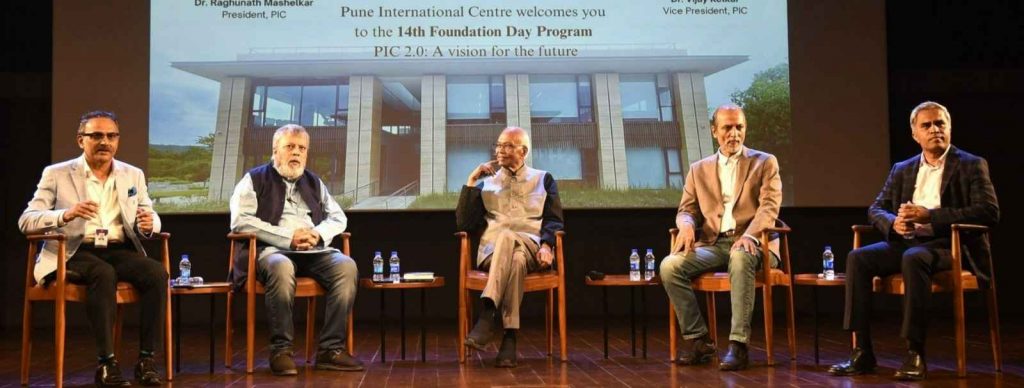
Pune, 25th September 2025: The Pune International Centre (PIC) marked its 14th Foundation Day on Wednesday, September 24, 2025, at its new campus in Pashan, Pune.
The event—held for the first time at the PIC Campus since its inauguration in January 2025—brought together eminent leaders, researchers, and policymakers who reflected on the think tank’s achievements and outlined PIC 2.0’s future role as a lighthouse of innovation-led, inclusive, and sustainable policy engagement.
In his opening address, Dr. Raghunath Mashelkar, President of PIC, reflected on PIC’s journey since its establishment in September 2011 and emphasised Pune’s potential as a global capability centre. India’s true strength, he noted, lies in its intellectual capital.
“We must have a mindset shift to realise that brain power can create disproportionate impact, just as Davos has done globally,” he said. Dr. Mashelkar also reiterated PIC’s five guiding principles — independence, integrity, integration, innovation, and influence, while calling for radical innovation and resource-rich growth.
In a panel discussion that followed, Dr. Mashelkar was joined by Mr. Prashant Girbane, General Secretary, PIC; Dr. Ajit Ranade and Prof. Abhay Pethe, Senior Fellows at PIC; Dr. Vijay Kelkar (online), Vice President, PIC; and Dr. Vidya Yeravdekar (online), Trustee, PIC, and Pro Chancellor at Symbiosis International (Deemed) University.
At the discussion moderated by Maj. Gen. Nitin Gadkari (Retd.), Director, PIC, Dr. Mashelkar envisioned PIC 2.0 as a hub of intellectual rigour, innovation, and resourcefulness, always striving for excellence.
Girbane stressed on amplifying PIC’s programmes among the youth, greater women’s participation, and stronger ecosystem partnerships.
Sharing his personal journey with PIC, Dr. Ajit Ranade referred to the inspirational stories of the founding of the Servants of India Society in Pune in 1905 and the early struggles of Apple Inc, illustrating how small beginnings evolve into transformative institutions. PIC 2.0, he noted, is a premier think tank rooted in intellectual output, rigorous policy advocacy, and independence from political and ideological biases. Prof. Pethe emphasised the importance of collaboration with universities and NGOs to build lasting synergies.
Dr. Kelkar highlighted PIC’s unique blend of thought leadership and collaborative urban space, envisioning a future where its members actively advance the Centre’s mission. Dr. Vidya Yeravdekar proposed greater involvement of youth through collaborations with universities and the induction of PhD scholars into PIC research projects.
Guiding the discussion, Maj Gen. Gadkari underlined the importance of resourcefulness, continuous improvement, and innovation, and invited reflections from participants on how PIC can leverage its credibility and transform into a multi-dimensional institution, including areas like national security studies. The discussion was followed by a lively Q&A session with the audience.
The event concluded with felicitation of PIC staff and researchers, and a cake-cutting ceremony, where Dr. Mashelkar, the senior-most member, and Prasad Walave, the youngest staff, cut the cake together.