Navi Mumbai Airport to Handle 90 Million Passengers, 3.2 Million Tonnes Cargo
Navi Mumbai, 6th October 2025: The Navi Mumbai International Airport (NMIA) — one of India’s most ambitious greenfield aviation projects — is set to become a benchmark in sustainability, technology, and passenger experience. Developed through a Public-Private Partnership (PPP) between Mumbai International Airport Ltd. (a subsidiary of Adani Airports Holdings Ltd., 74%) and CIDCO (26%), the upcoming airport at Ulwe in Navi Mumbai will play a crucial role in meeting the rising air traffic demands of the Mumbai Metropolitan Region and western India.
Spread across 1,160 hectares (2,866 acres), NMIA will feature two Code F compliant parallel runways, each measuring 3,700 metres in length and 60 metres in width, capable of handling the largest commercial aircraft. The airport will ultimately have four terminals, with the initial phase integrating both domestic and international operations to handle 20 million passengers per annum (MPPA). Upon completion of all phases, the capacity will scale up to 90 MPPA, with a cargo handling capability of 3.2 million metric tonnes annually.
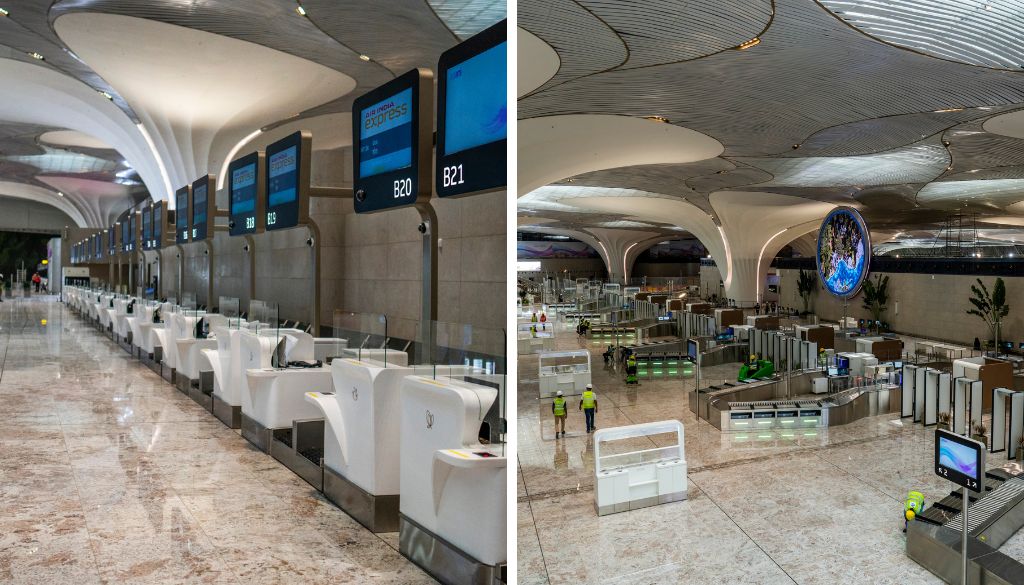
Architecturally inspired by India’s national flower, the lotus, the terminal design features 12 sculptural columns symbolizing unfurling petals and 17 mega-columns supporting the canopies, representing the harmony between technology and nature.
In its first phase, Terminal 1 will cover 2.34 lakh sq. m. with 66 check-in counters, 22 self-baggage drops, 29 aerobridges, and 10 bus boarding gates. The cargo terminal will handle 0.5 million metric tonnes annually, equipped with full automation, paperless operations, and advanced facilities for pharmaceuticals, perishables, dangerous goods, express cargo, and live animal management.
NMIA’s technology suite includes 5G-enabled “Connected Airport” systems, Digi Yatra integration, automated baggage handling, IoT-based real-time monitoring, and AI-driven traffic management. Passenger services will include digital art installations, immersive tunnels narrating Maharashtra’s heritage, kids’ play zones, CIP lounges accommodating 500 passengers, and an 80-room transit hotel.
Retail and F&B offerings will showcase over 110 outlets, including Mumbai’s iconic brands, international cuisines, breweries, and chef-curated dining concepts. A digital convenience platform via the Adani One App will offer easy access to retail, duty-free shopping, and passenger services.
Sustainability remains central to NMIA’s vision, with 47 MW solar power generation, rainwater harvesting, low-flow fixtures, wastewater recycling, and EV-based airport mobility. Future phases will also feature Automated People Movers (APMs) for intra-terminal transit, reducing emissions further.
The airport’s proximity to JNPT (14 km), MIDC Taloja (22 km), Thane (32 km), and Mumbai via the Trans Harbour Link (35 km) positions it as a logistics and connectivity hub for Maharashtra’s industrial and trade sectors.