Why Navale Bridge Remains Pune’s Riskiest Stretch on Mumbai-Bengaluru Highway
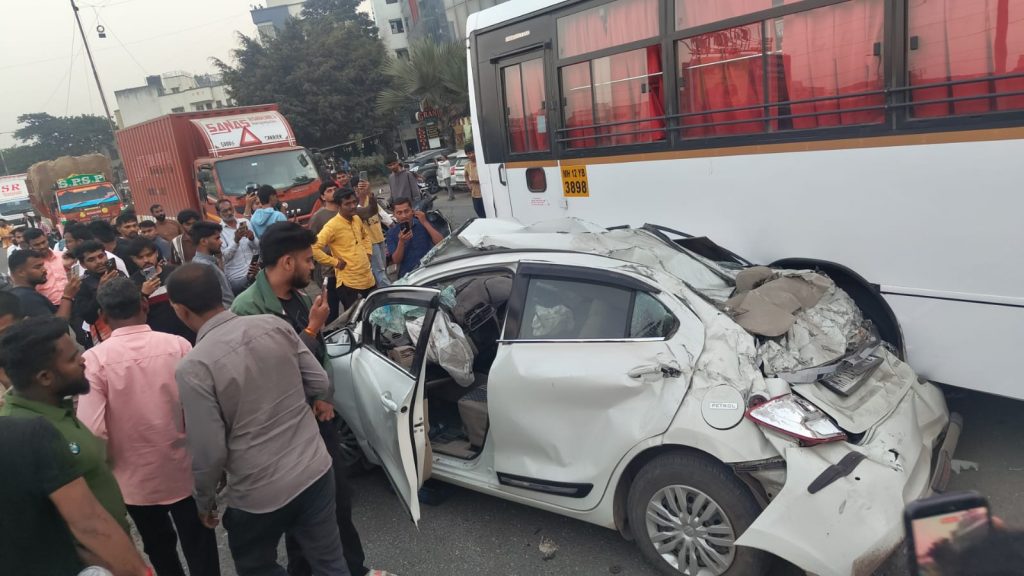
Narhe, 14th November 2025: Nearly a decade after being officially declared a ‘black spot’, the Navale Bridge stretch on the Pune–Bengaluru Highway continues to remain one of the deadliest accident zones in the city. Despite multiple technical upgrades, enforcement drives and awareness campaigns, the corridor still poses a grave threat to commuters, with experts warning that the risks will persist unless a coordinated, long-term strategy is executed.
The stretch has witnessed hundreds of crashes over the past ten years, claiming numerous lives and injuring many more. One of the most horrific incidents occurred on November 22, 2022, when a truck with failed brakes ploughed into over 40 vehicles, leaving several commuters injured and triggering a renewed debate on highway safety.
Steep Slope, Faulty Driving Practices at the Core of the Crisis
The steep downhill gradient from the Katraj tunnel towards Navale Bridge remains the central cause of the recurring accidents. Officials and transport safety experts say that many heavy-vehicle drivers switch off their engines while descending the slope to save fuel — a dangerous practice that often leads to brake failure.
The geometric design of the highway, merging of two-wheelers and autorickshaws onto fast-moving lanes, unrestricted entry from service roads, and rampant overspeeding add to the layered risk, making the corridor one of the most complex accident-prone locations in Pune.
Measures Taken, but Impact Minimal
Over the years, authorities have implemented several measures to reduce fatalities. These include installing speed guns, rumblers, warning signboards, conducting safety-awareness drives and setting up a police outpost just beyond the tunnel. However, residents and road-safety activists say that these steps have brought “little to no relief,” as accident numbers show no significant decline.
“The interventions have been piecemeal. The ground reality remains unchanged,” activists said, pointing to frequent crashes that continue unabated.
Experts Push for Structural Corrections
Traffic experts assert that the core challenge lies in the road’s geometric design, which demands engineering-based solutions.
“What this stretch needs is a dedicated truck speed-killer lane, emergency sand bays and a redesigned access system,” an expert said.
They also emphasised that local traffic should be segregated by restricting service-road entry points to prevent sudden merges that endanger highway motorists.
Civil groups add that unless the National Highways Authority of India (NHAI), Pune Municipal Corporation (PMC), Pune City Police and elected representatives collaborate on an integrated action plan, the black spot might soon escalate into a full-fledged “death zone.”
Behavioural Change Among Drivers Equally Crucial
Experts stress that responsibility does not lie solely with the administration. Many crashes also stem from risky driving behaviour.
They urged motorists — especially heavy-vehicle operators — to follow speed limits, check brakes and tyres regularly, and avoid switching off engines while descending steep gradients.
“Road engineering can reduce risk, but responsible driving is equally important,” they said.
Major Accidents Reported in Recent Years
21 October 2021: Container collides with PMPML bus; two women killed, four injured.
21 November 2022: Speeding trailer truck damages 47 vehicles; several injured.
10 February 2024: Truck crashes into six vehicles; multiple serious injuries.
23 February 2024: Truck driver loses control, hits 7–8 vehicles.
25 January 2025: Car rams into bus; two killed on the spot.
3 May 2025: Three people killed in three separate crashes.