Pune: RTI Exposes Civic Lapses on Mundhwa–Manjari Road: Repairs Only on Paper, Potholes Persist
Reported by Shoaib Tadvi
Mundhwa, 2nd December 2025: The condition of the Mundhwa–Manjari Road has become a stark example of prolonged civic failure in Pune, revealing serious gaps in planning, coordination and accountability within the Pune Municipal Corporation (PMC). Despite being included in the old regional plan and the draft Development Plan, the road remains severely damaged, chaotic and unsafe for daily commuters.
Documents accessed under the Right to Information (RTI) Act show repeated repairs recorded on paper, departmental buck-passing, and an admission from PMC that it lacked basic raw material for essential road restoration at a critical time.
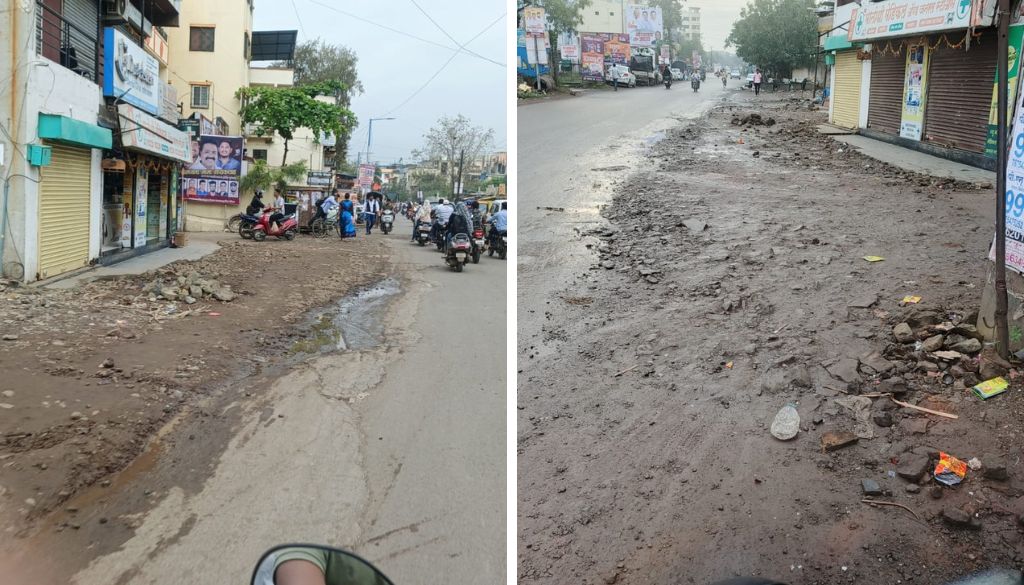
Residents describe the stretch as life-threatening. The worst-affected spot is at Sr. No. 37 in Keshavnagar, near the KRB Workshop, where deep potholes, loose gravel and waterlogging have created hazardous conditions for over two months. Despite repeated complaints through civic portals and direct follow-ups with officials, only temporary patchwork has been carried out — and those repairs fail within days.
RTI records indicate that complaints from the same locations appear repeatedly in internal registers. On many occasions, pothole repairs were shown as “completed” even as fresh complaints emerged at identical coordinates. This raises serious questions over material quality, contractor performance and civic supervision.
In one official reply, PMC acknowledged that urgent repairs were delayed due to unavailability of required construction material. Residents say such an excuse in a rapidly growing metropolitan city points to a systemic administrative breakdown rather than a one-off lapse.
Another key issue flagged in the documents is lack of clarity over responsibility. Encroachments, electric poles, cables, water lines and carriageway repairs fall under different departments, leading to delays with no single authority taking ownership. While PMC’s replies confirm that issues have been “forwarded” to relevant departments, ground action remains negligible.
RTI responses also confirm the road maintenance contract was awarded to contractor Sanjay Anandrao Jamble of Hadapsar through a formal tender, worth over ₹27 lakh for a period of two years (Tender Ref: PMC/ROAD/2025/22). However, the documents provide no evidence of quality checks or penalties despite repeated failures and recurring potholes.
Residents complain that repairs are merely superficial. Asphalt disintegrates after rain, gravel turns to dust within weeks, and potholes reappear deeper than before. Vehicles frequently break down after hitting hidden craters, while pedestrians are forced to walk dangerously close to drains.
Records further show a Detailed Project Report for a proposed grade separator at Mundhwa junction has been submitted, but funds are yet to be allocated and no execution timeline has been announced. The proposal remains confined to files while the road beneath continues to deteriorate.
Dr. Anantpindika, who has been following up through multiple RTI applications, said the crisis is entirely administrative. “This is not a natural disaster. It is a man-made failure. PMC keeps showing repairs on record, but the same potholes remain. The public is being misled through paperwork,” he said.
He added, “No department is willing to take responsibility. How can a major DP road be neglected for months when crores are spent every year on infrastructure?”
Commuters echo the frustration — auto drivers report heavy vehicle damage, cyclists speak of repeated falls, schoolchildren navigate risky stretches daily, and office-goers lose time due to traffic diversions caused by broken patches. Several said their grievances were marked “resolved” online even though the road remained untouched.
Urban experts note that repeated collapse after repairs signals absence of quality audit and weak enforcement of contracts. Administrative silos and logistical lapses have worsened the situation.
Activists warn that repeated negligence leading to danger to life may warrant legal action. Some residents are now considering approaching the courts if the situation does not improve.
The Mundhwa–Manjari Road was meant to serve as a vital arterial link for Pune’s expanding eastern region. Instead, it has become a reminder that development cannot be measured by plans on paper, but by the condition of infrastructure on the ground.
Without immediate full-scale resurfacing, strict supervision and accountability for failures, residents fear the situation will only worsen — deepening distrust in the civic system every time a commuter lands in yet another pothole marked as “repaired”.