The Story of Super El Niño and What It Means for 1.5 Billion People
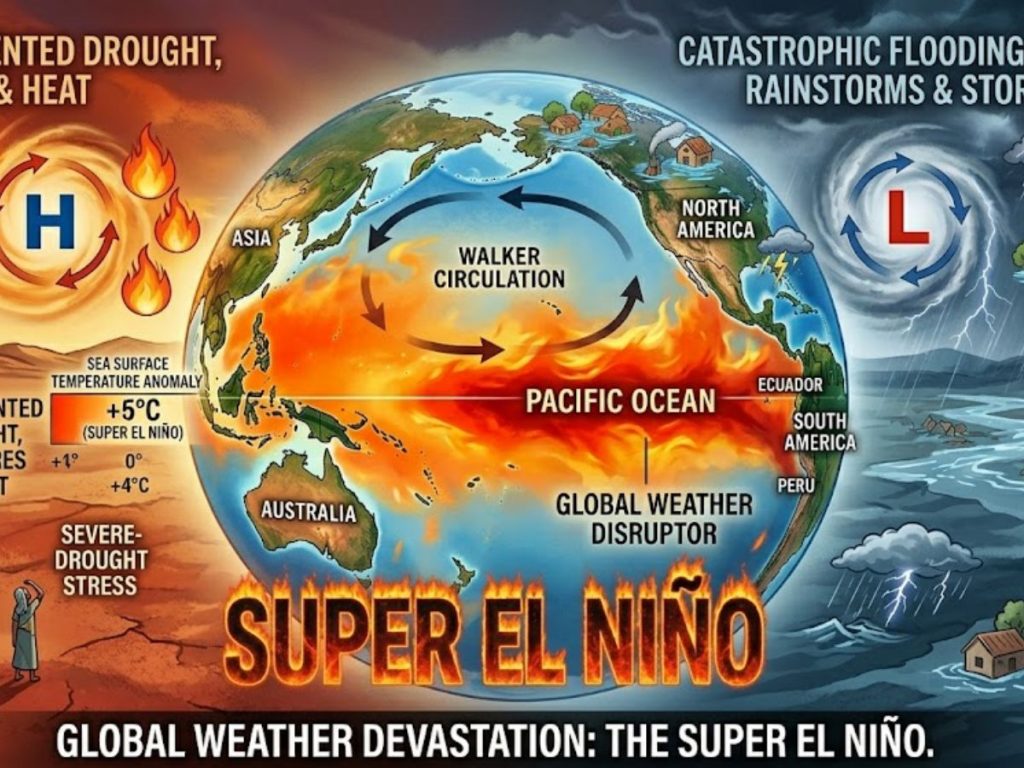
New Delhi, 19th May 2026: There’s an ocean thousands of kilometres away from India’s wheat fields, paddy farms, and bustling cities. Most Indians will never see it. But its temperature a number as abstract as a stock market index quietly decides whether a farmer in Vidarbha sleeps soundly or stares at a cracked, dry field wondering how he’ll repay his loan.
That ocean is the Pacific. And right now, it’s heating up in a way that has climate scientists reaching for words they rarely use: unprecedented, alarming, and increasingly super.
What Exactly Is a Super El Niño?
Every few years, the trade winds that normally push warm Pacific water westward weaken or reverse. Warm water sloshes back toward the coast of South America. Ocean temperatures rise. Weather patterns across the entire planet shuffle like a deck of cards. This is El Niño — Spanish for “The Little Boy,” a name Peruvian fishermen gave it centuries ago when they noticed the ocean warming around Christmas.
A Super El Niño is that same event, but turned up to an extreme. It occurs when sea surface temperatures in the Pacific Ocean rise more than 2°C above the long-term average at least four times more intense than a standard event. When that happens, the consequences aren’t just bigger. They’re categorically different.
The El Niño of 2023–24 was one of the strongest on record only the sixth such event since measurements began in 1950 ; earning it the “super” designation. Now, scientists warn that a rare Super El Niño may be forming again in the Pacific in 2026, potentially one of the strongest climate events in over a century.
The Monsoon — India’s Lifeline, Now at Risk
Ask anyone who grew up in rural India and they’ll tell you: the monsoon isn’t just rain. It’s hope arriving on the wind. It’s the smell of the first drops hitting dry earth that irreplaceable petrichor after months of brutal heat. It’s the moment farmers pick up their ploughs.
The monsoon accounts for about 70% of India’s annual rainfall and is the backbone of agriculture, which contributes roughly 18% to the economy and supports nearly half of India’s 1.5 billion people.
Super El Niño threatens all of that. A strong El Niño typically weakens the southwest monsoon, resulting in below-normal rainfall from June to September. And a super event doesn’t just trim the monsoon it can hollow it out entirely.
What makes it worse is a cruel irony that a 2025 study uncovered: while El Niño reduces overall summer rainfall, it paradoxically increases the frequency and intensity of heavy daily downpours. The little rain that farmers do receive tends to destroy rather than nurture crops. Too little, then too much, then nothing again. It’s a cycle that leaves no room to recover.
A Farmer’s Math Doesn’t Add Up Anymore
Picture Ramesh, a smallholder farmer in Maharashtra. He’s not a character from a textbook he’s representative of millions of real people whose stories rarely make headlines.
He planted his kharif crop in June, betting on the rains. They came but late, and violent, washing away seeds rather than nourishing them. Then they stopped. The soil cracked. Rain-fed irrigation accounts for around 50% of India’s net sown area and about 40% of total food production which means when the sky fails, there’s no backup plan for Ramesh.
It’s not just rice and pulses. In the Konkan region, mango and cashew farmers have reported losses of up to 90%, while across mango belts from Uttar Pradesh to Maharashtra, untimely rain has caused significant damage to exports and farmer incomes.
In the north, apple growers in Kashmir are reporting unusually early budding due to warmer temperatures a threat to the region’s Rs 10,000 crore apple economy while Himachal Pradesh faces potential losses to its Rs 5,000 crore apple sector. (The Wire)
And the pain lingers long after the weather normalises. An RBI paper studying the 2015–16 super El Niño found that rural wages remained subdued even after agricultural growth resumed. The weather moves on. The debt doesn’t.
When the Ground Burns: India’s Heatwave Crisis
Before the monsoon even becomes a question, there’s the summer to survive.
The 2023–24 El Niño contributed directly to what became the hottest year on record for India, with average temperatures 0.65°C above the 1991–2020 baseline. Delhi’s Mungeshpur area recorded an unprecedented 52.9°C.
Think about what 52.9°C actually means. Metal burns to the touch. Roads soften. The elderly and the very young become medically vulnerable within minutes of stepping outside. For the construction worker, the vegetable vendor, the school child walking home there is no air-conditioned escape.
Agricultural workers face the sharpest danger: they are 35 times more likely to die from occupational heat exposure than workers in all other sectors combined. These are the people feeding the country, and they’re working in conditions that are increasingly life-threatening.
The Power Crisis Nobody Talks About
The heat doesn’t just hurt bodies. It strains the entire energy system in ways that create a vicious feedback loop.During the peak heatwave months of April to June 2024, electricity demand ran 10.8% higher than the same period the previous year, with air conditioners alone accounting for nearly a third of the year-on-year increase in May.
At the same time, a weaker monsoon drains the rivers and reservoirs that hydroelectric plants depend on. In the first half of 2024, hydro generation fell 8% year-on-year due to the lingering effects of the 2023–24 El Niño. Coal-fired generation rose 10% to fill the gap, and gas-fired output jumped 50%.
More demand, less clean supply, more coal. Super El Niño doesn’t just threaten crops it pushes India’s clean energy transition backward, one heatwave at a time.
Food on Your Plate Gets More Expensive
El Niño’s effects eventually travel from the farm to the kitchen. Reduced rainfall during the crucial Kharif season lowers yields for rice, pulses, and sugarcane directly feeding food inflation.
A weak monsoon can also prompt the government to restrict farm exports, as it did during the 2023 El Niño, while simultaneously raising imports of edible oils like palm oil and soyoil. The urban shopper notices rising onion prices and shrugs. The farmer who grew those onions is staring at a loss.
A Warning Louder Than Thunder
A study published in Nature Communications in December 2025 found something deeply unsettling: Super El Niño events can trigger Climate Regime Shifts sudden, long-lasting changes in the climate system that affect ecosystems, soil moisture, rainfall, and human livelihoods for years or even decades.
This is the part that should make us pause. We’re not talking about one bad monsoon season. We’re talking about the possibility that the climate as India has always known it the rhythms that shaped its agriculture, its culture, its very calendar could shift permanently.
What Can Be Done?
The situation is serious, but not without agency. Adapting agricultural practices is one of the most direct responses shifting to efficient irrigation, embracing climate-resilient crop varieties, and practising multicropping and agroforestry to maintain soil health.
The Indian Ocean Dipole (IOD), when in a positive phase, can partially offset El Niño’s impact on agricultural output a natural buffer that climate scientists continue to monitor closely.
But technology and policy alone won’t be enough if the warnings aren’t heeded. India needs long-term investment in drought-resistant seeds, better water storage, crop insurance that actually reaches smallholders, and early warning systems that give farmers not just meteorologists , the information they need to act.
The Ocean Is Talking. Are We Listening?
There’s something almost philosophical about the way Super El Niño works. A strip of warm water in a distant ocean quietly rearranges the lives of people who will never see it, never hear about it on the news, and never understand why their crops failed or why the heat this year felt different from any heat before.
The Pacific doesn’t care about India’s agricultural calendar, its food inflation, its power grid, or the farmer sitting in Maharashtra wondering what went wrong. But we do. Or we should.
The science is clear. The risks are real. And the next Super El Niño isn’t a distant hypothetical it may already be forming beneath the surface of the world’s largest ocean, quietly making its way toward India’s sky.
The question isn’t whether Super El Niño will affect India. It already has. The question is whether India, its policymakers, its farmers, its urban consumers will take it seriously enough to prepare for what comes next.