How India Changed in 12 Years: Murlidhar Mohol Highlights Economy, Infrastructure and Welfare Gains
Reported by Mubarak Ansari
Pune, 15th June 2026: Union Minister of State for Civil Aviation and Cooperation, Murlidhar Mohol, on Monday said that the foundation for a “Viksit Bharat” (Developed India) by 2047 has already been firmly laid over the past 12 years under the leadership of Prime Minister Narendra Modi.
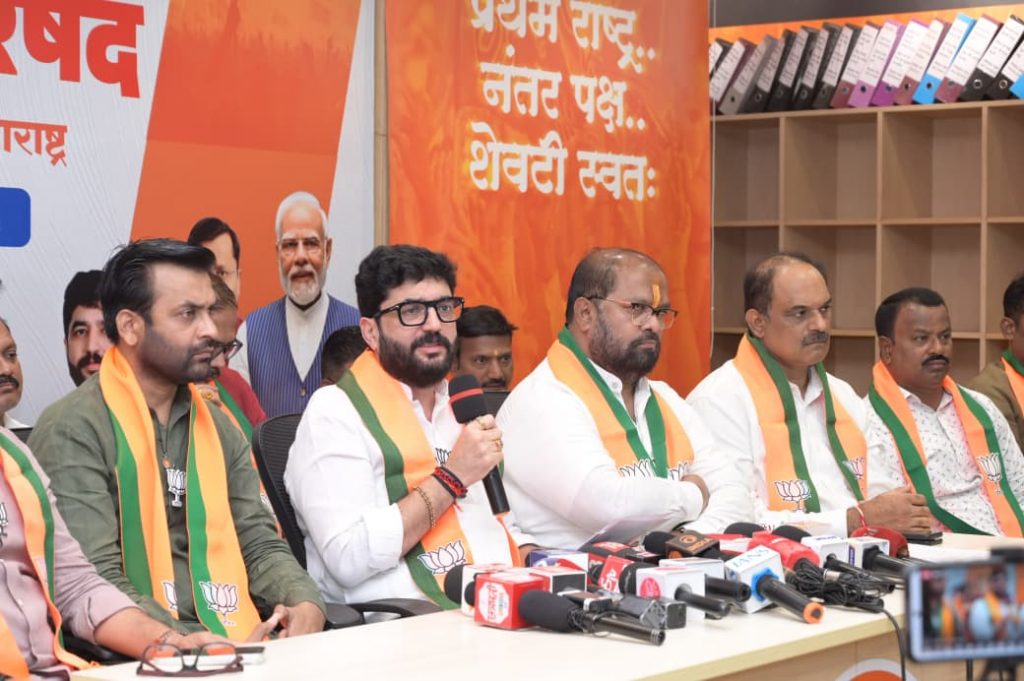
Addressing a press conference organised by the Pune city unit of the Bharatiya Janata Party (BJP) to mark the completion of 12 years of the Modi-led government at the Centre, Mohol said India has significantly strengthened its position on the global stage.
The press conference was held at the BJP’s city office and was attended by Pune BJP president Dheeraj Ghate, Pimpri-Chinchwad BJP president Shatrughna Nana Kate, Pune Rural (North) BJP president Pradeep Kand, Pune Rural (South) BJP president Shekhar Wadhane, and other party office-bearers.
Mohol said that in 2014, the people of India gave a clear mandate to the BJP-led National Democratic Alliance (NDA), placing their trust in its leadership.
“Guided by the vision of ‘Sabka Saath, Sabka Vikas’, Prime Minister Narendra Modi has continued to lead the country for 12 consecutive years. On June 10, 2026, he completed 4,993 days in office, setting a historic record driven by the unwavering support of the people,” Mohol said.
He added that the BJP would continue to engage with citizens by highlighting the government’s development initiatives undertaken over the past 12 years.
Highlighting key achievements of the Modi government, Mohol said India’s economy, which was ranked 11th globally in 2014, has now become the world’s fourth-largest economy.

He claimed that while average inflation during the previous United Progressive Alliance (UPA) government stood at around 10 per cent, the Modi government has maintained it at an average of 5.1 per cent.
On poverty alleviation and welfare schemes, Mohol said nearly 25 per cent of the population has moved above the poverty line. He added that around half of India’s population directly benefits from various government welfare schemes, while 80 per cent of citizens receive free food grains.
Speaking on governance reforms, Mohol said the government has transferred ₹51 lakh crore directly into beneficiaries’ bank accounts through Direct Benefit Transfer (DBT) mechanisms, reducing leakages and curbing corruption.
He also highlighted the expansion of infrastructure across the country, stating that the pace of national highway construction has increased from 11 kilometres per day to 34 kilometres per day. He cited the complete electrification of the railway network, the expansion of Vande Bharat train services, and increased capital expenditure on infrastructure projects.
Mohol said India’s metro network has expanded from 248 kilometres across five cities to 1,093 kilometres spanning 23 cities.
Referring to developments in the aviation sector, he said the number of operational airports in the country has increased from 74 to 165 over the past 12 years. He added that around 1.5 crore passengers have benefited from the UDAN regional connectivity scheme, while the recently launched UDAN Cafes aim to provide affordable food options at airports.
According to Mohol, the upcoming UDAN 2.0 initiative will extend connectivity to 120 additional locations and is expected to benefit nearly four crore passengers.
He further said that under the Pradhan Mantri Jan Dhan Yojana, more than 56 crore bank accounts have been opened, adding that India has emerged as a global leader in digital payments.
Highlighting developments in the defence sector, Mohol said the government has allocated nearly ₹6.75 lakh crore for defence and that India, once a major importer of defence equipment, now exports defence products to more than 90 countries, with exports reaching ₹23,000 crore.
He also pointed to the expansion of premier educational institutions, including the Indian Institutes of Technology (IITs) and Indian Institutes of Management (IIMs), and said the establishment of a separate Ministry of Cooperation has strengthened the rural economy by connecting nearly one-third of the country to the cooperative sector.

Discussing projects aimed at Pune’s development, Mohol said work is underway on 56 kilometres of underground roads to address traffic congestion in the city.
He said the Hinjawadi-Shivajinagar Metro corridor is expected to become operational soon and that residents of Pune and Pimpri-Chinchwad will eventually be able to travel directly to the airport via the metro network.
Mohol added that the new terminal building at Pune Airport has been completed, while runway expansion work is progressing rapidly following the acquisition of 313 acres of land. He also announced that 1,000 new electric buses have been approved for Pune.