‘Losing Sanity’, ‘National Cancer’: Pune Riverfront Approval Triggers Bitter War of Words between PMC Commissioner and Activist
Pune, 7th August 2026: Pune Municipal Corporation (PMC) Commissioner Naval Kishore Ram on Friday announced the approval of the Riverfront Development project for Stretch 6 of the Mula-Mutha River, describing it as an initiative focused on creating sustainable, aesthetically pleasing, flood-resilient, and functional public spaces.
In a post on X, Ram, a 2008-batch IAS officer serving as the PMC Commissioner, wrote: “PMC approves Riverfront Development for Stretch 6 with a focus on sustainable, aesthetically pleasing, flood-free and functional spaces.”
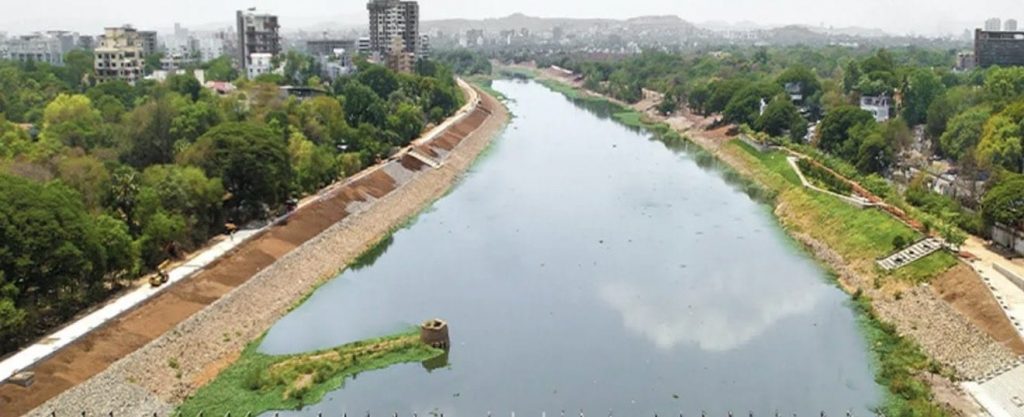
The post was accompanied by a photograph showing ongoing embankment and pathway works along the riverbank, with greenery and urban buildings in the background.
Stretch 6 covers approximately 4.1 km of the Mutha River between Vadgaon Khurd and Rajaram Bridge in the Sinhagad Road area.
Earlier proposals for this stretch, for which PMC had sought around ₹300 crore from the State Disaster Management Fund, included flood-protection embankments, tree plantations, improved drainage and nullah planning, landscaping, and public amenities such as jogging tracks. The proposal gained momentum after repeated flooding in nearby low-lying areas following heavy water releases from the Khadakwasla dam.
The larger Mula-Mutha Riverfront Development project spans around 44 km and aims to reduce flood risk, improve public access through walkways and cycling tracks, and create recreational spaces. Work on several other stretches, including the Sangamwadi-Bund Garden section, has progressed significantly, with some portions partially opened to the public earlier this year. Environmental clearances have been revised following directions from the National Green Tribunal, and the civic body has discussed design modifications for remaining stretches to retain heritage trees and protect natural streams wherever possible.
The announcement, however, triggered sharp criticism on X, particularly after Pune recorded its wettest July in 119 years, leading to widespread waterlogging, flood alerts, and evacuations.
Ameet Singh (@ameetgsingh), an activist, responded to Ram’s post, writing:
“The destruction of Pune continues. He has learned nothing from the floods that Pune experienced in July this year… This IAS bureaucracy is a national cancer.”
Ram replied:
“Bro, you are losing sanity. Be patient.”
Later, Ram addressed him as:
“Yes fraud man, I will think about what you say”
Singh escalated, writing:
“Corrupt, Venal and incompetent bureaucrats such as you are the problem… You preside over budgets running into billions of dollars and spend them all every year on infrastructure which crumbles and falls apart at the first few spells of rain.”
The exchange escalated as Singh argued that excessive concretisation and disregard for Pune’s natural topography had worsened urban flooding. He contended that deepening and widening river channels would be more effective than reinforcing riverbanks through the riverfront project. Singh also shared older photographs and videos of the river and recent flooding, claiming Pune did not experience flooding even after high dam releases during the 1990s.
Ram later responded:
“You can’t be abusive and constructive both. It’s more than an oxymoron. You are just a publicity-hungry narcissist. Since your talent is limited and restricted to old fables of sustainability, you have no chance to grow up. You will be doing the same job for years with no results.”
In another reply, Ram wrote:
“We will make more efforts. Let’s stay hopeful. I try hard with the team of PMC. Most of them are incompetent and corrupt. But I believe that civil society and administration together can achieve the desired results.”
Singh continued posting videos and images of flooding, along with older photographs of the river, criticising the project and the civic administration’s performance on roads, garbage management, and other urban infrastructure issues.
Other users also questioned the prioritisation of the riverfront project over long-pending road infrastructure works.
Anne Anish (
@AnneAnish
) wrote: “You seem to have plenty of time to respond to a ‘fraud’ on Twitter… Instead of engaging in personal exchanges on social media, why not address the real issue the public is asking about: the flooding…”
Dr Rahul Sawant (
@drrahulsawant
), a cardiologist, commented: “Yes, we, people of Pune are losing sanity. Roads full of potholes, traffic congestion… huge corruption under your nose in PMC main building, massive tree felling, RFD obstructing river flow n flooding!”
Rupesh Sarode (
@RupeshSarode03
) noted: “You are day dreaming… specially in India where everyone is corrupt.”
Anand Bellad (@anandbellad), who describes himself as an entrepreneur in engineering design and new product development, commented:
“Another farce. Pouring concrete and demolishing trees seems to be sustainable. I wish someone who loves this city is at the helm of its affairs. What a disaster this city has become.”
Another user, Nik (@InspireeMilions), who lists interests in rationality, technology, infrastructure, and myth-busting, questioned the civic body’s priorities, asking when long-pending projects such as the Balewadi-Wakad Road, Baner-Pashan Link Road, Baner-Mhalunge Road, Keshav Nagar-Kharadi Bridge, and Kondhwa Road would be completed. He also questioned spending on the riverfront project while several key road projects remain unfinished.
Environmental groups and activists have long criticised the Mula-Mutha Riverfront Development project, alleging that it involves excessive concretisation, narrowing of the river channel, tree felling, and potential impacts on riparian ecology and flood dynamics.
PMC officials, however, maintain that the project will strengthen flood protection while creating accessible and functional public spaces.