‘Savarkar Never Hated Muslims,’ Grand-Nephew Satyaki Tells Pune Court in Rahul Gandhi Defamation Case
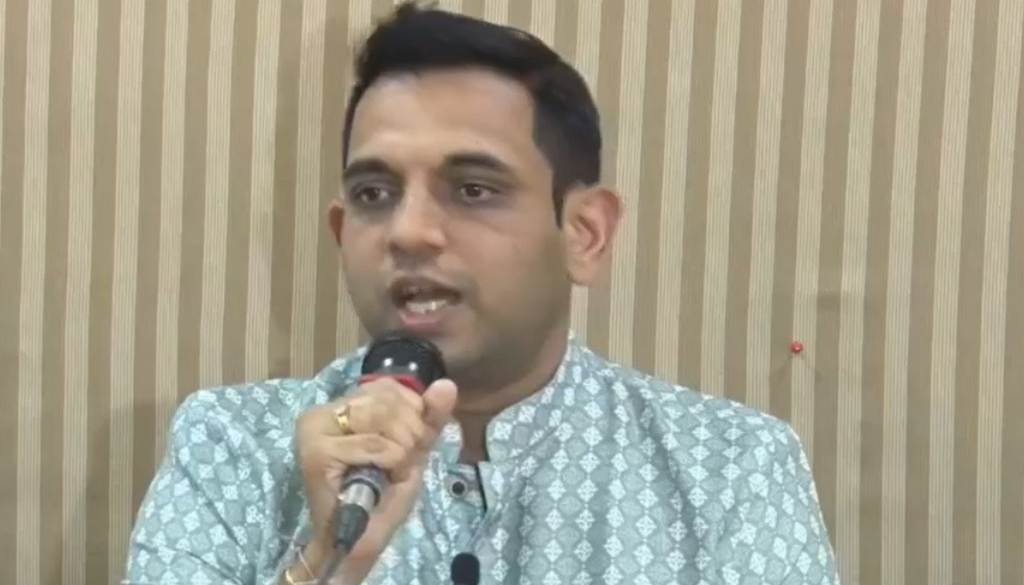
Pune, 1st September 2026: Satyaki Savarkar told a special MP/MLA court in Pune that his personal reputation was distinct from that of Hindutva ideologue Vinayak Damodar Savarkar, adding that the freedom fighter’s reputation in society was “certainly greater” than his own.
Satyaki, Savarkar’s grand-nephew, made the statement during his further cross-examination before Judicial Magistrate First Class Amol Shriram Shinde in the criminal defamation case filed against Congress leader and Lok Sabha Leader of Opposition Rahul Gandhi. The cross-examination was conducted by Gandhi’s lawyer, Advocate Milind D. Pawar.
The case stems from Gandhi’s alleged remarks about Vinayak Savarkar during a speech delivered in London on March 5, 2023. Satyaki, Savarkar’s grandnephew, has alleged that the remarks were false and defamatory.
During the hearing, Satyaki was asked to identify the specific part of Gandhi’s alleged speech that he considered defamatory. He referred to Gandhi’s alleged statement that Savarkar had written about himself and five or six friends beating a Muslim man and feeling happy about it.
Satyaki told the court that the statement portrayed Savarkar as an “extreme hater of Muslims” and a “mob lyncher”.
“Savarkar never hated Muslims. Rather, in his writings, he showed the ways and means for their progress,” Satyaki said during his deposition.
When asked whether there was a distinction between criticising Savarkar’s historical role and committing a criminal offence, Satyaki said criticism supported by evidence could be resolved through discussion.
However, he added that, according to his limited legal understanding, criticism intended to defame someone could amount to a criminal offence.
Satyaki said that, to the best of his knowledge, the British administration had accused Savarkar of waging war against it and of involvement in the murder of Nashik collector A.M.T. Jackson. He also agreed that the assassination of a political and public figure such as Mahatma Gandhi through a conspiracy was a serious and violent act.
The complainant’s lawyer objected to questions concerning Mahatma Gandhi’s assassination, arguing that they were unrelated to the present defamation case. The court said the objection would be decided at the time of the final judgment.
Satyaki further told the court that he could not state the legal definitions of the terms “terrorist” and “extremist”. He also said he could not comment on whether Mahatma Gandhi’s assassination could be described as the first extremist attack in independent India.
During the cross-examination, Satyaki confirmed that his grandfather, Gopal Godse, had written books following Mahatma Gandhi’s assassination, including Gandhi Hatya Ani Mee, which dealt with the assassination trial.
The defence also questioned him about a recorded interview involving Gopal Godse. Satyaki told the court that he had watched and read the three videos and transcripts submitted by the accused.
According to the transcript reproduced in the court record, Gopal Godse said that Nathuram Godse had been an RSS volunteer and criticised attempts to deny that association. The transcript attributed to Gopal Godse also maintained that the RSS had not instructed Nathuram to assassinate Mahatma Gandhi. Earlier proceedings in the case had also examined the Godse brothers’ association with the RSS.
Satyaki also confirmed that he had delivered a lecture on Savarkar’s Hindutva and his efforts towards Hindu unity at Rambhau Mhalgi Prabodhini in Pune on August 21. He said he was active on Facebook, Instagram, X and WhatsApp.
The court record further noted that Satyaki identified his grandfather’s photograph in a photocopy of an interview submitted by the defence, although he said he did not know whether the interview had been conducted by Arvind Rajagopal.
Satyaki said his family had neither been informed nor approached for permission when a statue of Vinayak Savarkar was unveiled in the Andaman Islands on December 12, 2025. He also said he did not know whether the RSS followed Savarkar’s ideology.
The cross-examination could not be completed because of remand-related court work and was adjourned until September 3, 2026.