BOOK REVIEW: TARAMANDAL SANGRAM: THE ULTIMATE HIGH GROUND
By
Maj Gen Jagatbir Singh, VSM (Retd)
New Delhi, 02 September 2026: ‘Taramandal Sangram’ by General Pannu is wonderful book which brings to the fore a domain which is an indispensable pillar of national security, economic prosperity, societal development and strategic influence but has primarily been confined to the scientific community and selected policy makers. As General Pannu states India must not only have satellites in orbit, but also the capability to see, understand and secure the environment around them.
An important part of national security is its orbital aspects. Satellites give you a canvas that reveals the operational picture and space technology gives confidence in decision making by creating a fused picture reducing in the fog of and leading to decision superiority.
The nature of warfare has undergone a profound transformation over the past few decades and militaries today operate in a highly networked environment where information is as critical as firepower. Today the access and ability to utilize space which remains contested has become a factor in determining operational effectiveness in a multi domain environment across land, sea, air, cyber and space. This is where geopolitical competition, technological innovation, economic interests and national security considerations intersect.
General Pannu informs with authority, educates with clarity and explains with vision these interconnected aspects of national power.
Space the Final Frontier
The book is written in four parts which examines ‘The Ultimate High Ground’, how ‘Space Technology is Central to Military Operations’, ‘Space as a Contested Arena’ and recommendations on ‘Moving Ahead of the Curve’. Apart from the main text it is supported by a large number of Appendices which gives a comprehensive background for the serious reader.
The space domain has an enormous impact on the ground and is therefore referred to as ‘the ultimate high ground or the final frontier’ seen as an essential and most significant domain. A vastly different environment from earth it is ‘beautiful but hostile’.
Today military space is the backbone of modern warfare. It enhances strategic depth, multiplies force effectiveness and offers a decisive edge in both unconventional and conventional conflicts. As the author points out ‘nations that fail to integrate space into their military strategy risk strategic obsolescence’. hence understanding space is the first step in mastering it and that is precisely what he sets out to do in the first part.
He also states that the battles of future would be autonomous fought on digital boards, gradually leading to mosaic wars. To enable such wars, it is imperative for nations to have persistent ISR capabilities. While mentioning China he states that it continues to invest more in space programmes and how the BeiDou satellite system has given it independence from US’s GPS constellations for military and commercial activities.
The space triad comprising of positioning, navigation and timing (PNT), satellite communication (SATCOM) and intelligence, surveillance and reconnaissance (ISR) forms the backbone of modern deep and precision warfare. ‘In an era where milliseconds matter and accuracy define victory the integration of these three pillars allow armed forces to sense, communicate and strike with unprecedented speed and accuracy.’ He further writes that ‘communication technology and algorithms must ensure compatibility with various emitters, receivers and transmitters. The real strength of the triad which is the ‘heart of military space capability’ lies in its synergy and it cannot function optimally without the integrative layer of geospatial intelligence.
The author states that in the modern era ‘precision and depth have emerged as the decisive factors in achieving operational superiority’ and that’ strategic technologies have had a revolutionary impact on the modern battlefield’.
The evolution of space as a strategic military domain has led to reimagining of deterrence and defence doctrines. Today when technology drives both ’threat and response’ the capability to operate and defend from space becomes ‘not just a force multiplier but a necessity to prevent conflict and assure dominance’.
He writes that India’s space policy ‘must emphasize space domain awareness as the first step in defence’. Tracking not just debris but manoeuvring satellites, proximity operations and potential threats from adversarial satellites is critical to preemptive action and survivability’.
As space becomes central to modern military operations the ability to protect, deny or degrade space-based assets is increasingly critical. Counter -space and anti-satellite capabilities represent this strategic shift. General Pannu also writes that space ‘launch on demand’ is emerging as a critical capability in modern space strategy, where ‘the ability to place payloads into orbit rapidly, responsively and when needed can shape the tempo of both conflict and national response’. Given the current geopolitical turbulence’ India needs to understand the value of this capability and view it as a ‘strategic necessity’.
He writes that India must account for an expanded battlespace that includes space, cyber and the electromagnetic domains while planning for potential multidimensional conflict scenarios. China’s commercial space exports to Pakistan masquerading as civilian would ultimately also serve their military functions. The Sino-Pak space collaboration marks the convergence of asymmetric warfare strategies and technological enablers that seek ‘to offset India’s conventional superiority’. India stands at a critical juncture in space militarization. Its success depends on foresight, strategic planning and coordinated action.
The integration of space assets of PNT, ISR and communication into one military space domain is no longer optional it is essential. Further, its aspirations to become a leading space power must be backed by strong command and control architecture- military grade, cyber resilient and fully indigenized. A space force is not merely a symbol of modernity but a strategic necessity.
Space today is a rapidly contested global common and while India does not want to weaponize space or create harmful debris, like other space nations it is concerned about securing its space assets. While India’s space capability has matured from a developmental platform to a full spectrum strategic asset, the future necessitates building a secure, sovereign and commercially viable space asset. But its expenditure on space is six times lower than China and thirty times lower than the US. It is therefore ’essential for India to open up the space sector to private players for space-based applications.
Mosaic Warfare is an emerging warfighting doctrine that involves rapid, flexible and composable force structures, enabled on GIS platforms by real time data fusion, AI, ISR and high-speed decision cycles. Transformative Mosaic Warfare shifts traditional linear kill chains into a dynamic and integrated ‘kill web’ approach.
Space warfare even though an extension of terrestrial ware is inherently more political. Though we are not yet in the midst of full-scale space wars, it is increasingly clear that space has become a central domain in terrestrial conflicts.
As nations invest more in space, they also develop the capacity to disrupt, deny, degrade and destroy their adversaries space systems. He states that the future of space wars will be shaped by the convergence of cutting-edge technologies, rising geo political rivalries and the increasing militarization of space assets.
Space is no longer a benign domain but a contested, congested and competitive war fighting environment. Ultimately the contest for space superiority and command will depend equally on the ability to maintain access to the celestial lines of communication, preserve critical space infrastructure and ensure the uninterrupted flow of information, logistics and power through the extent of the space domain. India’s approach must integrate these elements to ensure space dominance in future multi domain conflicts.
Space is the glue enabling persistent surveillance, rapid data sharing and precise engagement. The future battlefield will be dominated by network centric warfare, requiring real time data sharing and space-based assets to provide Commanders with situational awareness and decision-making advantage.
General Pannu writes that space warfare is not a contest of satellites alone. It is a ‘contest of decision cycles, resilience, information superiority and network effectiveness.’
But there are questions that need to be asked and choices made as space becomes increasingly central to economic prosperity, national security and technological advancement. How can space remain a global common while also serving competing national interests? Can international cooperation survive growing geopolitical tensions? What will be the consequences for nations that fail to develop resilient and self-reliant space capabilities?
Conclusion
The history of warfare has often been shaped by those who recognize emerging domains before they become battlefields. General Pannu understood the importance of the space domain at an early age in service following his experiences while leading his Company in the deserts to a patrol in the high Himalayas. Many years later backed by his operational experiences he was instrumental in setting up the Defence Space Agency and Defence Cyber Agency as well as organizing wargames on space.
Historically space was used for force enhancement; satellites provided communication, reconnaissance, navigation and early warning. Today the shift is towards force application. Space assets are no longer just the “eye in the sky”, but instruments shaping and driving warfare in their own right.
The book examines various nuances of space as a strategic domain that influences national development and needs to be read by all those who are connected with and are interested in India’s national security to include policy makers, practioners, scientists, industry leaders, scholars and students.
He rightly recommends that we stop viewing space as an elite scientific domain and start embracing it as a strategic industrial domain and create a military industrial space complex.
Global space militarization is a reality shaping 21st century geopolitics and warfare. In the modern era the increasing role of space has become a pivotal factor in both strategic planning and execution of military operations.
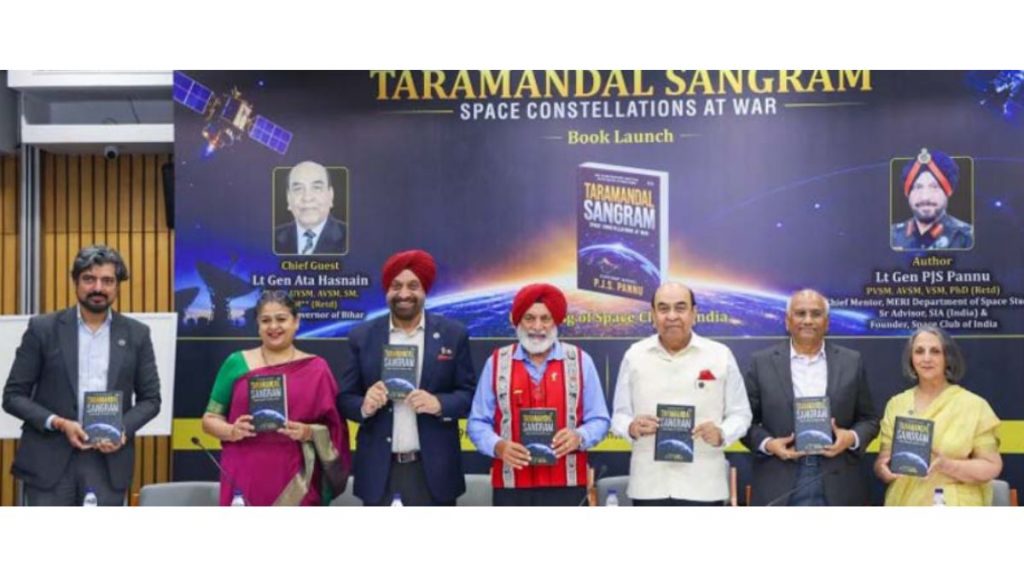
For India space is no longer an optional domain but a vital strategic frontier. As General Hasnain stated in the Book Launch; “it is more than a book on space” but a book on the “changing nature of national power”.