
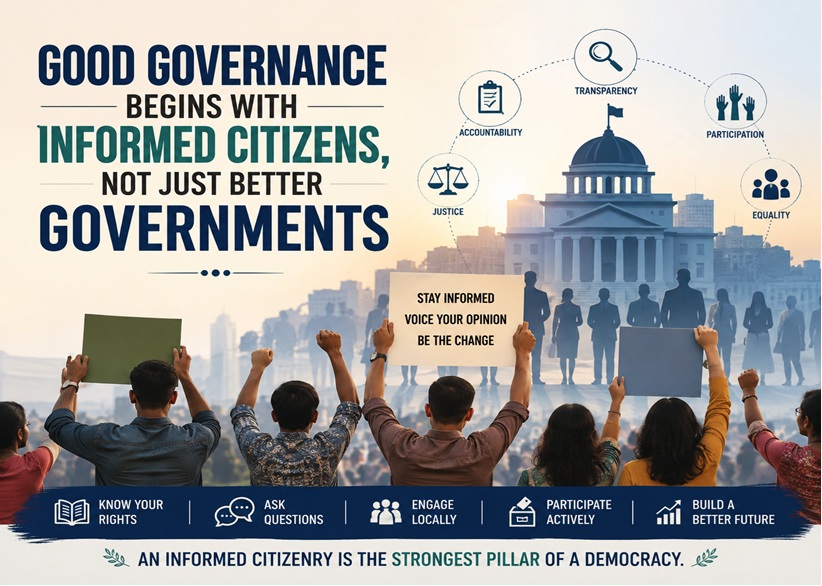
Good Governance Begins With Informed Citizens, Not Just Better Governments
By Ashok Thombre
New Delhi, 22nd August 2026: Governance is usually evaluated in terms of good public policies, efficient administration and economic development. Governments are expected to provide infrastructure, welfare programmes, strengthen institutions and better public services. The responsibilities outlined above are necessary, but another is often ignored: informed and engaged citizens. If the process of governance in a democracy is unidirectional, and governments do something and citizens are only recipients, then it’s not going to work. The first step in good governance is to know one’s rights, responsibilities, and the systems in place to help people.
India has come a long way in the last 20 years in the field of Public Welfare. Educational, healthcare, financial inclusion, digital governance, sanitation and rural development efforts have benefited millions of lives. Digital platforms have made access to government services easy and programmes for women, children, farmers and the economically weaker sections have expanded the scope of welfare. However, even with these developments, there is still a huge disconnect between policy making and policy awareness.
In several national surveys and governance studies, it has been revealed that a large number of eligible beneficiaries are not aware of the various government schemes available to them. Citizens are not always aware of and able to take advantage of many of these, be it educational scholarships, livelihood programmes, social security, health insurance or skill development opportunities. This is especially true in economically disadvantaged, rural and tribal areas, where information is not always as efficient as policy.
From my experience in public policy, education and grassroots social development over the years, one of the most significant issues isn’t schemes that are not in place, it’s policy literacy that isn’t present. In rural workshops, I have met many times citizens who are entitled to several welfare programmes but never applied because they did not know about them, or they did not know how to apply.
With India’s digital transformation, new opportunities have emerged in this direction. The government estimates that digital public infrastructure has helped to increase the reach of government services through online platforms, mobile apps and direct benefit transfer platforms. The innovations have enhanced transparency and administrative delays. Digital governance is not sufficient to ensure inclusive governance, however. Digital access requires digital literacy, particularly in rural areas where there are significant disparities in access to the Internet, access to devices, and awareness of technology.
Civics instruction should do more than simply present facts about civics and government and provide students with information about the organization and operation of a local government agency, or how public services are provided, but also inspire students to understand the ways they can engage in public life in a responsible way.
This is particularly important for first generation learners and communities that are marginalised. They are often first introduced to governance systems through education. Educating young people on public policy at a young age helps them to be active citizens, responsible citizens, and future leaders.
Another key element in good governance is community involvement. There should be a strong presence of roles and functions of local institutions like panchayats, self-help groups, educational institutions, civil society organisations and community leaders in bridging between the government and citizens. The awareness about health programmes, education, sanitation, women welfare programmes has improved significantly in many villages with high participation rates.
I have witnessed the benefits of community engagement in policy outcomes when working on child marriage prevention, access to education, and awareness campaigns in the rural areas of Rajasthan, Madhya Pradesh, and Bihar. The involvement of teachers, local administrators, women associations and village leaders resulted in enhanced awareness, increased school enrolment and increased community action to address social issues.
Public participation should not be restricted to every few years, it should be an ongoing process, with strengthening of governance through continuous dialogue between the institutions and the society.
Civic involvement has been associated with robust institutional trust and good quality public service across the world. Citizen engagement has been consistently recognised by the Organisation for Economic Co-operation and Development (OECD) as a key factor for better policy making, increased transparency and increased public trust in government institutions. These lessons are applicable to India as it moves towards inclusive and participatory governance as well.
The future of governance will not only rely on technological innovation and administrative reforms but also on the effectiveness of investing in civic awareness in societies. Building robust democracies is a task that governments can only do part of. The education sector, media, civil society and community organisations should collaborate to develop aware citizens with knowledge of their rights and responsibilities.
Informed citizens depend on a healthy flow of verified information. Today, much of that flow starts with how institutions, public bodies, and organisations communicate through the press. Structured channels such as press release distribution help ensure announcements reach hundreds of media outlets quickly, so facts get to the public before rumours do.
Finally, good governance must be created by good informed citizens and not just good governments. Policies are only meaningful when they are understood, trusted and actively implemented by individuals. Building the policy literacy and civic awareness of the people of India should be a national agenda as the country strives to become more inclusive and developed. When governance is not given to citizens, but given by citizens, a democracy is functioning at its best.
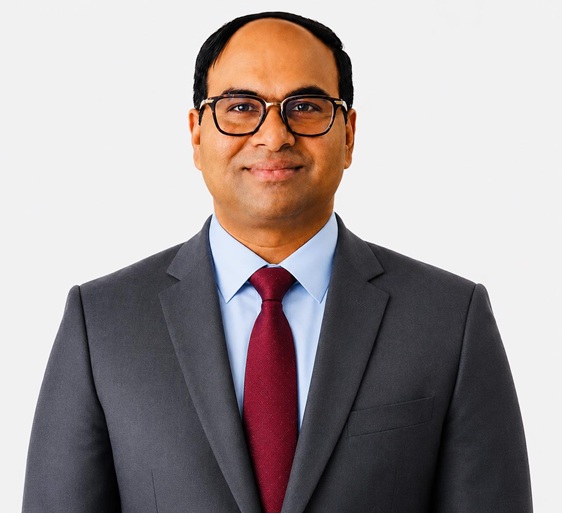
(This article is authored by Ashok Thombre, International Business Advisor, The Quantico)