‘Fool’s Gold’ Rusting in Northwestern Himalayas Releases CO2, Study Finds
Pune, 4th September 2026: The oxidation of pyrite, commonly known as “fool’s gold”, in the northwestern Himalayas could be releasing carbon dioxide (CO2) into the atmosphere and turning some rapidly eroding, glacier-fed landscapes into a net source of carbon rather than a sink, according to a new study.
The study, based on water chemistry and sulfur and oxygen isotope analyses from the upper Indus basin, examined how geological processes in the region influence the long-term carbon cycle.
Atmospheric CO2 plays a critical role in regulating Earth’s climate by helping maintain temperatures suitable for liquid water. Over geological timescales, CO2 is continuously added to the atmosphere through processes such as volcanic activity and removed through chemical weathering of rocks.
When atmospheric CO2 dissolves in water, it forms weak carbonic acid, which reacts with silicate rocks such as granite and basalt. The resulting chemical products can ultimately transfer and store carbon as oceanic carbonates. Silicate weathering is therefore considered an important long-term mechanism for removing CO2 from the atmosphere.
However, researchers found that this process works differently in parts of the northwestern Himalayas, particularly in the upper Indus basin.
Pyrite Oxidation Reverses the Carbon Sink Effect
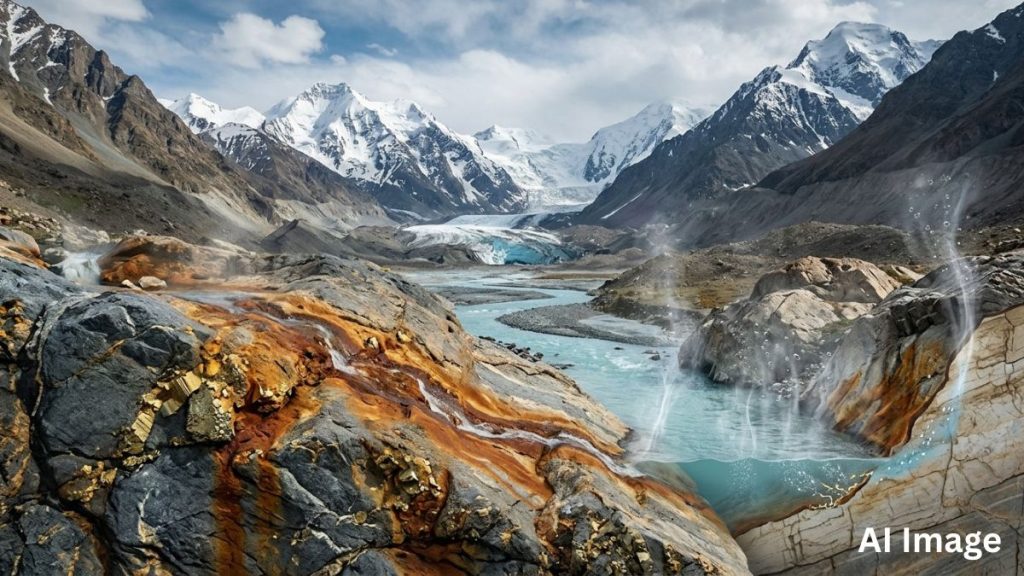
According to the study, weathering in the upper Indus basin is influenced not only by silicate rocks but also by the oxidation of pyrite, an iron sulfide mineral often referred to as “fool’s gold” because of its metallic appearance.
When pyrite is exposed to oxygen and water, it undergoes oxidation and generates sulfuric acid. This stronger acid can react with carbonate rocks, releasing CO2 into the atmosphere.
Using water chemistry and dual sulfur and oxygen isotope data, the researchers quantified the contribution of pyrite oxidation to CO2 release in the upper Indus catchment.
The study found that in the glaciated regions of the upper Indus basin, CO2 released through pyrite oxidation exceeds the amount of CO2 consumed through silicate weathering.
As a result, these rapidly eroding, glacier-fed landscapes can function as a net geological source of CO2, rather than a carbon sink.
Implications for the Long-Term Carbon Cycle
The findings highlight the complex relationship between rock weathering and climate regulation in high-altitude regions. While silicate weathering can remove CO2 from the atmosphere, the oxidation of sulfur-bearing minerals such as pyrite can counteract that effect by generating sulfuric acid and promoting CO2 release from carbonate rocks.
The researchers said glacier-fed river catchments could therefore represent an important geological source of CO2. Although these processes operate over geological timescales, their contribution could influence the global carbon cycle and climate over millions of years.
The study, titled “Dual-isotopic (δ34S and δ18O) evidence for net CO2 release from the northwestern Himalayan catchments,” was authored by Rakesh Kumar Rout, Gyana Ranjan Tripathy, Satyabrata Das, Achyuth Venugopal, Nitish Kumar, Santosh Kumar Rai and Abhayanand Singh Maurya.
It has been published in Chemical Geology in 2026.
Reference:
Rakesh Kumar Rout, Gyana Ranjan Tripathy, Satyabrata Das, Achyuth Venugopal, Nitish Kumar, Santosh Kumar Rai, Abhayanand Singh Maurya (2026) Dual-isotopic (δ34S and δ18O) evidence for net CO2 release from the northwestern Himalayan catchments, Chemical Geology, 123609, https://doi.org/10.1016/j.chemgeo.2026.123609.
Weblink: https://www.sciencedirect.com/science/article/pii/S0009254126003785?via%3Dihub