
New Redevelopment Order to Bring Greater Transparency and Clarity to Housing Societies: Suhas Patwardhan
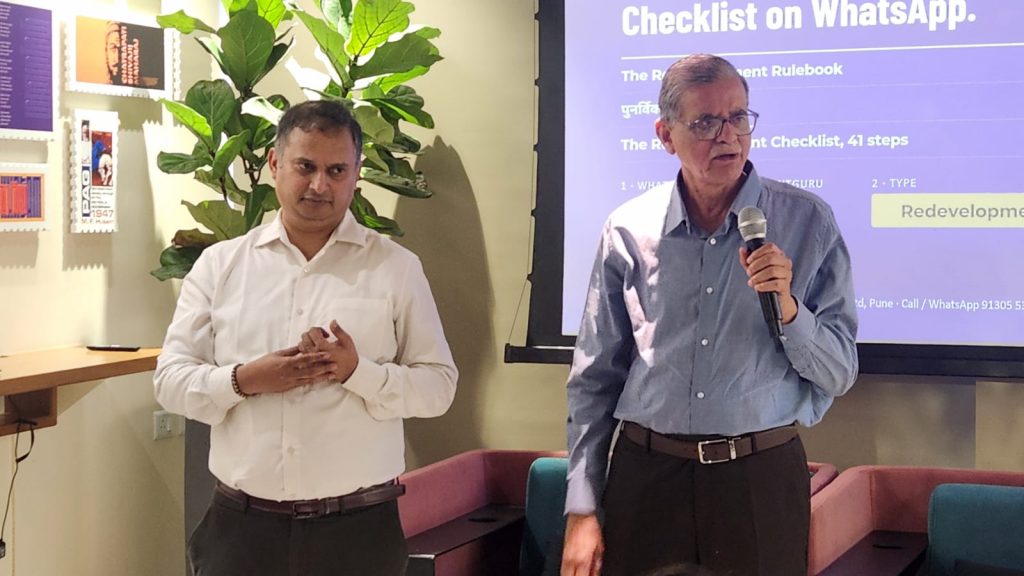
Pune, 14th October 2026: The Maharashtra government’s new order on the redevelopment of co-operative housing societies, issued on September 30, 2026, will bring greater transparency, clarity and procedural discipline to the redevelopment process, while balancing the interests of housing societies and developers, said Suhas Patwardhan, President of the Maharashtra State Co-operative Housing Societies Federation. He was speaking at a free seminar on Maharashtra’s new housing redevelopment order, organized by Dreams Redeveloped, a Pune-based redevelopment advisory and data platform recently at CC&Co, Gokhale Business Bay, Kothrud. The seminar was conducted by CA S Lakshminarayanan, Founder of Dreams Redeveloped, who explained the key changes and their implications for housing societies. Members of various societies, lawyers, architects and developers attended the seminar.
Patwardhan said that the revised provisions would help resolve ambiguities in the redevelopment process. Clearer tender procedures, newspaper advertisements and defined timelines for various stages would enable society office-bearers and members to make informed decisions and conduct the process more transparently.
The new provisions also clarify procedures relating to meetings, including Special General Meetings, helping reduce confusion among housing societies. Patwardhan emphasized that committee members must understand their existing legal responsibilities and comply with applicable provisions. The Federation, he added, conducts training programs to familiarize society office-bearers with legal compliance, administrative procedures and their responsibilities during redevelopment.
During the seminar, Lakshminarayanan presented The Redevelopment Rulebook, a detailed, provision-by-provision comparison of the new order with the government resolution issued on July 4, 2019.
The comparison examined 84 provisions and found that 38 remained unchanged, 24 had been modified, 17 were entirely new, while five provisions from the 2019 resolution were not restated in the new order.
“The Order does not lower the consent threshold. It raises the standard of proof around it,” said Lakshminarayanan, highlighting the importance of documentation and compliance. The requirement for approval from at least 51 per cent of the total membership and the two-thirds quorum for Special General Meetings remain unchanged.
Among the significant changes are an expanded sequence of meetings, taking the number of Special General Meetings before developer appointment from two to four; mandatory newspaper advertisements in Marathi and English for inviting tenders; and the opening of tenders at a Special General Meeting. The project report must now compare applicable DCPR and UDCPR schemes, enabling societies to evaluate redevelopment options more systematically.
The order also introduces structured procedures for developer selection, including the presence of a Registrar’s representative, identity verification and the provision for a secret ballot when requested by the requisite number of members. It further specifies accountability for office-bearers and committee members who violate the order or engage in misconduct affecting members’ interests.
However, certain issues remain open to interpretation, including the treatment of redevelopment projects already underway and the absence of specified timelines for some procedural stages. Societies have been advised to seek legal guidance on such matters before proceeding, Lakshminarayanan concluded.